s://readmedium.com/393e77c0389">
<div>
<div>
<h2>Steal my personal website</h2>
<div><h3>Because you need one and because I made it really easy</h3></div>
<div><p>medium.com</p></div>
</div>
<div>
<div style="background-image: url(https://miro.readmedium.com/v2/resize:fit:320/1*EsSaW2kgH22aH-k-Ol08WA.jpeg)"></div>
</div>
</div>
</a>
</div><p id="f65d">The importance of a personal brand…</p><div id="6af6" class="link-block">
<a href="https://readmedium.com/d740a5376064">
<div>
<div>
<h2>Lead with yourself, not your product</h2>
<div><h3>You are the most important product you can build</h3></div>
<div><p>medium.com</p></div>
</div>
<div>
<div style="background-image: url(https://miro.readmedium.com/v2/resize:fit:320/1*yv92ReOeDRuRG4gKrVnIDg.jpeg)"></div>
</div>
</div>
</a>
</div><p id="40ce">And my philosophy on building great products (with <a href="http://somebody.io">Somebody.io</a> as the case study).</p><div id="2221" class="link-block">
<a href="https://readmedium.com/ae06fe00cb5f">
<div>
<div>
<h2>The Paradox of Constraints</h2>
<div><h3>How to build products that users actually use</h3></div>
<div><p>medium.com</p></div>
</div>
<div>
<div style="background-image: url(https://miro.readmedium.com/v2/resize:fit:320/1*xwS4p_TXHuQMQABrs5hAFg.jpeg)"></div>
</div>
</div>
</a>
</div><p id="5a39">I then joined a number of Facebook groups around topics like Product Management, Design, Software Development, Hackathons, Startups, Entrepreneurship, etc. (mainly targeting groups with at least 3,000 members), where I then posted my content.</p><p id="518b">By prefacing the piece of content with the appropriate context for the group, I was able to avoid “straight-up spamming”, and instead, actually drive meaningful engagement and conversation.</p><p id="ac30">Here’s a post to a group of “fellow product builders”:</p><figure id="c41c"><img src="https://cdn-images-1.readmedium.com/v2/resize:fit:800/1*5AKiD-_07ZhulmmKjQFPhQ.png"><figcaption></figcaption></figure><p id="9527">And here’s a post to a group of product designers:</p><figure id="d63b"><img src="https://cdn-images-1.readmedium.com/v2/resize:fit:800/1*FtCBKRX3NtTTw77TIunmUA.png"><figcaption></figcaption></figure><p id="6020">With every post, I was also diligent about liking all comments (in order to maintain engagement) and responding to all questions or feedback (in order to drive the conversation forward).</p><p id="6a7b">Every post probably generated tens of new users, but scaled across dozens of Facebook groups, the number of new users starts to add up. And also, these users are typically “better users” because they have much more context around the product — After all, they’ve read relevant content, engaged in discussion, and gotten their questions directly answered.</p><p id="032f">The combination of Medium posts with Facebook distribution has certainly yielded some awesome results.</p><h2 id="75ce">Product Hunt comments</h2><p id="6863">I knew that launching on Product Hunt would help recruit new users. I also knew that the #1 product every day gets a disproportionate amount of attention.</p><p id="f2ed">As a result, on the morning that <a href="http://somebody.io">Somebody.io</a> was going to be featured, I woke up at 3am PST to start replying to Product Hunt comments. This helped build Somebody’s momentum, ultimately propelling it to the number one spot at around 5:30am PST.</p><p id="f328">Once at the top spot, I continued to answer questions and individually engage with each commenter:</p><figure id="dfdf"><img src="https://cdn-images-1.readmedium.com/v2/resize:fit:800/1*Tv8NphPfCQt_twY9pIaEeg.png"><figcaption>The top comment on<a href="https://www.producthunt.com/tech/somebody-io"> Product Hunt</a></figcaption></figure><p id="df65">By responding to all comments, I encouraged more comments, which created more responses, encouraging more comments, and so on.</p><figure id="9584"><img src="https://cdn-images-1.readmedium.com/v2/resize:fit:800/1*Ztz0n8j0vqdyXHq7ssgzvA.png"><figcaption>3–4x more comments than the next most popular products</figcaption></figure><p id="acf2">As a result, we got to hear a lot of amazing feedback:</p><figure id="1e36"><img src="https://cdn-images-1.readmedium.com/v2/resize:fit:800/1*KY_cZAKiNWGn4r6pasWNYg.png"><figcaption></figcaption></figure><figure id="63e2"><img src="https://cdn-images-1.readmedium.com/v2/resize:fit:800/1*dYwxrtCd5qTtB6XcnUQCqQ.png"><figcaption></figcaption></figure><figure id="6476"><img src="https://cdn-images-1.readmedium.com/v2/resize:fit:800/1*zh6yQclvFe8gOMfzggJ--A.png"><figcaption></figcaption></figure><figure id="0e9a"><img src="https://cdn-images-1.readmedium.com/v2/resize:fit:800/1*U6CUJAUmp4Hkv9y1zRKZVA.png"><figcaption></figcaption></figure><p id="b6cc">Certainly, Product Hunt helped drive broader awareness, but it was all built on top of the individual attention I gave to each commenter.</p><p id="b97a"><i>By the way, if you want to get featured on Product Hunt, you’re going to have to hustle for that too.</i></p><figure id="cc32"><img src="https://cdn-images-1.readmedium.com/v2/resize:fit:800/1*_JC-RFeuUXhOKmI2dOiDdA.png"><figcaption>Twitter exchange with <a href="undefined">Ryan Hoover</a>, founder of Product Hunt</figcaption></figure><p id="de29">Many founders find it hard to only concentrate on one user at a time. The numbers just feel so small, and the time investment doesn’t seem worth it.</p><p id="be26">But Paul Graham is able to nicely put this brute force effort in context. It’s all about compound growth:</p><blockquote id="f0c0"><p>“If you have 100 users, you need to get 10 more next week to grow 10% a week. And while 110 may not seem much better than 100, if you keep growing at 10% a week you’ll be surprised how big the numbers get. After a year you’ll have 14,000 users, and after 2 years you’ll have 2 million.” — Paul Graham</p></blockquote><h1 id="ea23">Making every user’s experience incredible</h1><blockquote id="fdc6"><p>“You should take extraordinary measures not just to acquire users, but also to make them happy. Your first users should feel that signing up with you was one of the best choices they ever made. And you in turn should be racking your brains to think of new ways to delight them.” — Paul Graham</p></blockquote><h2 id="20aa">Concierge product help</h2><p id="04da">After getting a big wave of new users from the Product Hunt launch, I spent 15 hours the following two days individually visiting every user’s Somebody site. I then reached out to them one-by-one via email, let them know what I liked about their site, asked for brutally honest feedback on the product, and gave them tips on how to use the product more effectively.</p><p id="42b8">For some users, I even sent them Photoshopped versions of their photos if I thought it could help them improve their site.</p><p id="4901">For example, here’s an email I received from <a href="http://jasontowns.somebody.io/">Jason Towns</a>, who was struggling to properly position his headshot:</p><figure id="1243"><img src="https://cdn-images-1.readmedium.com/v2/resize:fit:800/1*VrxH5AYkuYXvGquh4VXl7g.png"><figcaption></figcaption></figure><p id="eaf4">I took a look at Jason’s page, and agreeably his headshot wasn’t quite right.</p><figure id="a21c"><img src="https://cdn-images-1.readmedium.com/v2/resize
Options
:fit:800/1*92MdtyhGAC8L3s2k_huNcA.png"><figcaption></figcaption></figure><p id="e9e1"><a href="http://somebody.io">Somebody.io</a> centers the main “Hero Image” on the page both vertically and horizontally — so, usually the best way to fix a problem like Jason’s is to crop the photo so that the subject is centered. Unfortunately, this wasn’t going to work for Jason’s photo: In the original photo Jason uploaded, his head is partially cut off, making it very challenging to effectively crop it.</p><figure id="62c9"><img src="https://cdn-images-1.readmedium.com/v2/resize:fit:800/1*LhHUd4Dnjad58ZRg7GUG_Q.png"><figcaption>Jason’s original photo.</figcaption></figure><p id="1d2f">There were two options to help Jason: 1) Recommend that he uses a different photo (that shows his entire head), or 2) Extrapolate the photo via Photoshop.</p><p id="23db">I picked option 2.</p><p id="e816">I spent 15 minutes editing Jason’s photo and then sent it back to him.</p><figure id="9035"><img src="https://cdn-images-1.readmedium.com/v2/resize:fit:800/1*RRipjSyw-Bd0BjqHzG-ajQ.png"><figcaption>Jason’s new Photoshopped photo.</figcaption></figure><p id="0a75">Jason loved it and immediately uploaded the new photo. His site was starting to come together:</p><figure id="934e"><img src="https://cdn-images-1.readmedium.com/v2/resize:fit:800/1*aKsIKVWWAe2ZUGkYUrk1hw.png"><figcaption>Jason’s new photo after cropping it on the left side.</figcaption></figure><h2 id="1386">Curating Domain Names</h2><p id="8d4c">Many users had finished their site by the time I checked them out. For these users, I wanted to help them find an awesome personal domain name to complement their awesome personal site.</p><p id="1e3b">So, for each user, I curated a list of my favorite available domain names that they might like, and shared the list via email.</p><figure id="53bf"><img src="https://cdn-images-1.readmedium.com/v2/resize:fit:800/1*ZUIQ1VcpD_vCi8lRQTMCKg.png"><figcaption></figcaption></figure><p id="84ad">In many cases, users immediately upgraded to one of the curated options, not previously realizing that they could use a custom domain with <a href="http://somebody.io">Somebody.io</a>.</p><figure id="1503"><img src="https://cdn-images-1.readmedium.com/v2/resize:fit:800/1*PGzUdFfKyCL-tY-xD6jmEA.png"><figcaption></figcaption></figure><p id="c76b">In other cases, like Spencer’s, the user didn’t actually need help with domain curation, but appreciated the extra effort:</p><figure id="9850"><img src="https://cdn-images-1.readmedium.com/v2/resize:fit:800/1*NitC31m0mHE40llhjYnUFw.png"><figcaption></figcaption></figure><p id="925a">Even in the cases when users wanted to delete their Somebody account, I made sure that they still had an awesome experience working with us.</p><p id="8b27">In fact, I try to act on these requests in under 5 minutes. The reason: Currently, the product doesn’t let user’s delete their site (this is a product deficiency). But this doesn’t mean that the user’s experience itself needs to suffer.</p><figure id="3d68"><img src="https://cdn-images-1.readmedium.com/v2/resize:fit:800/1*3fNku1rwVtURoClMn9dfQQ.png"><figcaption>Responded in less than a minute.</figcaption></figure><p id="10b2">Paul Graham says it best:</p><blockquote id="9eaf"><p>“It’s not the product that should be insanely great, but the experience of being your user.” — Paul Graham</p></blockquote><h1 id="b1b2">Launch faster by “being” the product</h1><blockquote id="7e10"><p>“There’s a more extreme variant where you don’t just use your software, but are your software. When you only have a small number of users, you can sometimes get away with doing by hand things that you plan to automate later. This lets you launch faster, and when you do finally automate yourself out of the loop, you’ll know exactly what to build because you’ll have muscle memory from doing it yourself.” — Paul Graham</p></blockquote><h2 id="c465">Manually connecting every custom domain</h2><p id="63d7">In order to fund the hosting costs of the free Somebody sites, we offer a Pro subscription that let’s users connect custom domain names (like <a href="http://maxdeutsch.com">MaxDeutsch.com</a>, instead of <a href="http://maxdeutsch.somebody.io">MaxDeutsch.somebody.io</a>) for $3/mo.</p><figure id="7de1"><img src="https://cdn-images-1.readmedium.com/v2/resize:fit:800/1*nKx-ZGFKKM04wK0Bazeg1A.png"><figcaption>The Somebody.io upgrade page</figcaption></figure><p id="15f1">Although we wanted to launch with this offering, building out the Pro functionality would require a significant effort (especially the domain registrar part). So, we didn’t.</p><p id="6958">Instead, once users upgrade to Somebody Pro, they see this message:</p><figure id="a7be"><img src="https://cdn-images-1.readmedium.com/v2/resize:fit:800/1*tNGtNU8Sc7JhM6jrLXccvQ.png"><figcaption></figcaption></figure><p id="cbab">Basically, we tell Pro users to “Email us” and “We will set everything up for you”. Then, we manually connect everything up in the backend.</p><p id="73d1">Not only did this let us get to market faster, but (because we are setting up every domain name by hand), we can be sure that it works properly.</p><p id="f999">In many cases, users have even given me temporary credentials to make sure everything works okay:</p><figure id="3281"><img src="https://cdn-images-1.readmedium.com/v2/resize:fit:800/1*v3jywHOjSG_a0alIMfjs3g.png"><figcaption></figcaption></figure><p id="6321">You might worry that “faking the product” would upset users — but, as long as you ensure the experience is awesome, users tend to look past the manual process. Some users even appreciate it:</p><figure id="518f"><img src="https://cdn-images-1.readmedium.com/v2/resize:fit:800/1*BN6MXHVtBvNNy4Tw7Pe8Lw.png"><figcaption></figcaption></figure><blockquote id="ef3f"><p>“If you can find someone with a problem that needs solving and you can solve it manually, go ahead and do that for as long as you can, and then gradually automate the bottlenecks. It would be a little frightening to be solving users’ problems in a way that wasn’t yet automatic, but less frightening than the far more common case of having something automatic that doesn’t yet solve anyone’s problems.” — Paul Graham</p></blockquote><h1 id="93b2">Now, it’s your turn.</h1><p id="8ca7">If you’re preparing to launch your product soon, hopefully this post has given you two things: 1) Some growth tactics that you can use, and 2) An appreciation for the effort required to get your product off the ground.</p><p id="db2d">Launching your product is certainly hard work, but if you commit yourself to the unscalable brute force mentality, it will pay off. Your users will love you for it:</p><figure id="9f8d"><img src="https://cdn-images-1.readmedium.com/v2/resize:fit:800/1*XXyLzXyRh3E2KZgcsCecKQ.png"><figcaption></figcaption></figure><p id="807b"><i>Max Deutsch is the founder of <a href="http://rhombus.it">Rhombus</a>, a Startup-As-A-Service company, based in San Francisco. Rhombus works with non-technical entrepreneurs to build stunning mobile apps.</i></p><div id="93c0" class="link-block">
<a href="https://readmedium.com/c6d2e3704713">
<div>
<div>
<h2>I Built a Speed-Listening App</h2>
<div><h3>Because 2x just isn’t fast enough</h3></div>
<div><p>medium.com</p></div>
</div>
<div>
<div style="background-image: url(https://miro.readmedium.com/v2/resize:fit:320/1*bW1CUcgwmuXDbSM1JCyJjg.jpeg)"></div>
</div>
</div>
</a>
</div><h2 id="964f">If you enjoyed the post, it would mean a lot if you could hit the heart button below. It helps me know what I should write more about and helps other people see the story :)</h2></article></body>
Brute force is the best way to grow a product
Stop trying to automate your growth
On May 20th, Somebody.io, a personal website builder that I’ve been working on with Mario Zigliotto, launched on Product Hunt and quickly climbed to the top spot. As a result, thousands of people signed up and published beautiful personal websites (like this, this, this, and this).
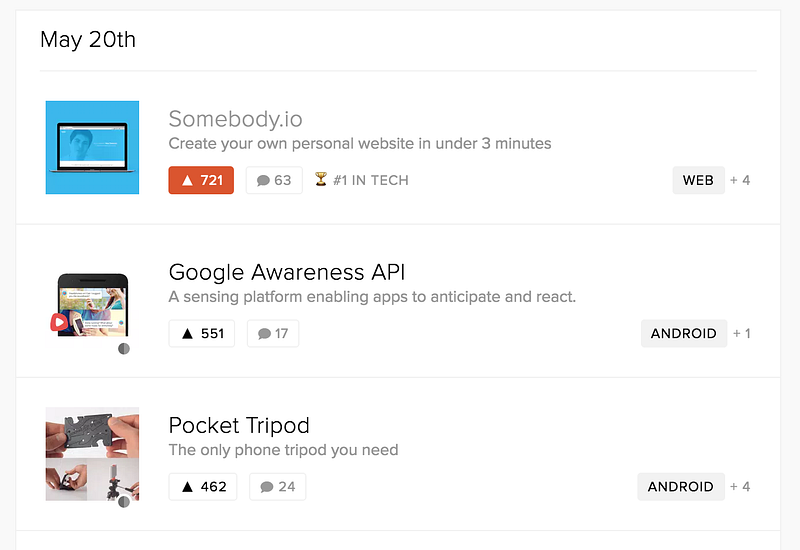
#1 on Product Hunt
The exposure from Product Hunt was great, but I was concerned that the momentum would quickly die.
This fear was based on experience: A few weeks before the Somebody.io launch, Product Hunt had featured two of my other projects (speed-listening app Rightspeed and ReallyLongTweets.com) on their homepage. The publicity created a nice spike in traffic, but that traffic soon tapered off.
So, this time, I was determined to keep the momentum going.
The best way to build momentum
With Somebody.io, I found that the best way to build momentum is via brute force. In other words, I didn’t create some sort of “automated growth hack machine” that magically grows my product while I sleep. Instead, perhaps to your disappointment, I simply put in the hard work and the necessary hours.
“Internet gurus” are really good at selling the attraction of passive income, facilitated by “growth hacks” like automatization, email drip campaigns, landing page optimization, affiliate marketing, etc.
But the truth is, at the earliest stages of your company, this stuff doesn’t work. In fact, it’s in the completely wrong direction.
You should be deploying all of your attention to one-on-one human interaction (and spending no time working on your optimized conversion funnel, automated marketing, or anything where your users are abstracted away from the individual).
This sentiment isn’t new. It’s exactly what Paul Graham, founder of Y Combinator, prescribes in his famous essay “Do Things that Don’t Scale”. And although most tech founders can recite PG’s catchphrase in their sleep, I don’t think many founders actually apply it when it’s their turn.
Thus, my hope is to share some of the ridiculously unscalable things I’ve done over the past few weeks and the awesome results and feedback I’ve gotten so far. Hopefully, this helps you prepare yourself for an epically unscalable, brute force-intensive product launch of your own.
Getting users one-by-one
“The most common unscalable thing founders have to do at the start is to recruit users manually. Nearly all startups have to. You can’t wait for users to come to you. You have to go out and get them.” — Paul Graham
Twitter Search
Before launching on Product Hunt, I tracked down new users primarily via Twitter Search.
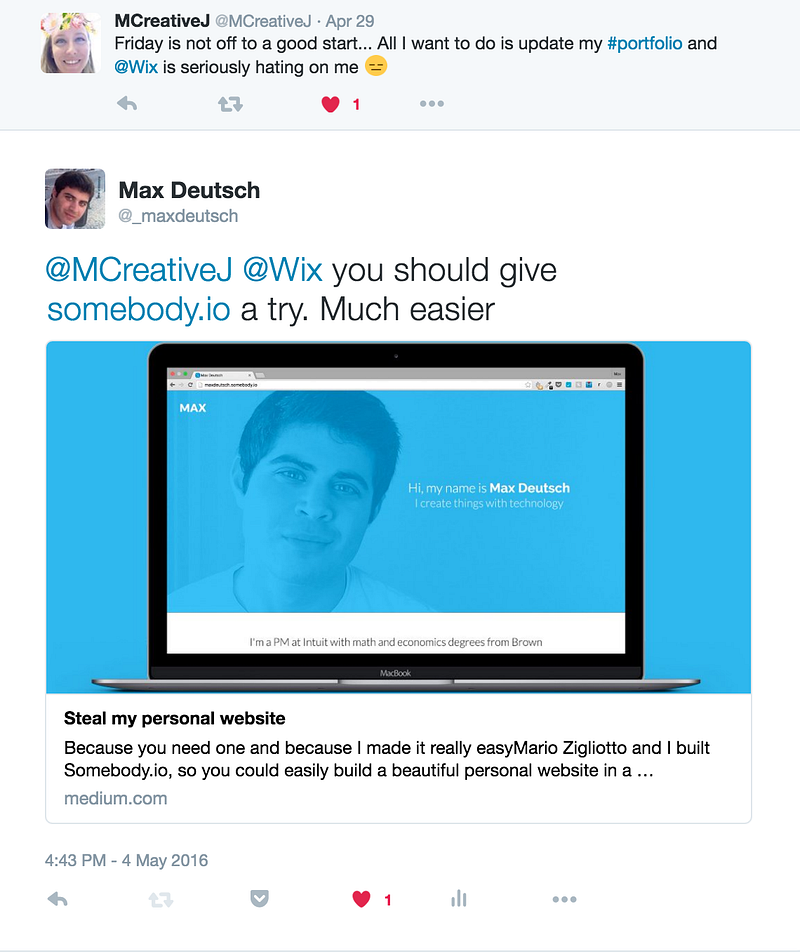
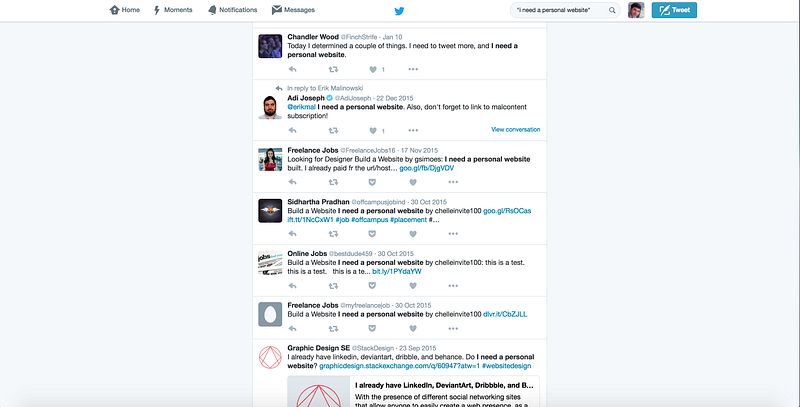
I searched for particular phrases on Twitter like “I need a personal website”…
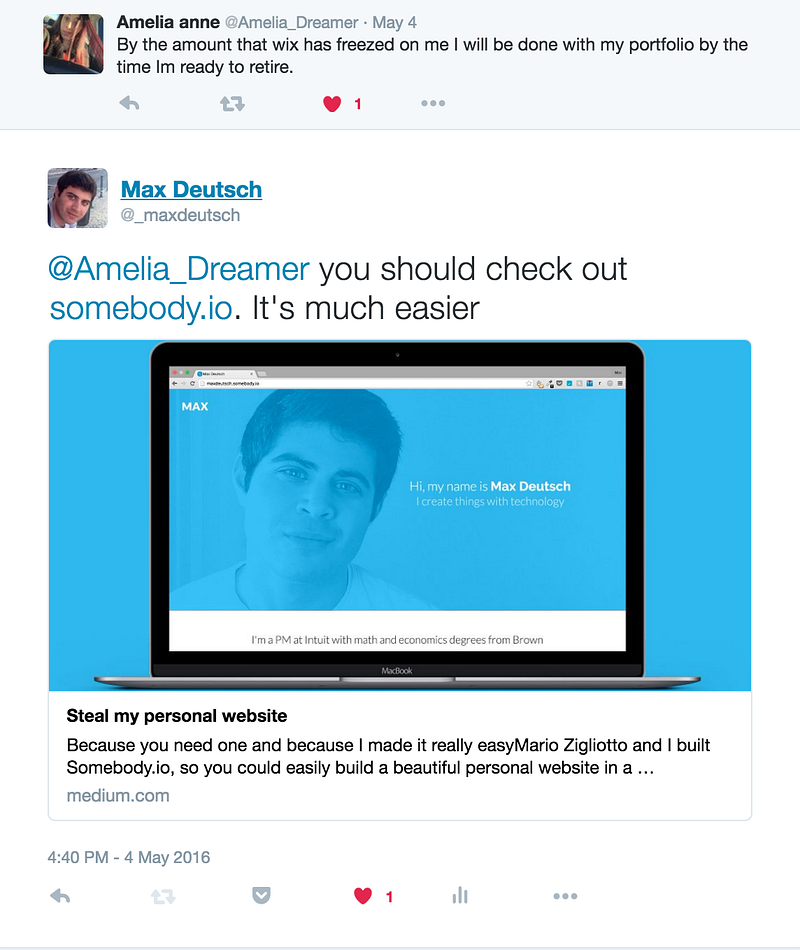
Or, “I need a portfolio”.
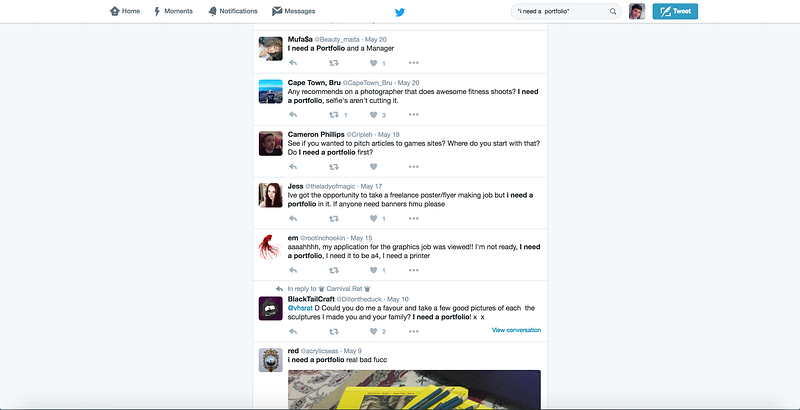
The result was a big list of people who were immediately looking to build a personal website or portfolio (naturally). I took the time and wrote a response to almost every Tweet in the search results from the past six months.
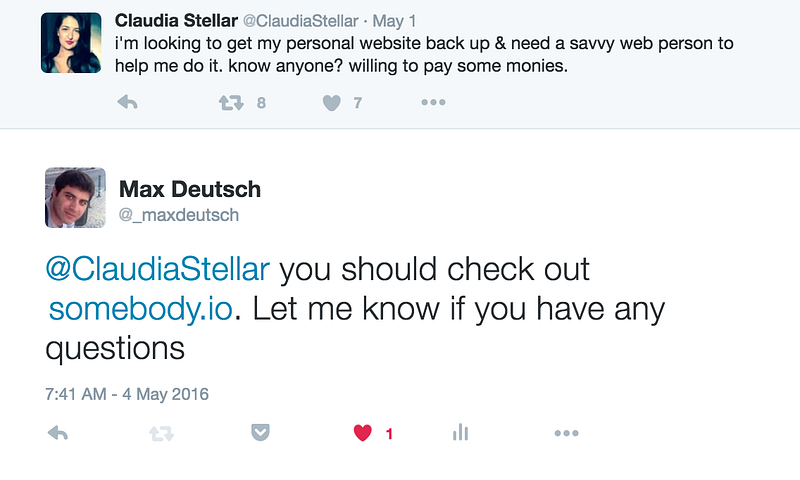
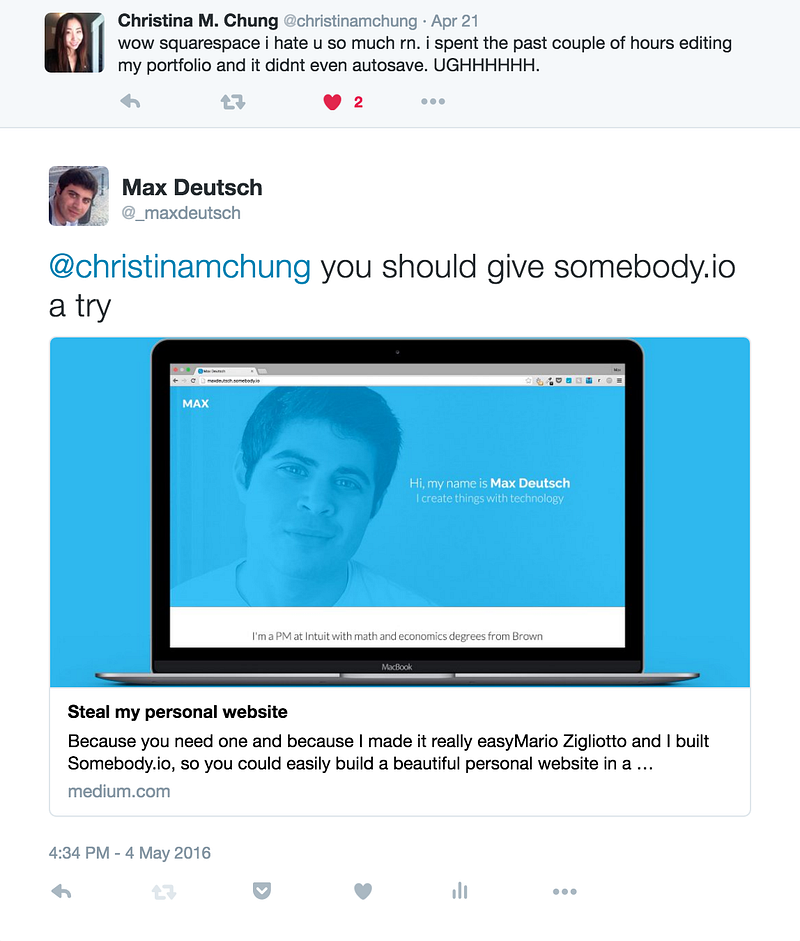
I also searched for users of my “competitors” like Squarespace, Wix, Weebly, etc., and used Twitter Advanced Search, so I could filter for Tweets with a negative sentiment.
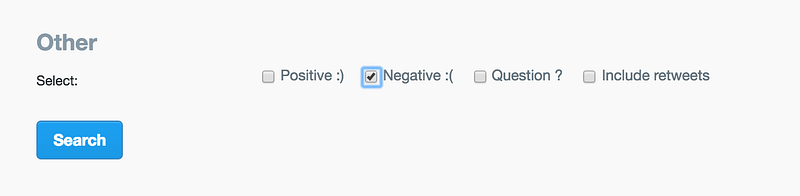
Twitter search certainly requires time and a little cleverness, but the effort pays off: Most of the first Somebody.io users were straight from Twitter.
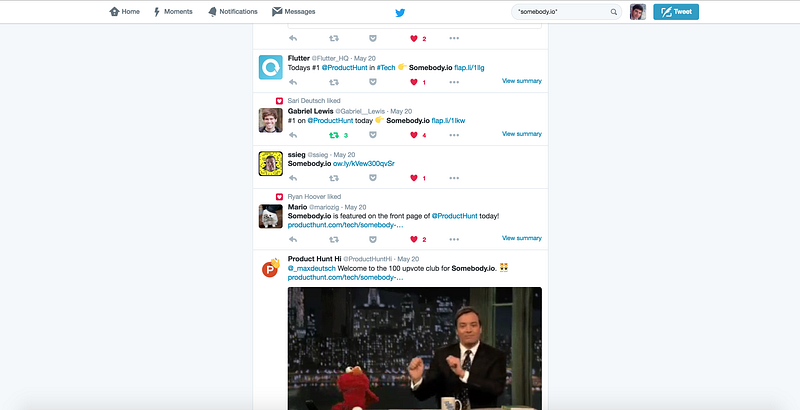
Bonus: I also search for “Somebody.io” on Twitter daily, so I can make sure I’m engaging with everyone who’s talking about the site.
Facebook groups + Medium posts
Two other things that doesn’t scale well are 1) Writing original content, and 2) Manually distributing original content. Of course, when done together, these two things also produce awesome results (I could write a completely separate post on the power of content marketing).
During the earliest days of Somebody.io (early May, pre-Product Hunt), I spent a significant amount of time writing content about the concept of the site…
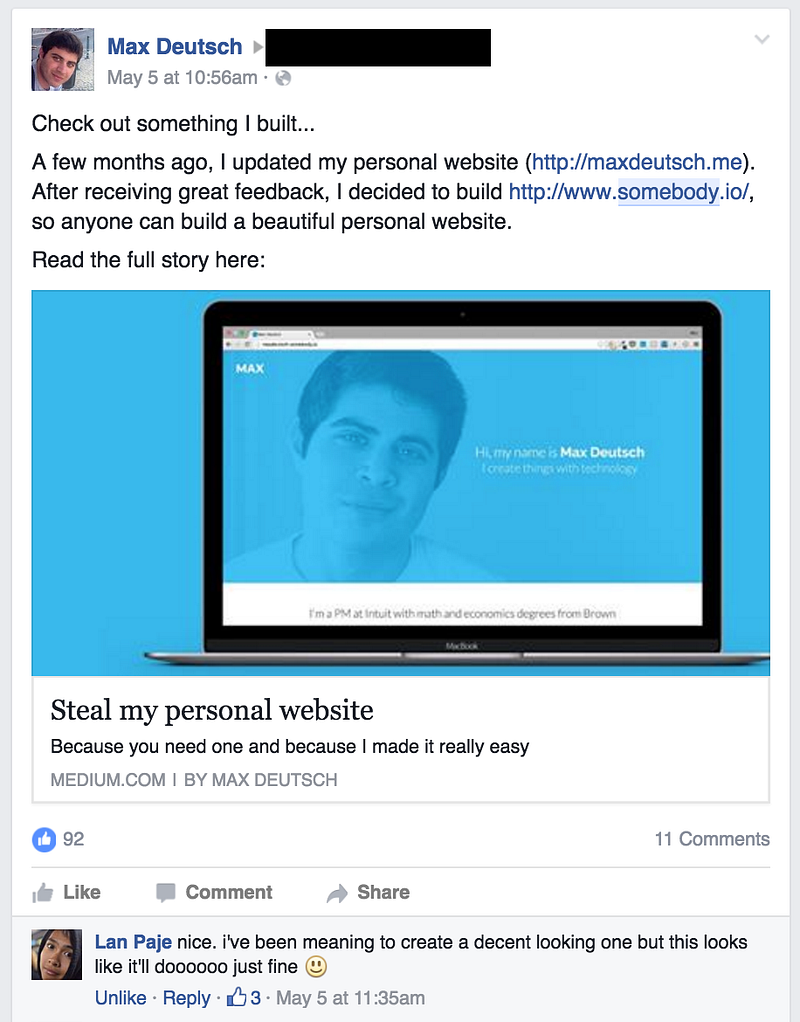
I then joined a number of Facebook groups around topics like Product Management, Design, Software Development, Hackathons, Startups, Entrepreneurship, etc. (mainly targeting groups with at least 3,000 members), where I then posted my content.
By prefacing the piece of content with the appropriate context for the group, I was able to avoid “straight-up spamming”, and instead, actually drive meaningful engagement and conversation.
Here’s a post to a group of “fellow product builders”:
And here’s a post to a group of product designers:

With every post, I was also diligent about liking all comments (in order to maintain engagement) and responding to all questions or feedback (in order to drive the conversation forward).
Every post probably generated tens of new users, but scaled across dozens of Facebook groups, the number of new users starts to add up. And also, these users are typically “better users” because they have much more context around the product — After all, they’ve read relevant content, engaged in discussion, and gotten their questions directly answered.
The combination of Medium posts with Facebook distribution has certainly yielded some awesome results.
Product Hunt comments
I knew that launching on Product Hunt would help recruit new users. I also knew that the #1 product every day gets a disproportionate amount of attention.
As a result, on the morning that Somebody.io was going to be featured, I woke up at 3am PST to start replying to Product Hunt comments. This helped build Somebody’s momentum, ultimately propelling it to the number one spot at around 5:30am PST.
Once at the top spot, I continued to answer questions and individually engage with each commenter:
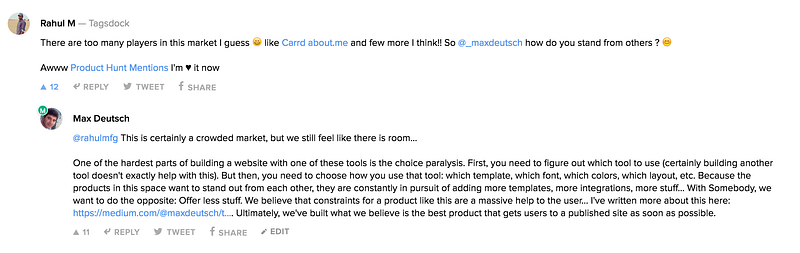
By responding to all comments, I encouraged more comments, which created more responses, encouraging more comments, and so on.
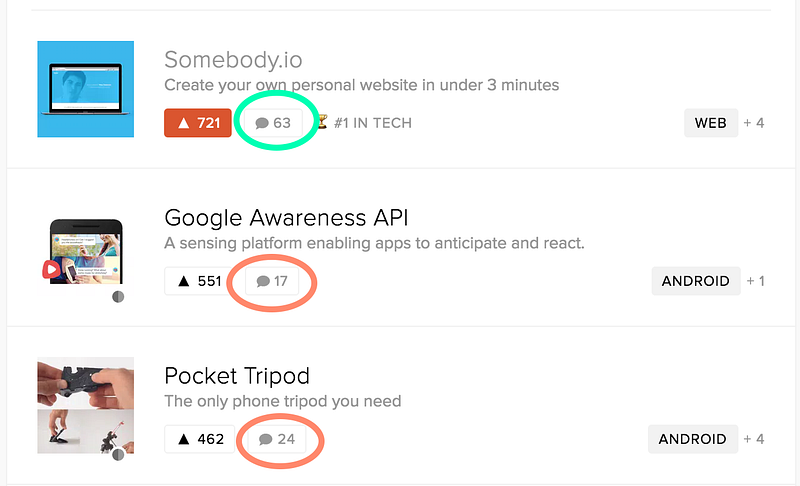
3–4x more comments than the next most popular products
As a result, we got to hear a lot of amazing feedback:

Certainly, Product Hunt helped drive broader awareness, but it was all built on top of the individual attention I gave to each commenter.
By the way, if you want to get featured on Product Hunt, you’re going to have to hustle for that too.
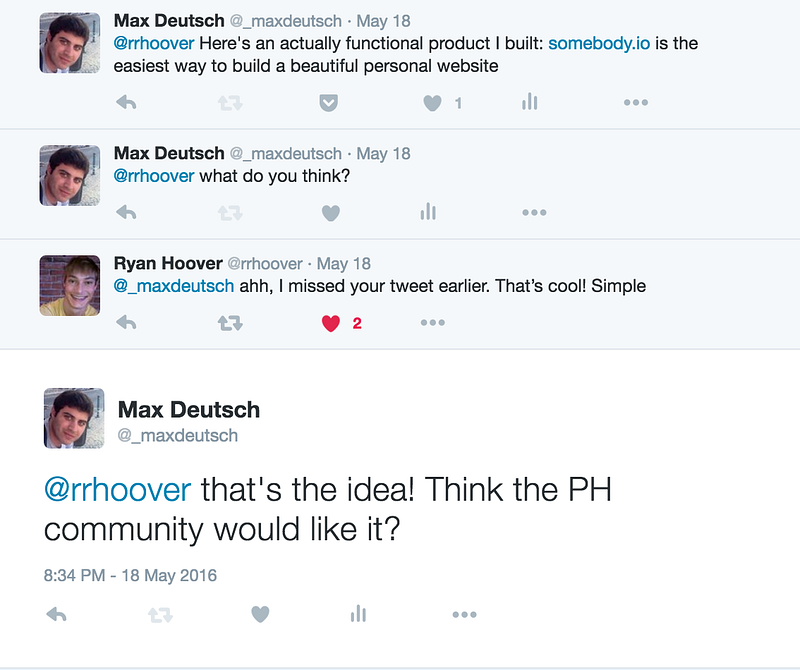
Twitter exchange with Ryan Hoover, founder of Product Hunt
Many founders find it hard to only concentrate on one user at a time. The numbers just feel so small, and the time investment doesn’t seem worth it.
But Paul Graham is able to nicely put this brute force effort in context. It’s all about compound growth:
“If you have 100 users, you need to get 10 more next week to grow 10% a week. And while 110 may not seem much better than 100, if you keep growing at 10% a week you’ll be surprised how big the numbers get. After a year you’ll have 14,000 users, and after 2 years you’ll have 2 million.” — Paul Graham
Making every user’s experience incredible
“You should take extraordinary measures not just to acquire users, but also to make them happy. Your first users should feel that signing up with you was one of the best choices they ever made. And you in turn should be racking your brains to think of new ways to delight them.” — Paul Graham
Concierge product help
After getting a big wave of new users from the Product Hunt launch, I spent 15 hours the following two days individually visiting every user’s Somebody site. I then reached out to them one-by-one via email, let them know what I liked about their site, asked for brutally honest feedback on the product, and gave them tips on how to use the product more effectively.
For some users, I even sent them Photoshopped versions of their photos if I thought it could help them improve their site.
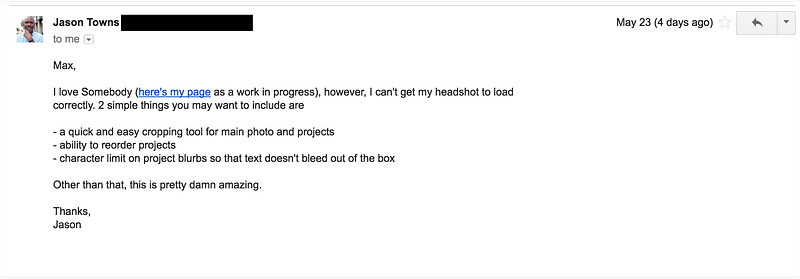
For example, here’s an email I received from Jason Towns, who was struggling to properly position his headshot:
I took a look at Jason’s page, and agreeably his headshot wasn’t quite right.
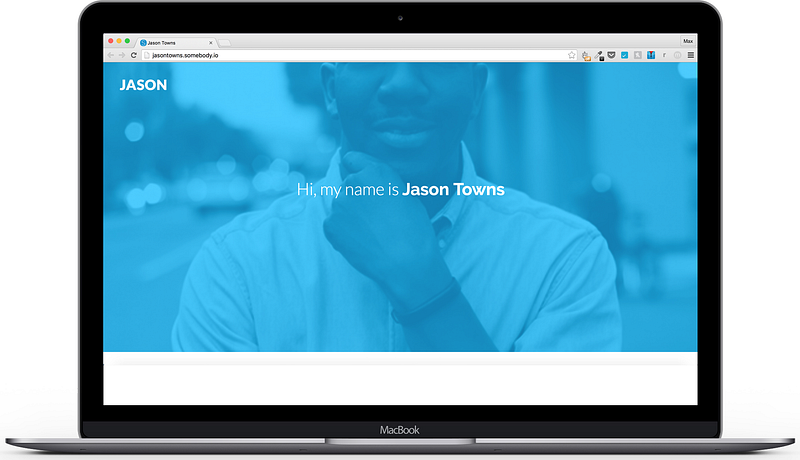
Somebody.io centers the main “Hero Image” on the page both vertically and horizontally — so, usually the best way to fix a problem like Jason’s is to crop the photo so that the subject is centered. Unfortunately, this wasn’t going to work for Jason’s photo: In the original photo Jason uploaded, his head is partially cut off, making it very challenging to effectively crop it.

Jason’s original photo.
There were two options to help Jason: 1) Recommend that he uses a different photo (that shows his entire head), or 2) Extrapolate the photo via Photoshop.
I picked option 2.
I spent 15 minutes editing Jason’s photo and then sent it back to him.

Jason’s new Photoshopped photo.
Jason loved it and immediately uploaded the new photo. His site was starting to come together:
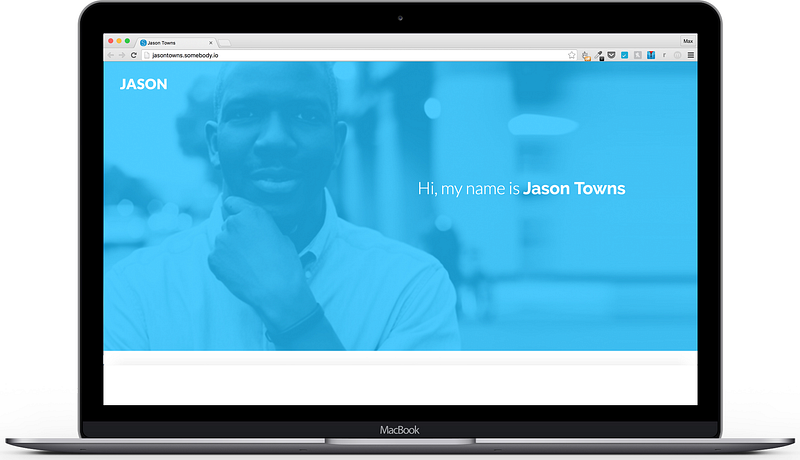
Jason’s new photo after cropping it on the left side.
Curating Domain Names
Many users had finished their site by the time I checked them out. For these users, I wanted to help them find an awesome personal domain name to complement their awesome personal site.
So, for each user, I curated a list of my favorite available domain names that they might like, and shared the list via email.
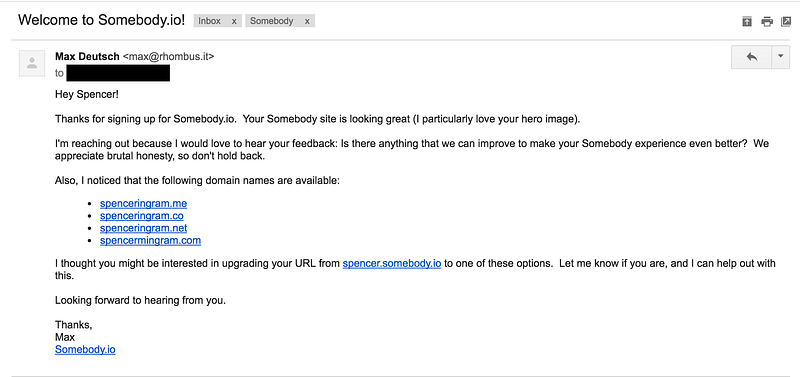
In many cases, users immediately upgraded to one of the curated options, not previously realizing that they could use a custom domain with Somebody.io.
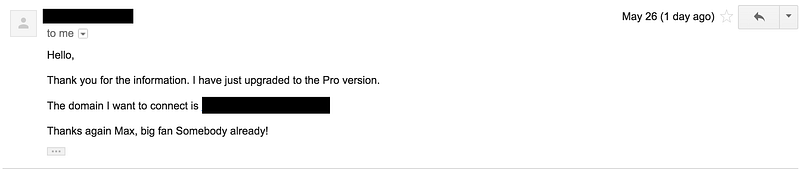
In other cases, like Spencer’s, the user didn’t actually need help with domain curation, but appreciated the extra effort:

Even in the cases when users wanted to delete their Somebody account, I made sure that they still had an awesome experience working with us.
In fact, I try to act on these requests in under 5 minutes. The reason: Currently, the product doesn’t let user’s delete their site (this is a product deficiency). But this doesn’t mean that the user’s experience itself needs to suffer.
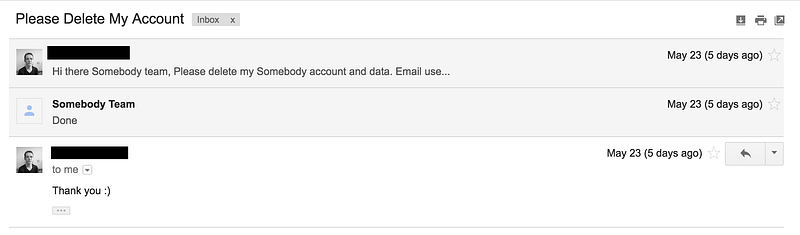
Responded in less than a minute.
Paul Graham says it best:
“It’s not the product that should be insanely great, but the experience of being your user.” — Paul Graham
Launch faster by “being” the product
“There’s a more extreme variant where you don’t just use your software, but are your software. When you only have a small number of users, you can sometimes get away with doing by hand things that you plan to automate later. This lets you launch faster, and when you do finally automate yourself out of the loop, you’ll know exactly what to build because you’ll have muscle memory from doing it yourself.” — Paul Graham
Manually connecting every custom domain
In order to fund the hosting costs of the free Somebody sites, we offer a Pro subscription that let’s users connect custom domain names (like MaxDeutsch.com, instead of MaxDeutsch.somebody.io) for $3/mo.
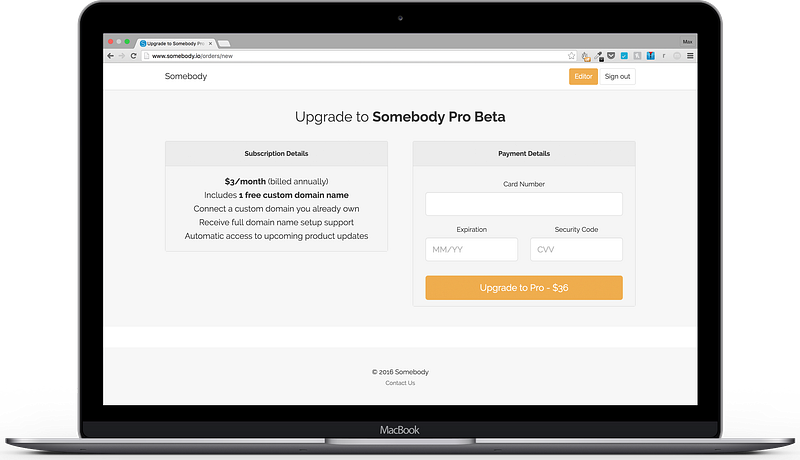
The Somebody.io upgrade page
Although we wanted to launch with this offering, building out the Pro functionality would require a significant effort (especially the domain registrar part). So, we didn’t.
Instead, once users upgrade to Somebody Pro, they see this message:
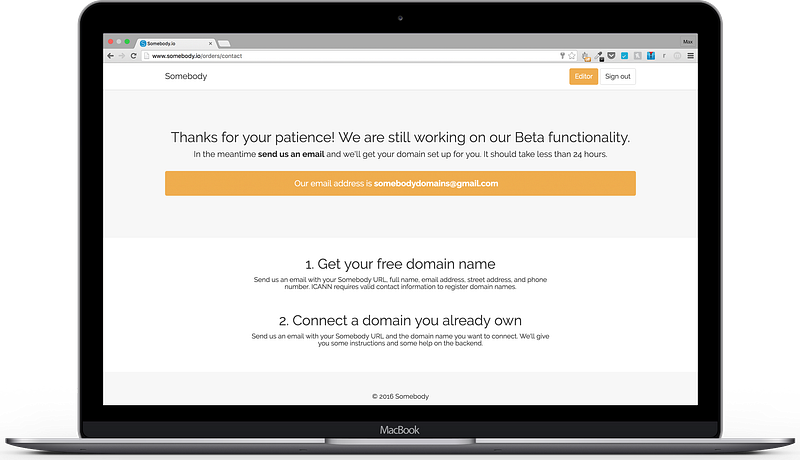
Basically, we tell Pro users to “Email us” and “We will set everything up for you”. Then, we manually connect everything up in the backend.
Not only did this let us get to market faster, but (because we are setting up every domain name by hand), we can be sure that it works properly.
In many cases, users have even given me temporary credentials to make sure everything works okay:
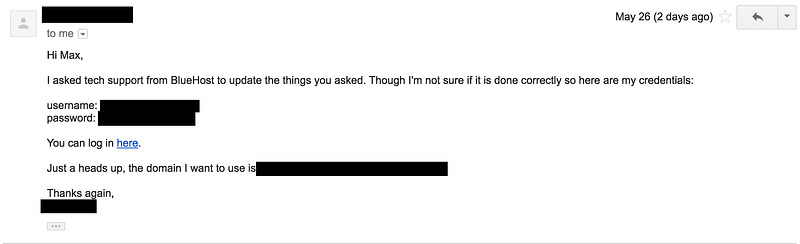
You might worry that “faking the product” would upset users — but, as long as you ensure the experience is awesome, users tend to look past the manual process. Some users even appreciate it:

“If you can find someone with a problem that needs solving and you can solve it manually, go ahead and do that for as long as you can, and then gradually automate the bottlenecks. It would be a little frightening to be solving users’ problems in a way that wasn’t yet automatic, but less frightening than the far more common case of having something automatic that doesn’t yet solve anyone’s problems.” — Paul Graham
Now, it’s your turn.
If you’re preparing to launch your product soon, hopefully this post has given you two things: 1) Some growth tactics that you can use, and 2) An appreciation for the effort required to get your product off the ground.
Launching your product is certainly hard work, but if you commit yourself to the unscalable brute force mentality, it will pay off. Your users will love you for it:

Max Deutsch is the founder of Rhombus, a Startup-As-A-Service company, based in San Francisco. Rhombus works with non-technical entrepreneurs to build stunning mobile apps.
If you enjoyed the post, it would mean a lot if you could hit the heart button below. It helps me know what I should write more about and helps other people see the story :)