
“How the Mighty” Chapter 17 — Carrie
Brothers
Cherchez la femme
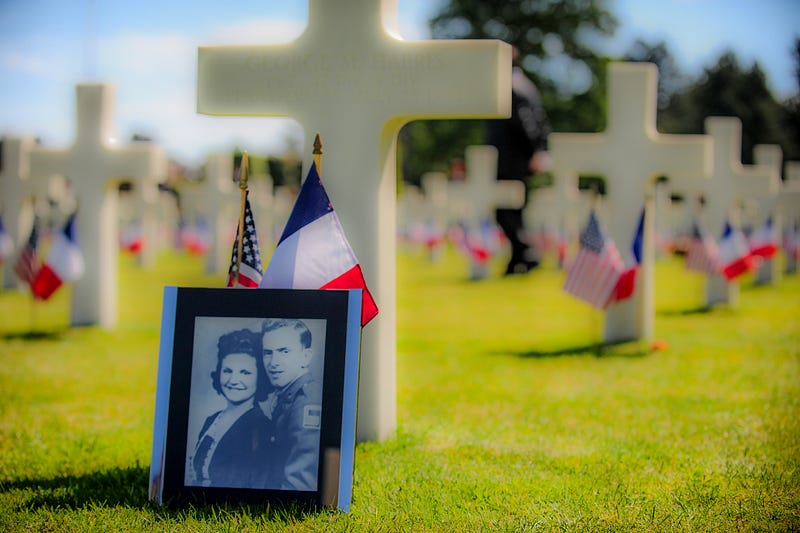
“She is not here,” Carrie translated. “Best bring out that photo.”
She turned back to the silver-haired lady in the door, “Savez-vous où elle est?” Where is she?
“She is gone to the cemetery.”
“Oh, no! We’re too late.” Carrie’s face fell, and the old lady laid a hand on her shoulder.
“Non, to the American cemetery. For the ceremony. She was here on that day, you know. There are very few left. Oh, la la, but she has some stories to tell!”
The veteran pulled out his photograph and showed it.
“Oh, she is beautiful, our Arthéme,” she said. “So young! And look, there is poor Sergeant Osmond.”
“Me,” the veteran said, indicating the sergeant.
“Impossible!” snapped the old lady. “Ce soldat est mort!”
“She says you’re dead, mate,” Carrie said.
He looked around, bewildered. “This is the same place. I was here. Look, the stones, the windows, exactly the same.”
“He is dead. In the cemetery. Every year she goes to see him. Sometimes other times, when she is feeling sad. I have gone with her many times. We take flowers for him. She cries, and she tells me the stories.”
“Moment, Madam,” said Carrie, sensing a better story than she had imagined. “Is this the place?”
She flicked through the photographs on her camera, stopping at the shot of the roses laid on the grave.
“Yes,” the old lady said. “See, the name is the same as mine. Osmont, Osmond. It is the same.”
“And you,” Carrie turned to the veteran, “you’re this fellow in your snapshot?”
He nodded.
She tapped his photo. “It looks like you, but you’re not quite as cute nowadays. And not as dead. This lady says you’re buried in the American cemetery, and you were at the grave this morning.”
He nodded.
“Your brother, maybe?”
He shook his head.
The French grandmother had turned away, and was now calling inside. Calling for help. Oh, great, they were in the shit now.
A young man came up behind the old woman. A farmhand, perhaps, who spent a lot of time doing heavy labour by the trim, muscled look of him. He’d throw them both out into the lane and chuck the rental car after them.
“Grand-mère?”
The lady delivered a stream of rapid Normandy French which Carrie couldn’t follow at all, and he disappeared. Off to ring the cops, no doubt, and they would be spending the night in the cells.
“Maybe we’d better leave.”
“No!” The old soldier was standing tall now. “I’m not leaving until I see Arthéme again. I need to explain.”
“Too right you do, buster.”
There was a sudden clatter above them, and they all looked up.
Two helicopters swept over the farmyard, their noise filling the space with thunder for a moment. And then they were gone, heading low toward the beach.
The young man returned, carrying a bundle. The old lady took it, and shook it out carefully. “See?”
Carrie gasped. The old man grabbed her arm, swaying. She led him gently to an old stone bench. He sat down and buried his face in his hands.
The lady was holding an old American uniform jacket. The chevrons of a sergeant on the sleeves, the sewn-on name-tag clearly reading “Osmond”.
So, Sergeant Osmond had left in a hurry, leaving his clothes behind. This just got more and more interesting.
“Voila!” The old Frenchwoman indicated a label inside the collar. A name and service number was still visible.
“It is the same soldier buried there. There is no mistake.”
Carrie gently took the old photograph from the unresisting hand of the veteran. Together the three of them — grandmother, grandson, and herself — compared the jacket with the photograph.
A perfect match. Except…
Over the heart were embroidered two red roses.
“So young!” breathed the young man.
He spoke English; that was a relief, Carrie thought.
“My great-grandmother has spent all the years since the war, grieving for this man. She takes flowers there each year. Now my brother and I push her wheelchair, and she tells us stories of the day the Americans came to France. We must show her this photo. But who is this man? A comrade?”
Carrie spread her hands. “I was at the cemetery this morning, and I found him weeping over the same grave. There is some connection.”
“We must find out. It would mean everything to Grand-mère Arthéme.”
They all looked at the veteran, lost in his own memories. He felt their gaze on him, or maybe it was the expectant silence.
He looked at Carrie. “Can you drive me back to the cemetery?”
In the end the young man — his name was Alexandre — drove them to the cemetery.
“We will meet my little brother — le petit Nicolas — and he will take you to her. He has the entry pass, you see.”
“Um, so do we,” Carrie said from the back seat of the elderly Peugeot. “But they may not be happy to see us again.”
“We go a different way.”
Carrie looked out the window at the Normandy countryside. Thick hedges screened the lane they were on. Hard to imagine this rural tranquility buzzing with machine-gun bullets, the sound of explosions, the ugly grey tanks clanking along.
The car was likewise rustic. There was a hole in the floor through which France was visible, it had clearly been used for transporting livestock at some stage, and there were several little foil wrappers tucked into the creases of the back seat.
Rather like the farm car in which Carrie had learned to drive, she thought, taking her mind back to her high school days.
And other lessons besides, she recalled. Perhaps things didn’t change that much around the world.
Alexandre drove with one hand on the wheel, using it to change gears as necessary, and the other wrapped around his phone, which never left his ear. His rapid Norman French whipped past Carrie’s ears, with maybe one word in five comprehensible. Le petit Nicolas sounded like a jolly fellow, judging by the way he made his elder brother laugh.
They were almost at the beach before they stopped. A tiny, sandy carpark with a few battered trucks.
“The gardeners’ entrance,” Alexandre explained, bouncing from his seat to help the veteran out.
There was a burly security guard examining them. Carrie unzipped her camera bag for it to be searched, but Alexandre embraced the guard, and waved them through.
“This fat old rascal is Pierre. When they offered him the job, they asked if he always told the truth, and he said he would never lie. The Americans took him on, can you believe it? It’s okay, Pierre, they are with me. Perhaps there might be a bottle or two for you tonight, hey?”
Inside the gate, an exact replica of Alexandre stood waiting for them, with a wheelchair into which the old soldier gratefully sank. Carrie looked from one to the other, and the brothers laughed.
“My younger brother,” Alexandre explained.
“By ten minutes,” said Nicolas, in what was evidently a stock routine.
Nicolas pushed the wheelchair past steaming mulch heaps, through a screen of shrubs, and there was the French President at the microphone, thanking the veterans for their service, talking of liberation and freedom and duty.
But the veteran had eyes only for the tall French lady who had risen from her seat and was standing, waiting.
This proved to be surprisingly difficult to write. Even now there is too much exposition in the dialogue, and it could lose a few sentences, but I have already spent longer on this than intended, and there are five chapters still to go.
The difficulty lay in making the dialogue credible and comprehensible to the characters, and yet at the same time not overload the reader with information they have already learnt.
Believe it or not, but Nicolas and Alexandre were the two most popular French boys names in the year I picked for the twins to be born. They named themselves!
Britni
The story so far:


