Bringing The Real World into The Classroom
Reality-Learning in Action

Reality-learning refers to the learning experience that exposes students to authentic, real world experiences for a classroom-based curriculum. It is a unique variant of experiential learning that focuses on changing the perception of reality. It deploys a constructivist, andragogical approach to bring about actual changes in behavior made sustainable by the perceptions of a fresh social reality.
Increasing globalization and short product life-cycles demand companies to think “outside the box”. By the end of the 1990s, many companies had reached the point of diminishing returns with their cost-cutting efforts. They needed to find new ways to make money and drive corporate growth. Innovation became a high priority. The successful ones introduce “value innovations” into untapped market space, creating demand and the opportunity for highly profitable growth. This space is called the “Blue Ocean”. In blue oceans, “competition is irrelevant because the rules of the game are waiting to be set”.
The “Blue Ocean” concept is used as the sensemaking frame for reality-learning in the design of our experimental reality-learning curriculum. A “frame” refers to structured patterns of thinking, knowing and acting that are built into the authentic routine practices of the social world. Frames are used by people to draw upon as resources for the sensemaking process of creating links between what they currently see and their beliefs cultivated from past experiences. Reality-learning uses the Blue Ocean frame to “re-construct” the perceived situation, and suggests that students have to “see” the desired change before making it happen.
The main thrust of Blue Ocean Strategy (BOS) is: Keep doing the same as before or improve it marginally and the best you can hope for is temporary survival in today’s business environment. Instead, companies that are first not only to accept change, but to drive change and make innovation a strategic priority will be the ones to excel and create Blue Oceans of uncontested market space.
The BOS Model provides a toolbox of inter-related concepts and methodology allowing companies to break away from head-on competition in order to create and maintain uncontested market spaces of high customer value. The toolbox includes the whole leadership gamut from Strategy Formation, Strategy Implementation, Organizational Change and Staff Motivation.
Value Innovation is an important thinking tool of BOS, and provides the strategy formation framework. Value Innovation is a highly pragmatic, visual methodology that allows companies to challenge industry boundaries and taken for granted assumptions and in the process discover highly distinctive and successful strategies. Value Innovation sets the stage for the rest of the BOS concepts.
Designing a Reality-Learning Curriculum
Teaching about change, uncertainty and increasing environmental turbulence is not new, and various concepts have been discussed since the late 1960s. Teaching resources are mostly geared toward imparting knowledge about the nature and causes of change in order to enhance the adaptive capability to change. Some also present topics such as resistance or coping with change.
The Human Resource Management (HRM) course, which was originally designed for Electronic Engineering undergraduates at the Singapore Nanyang Technological University, was selected as a Reality-Learning opportunity to prepare the engineering graduates for the global realities and challenges of industry.
The curriculum was re-configured and re-designed by integrating the realities of globalisation and change in the crucial issues confronting 21st-century leadership and key themes such as: transformational leadership, culture, teamwork, motivation, diversity, vision, mission and multiple stakeholder perspectives.
The new Reality-Learning curriculum goes beyond merely exposing students to these concepts through traditional lecture-cum-tutorial methodology. It became an experiential platform that would allow students to develop a learning relationship with the concept of uncertainty and to become excited about a HRM strategy to manage the realities of change itself. In essence, students can now experience the emotional reactions that accompany change as they operationalize and actionise the HRM principles of motivation, inter-personal communication, leadership and group dynamics.
Our curriculum objectives recognize that both teachers and learners daily engage uncertainty, paradox, pervasive rapid change, and dramatic challenges to the status quo and traditional mindset. Therefore, the individual’s capability to adapt to change and embrace ambiguity is central in our curriculum.
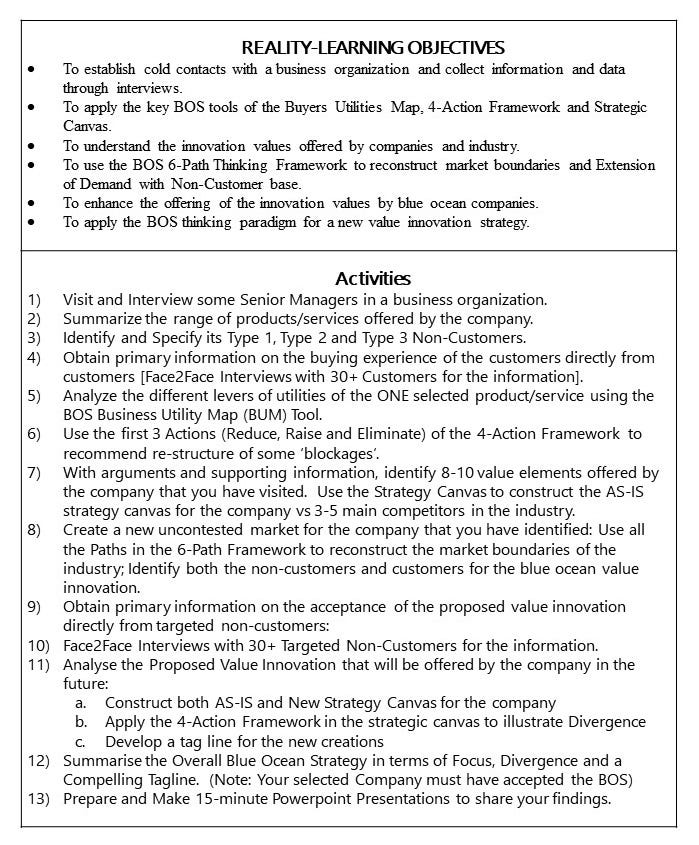
A Project served as the action platform for Reality-Learning. The Project was designed as an activity system of engaging the real-world context of business by requiring students to deal with authentic real world complexity: making cold contacts with business organisations and obtaining adequate, actual, relevant and timely information for the project. Sociologically, it is a behavioral exercise that combines information gathering, issues identification, problem finding with problem solving and decision-making within a BOS framework.
Below shows the Reality-Learning Objectives and Activities.
The duration of the project is 8 weeks. A total of 1,225 students have enrolled for the module over two semesters. In addition, a total of 245 business organizations are involved in the team projects.
Interaction with Reality-Learning Facilitators
Reality-learning is emboldened and empowered by Reality-Learning Facilitators in constant and continuous interaction with reality-learners.
The role of Reality-Learning Facilitators is to provide guidance and support to learners as they participate in authentic and task-related, structured social interactions. The Facilitators also aid in the intellectual development of students in ways that leave room for individual sensemaking as well as the joint expansion of shared meaning.
The core task of Reality-Learning Facilitators is to facilitate students in their efforts to interpret reality, to frame and re-frame the issues and to make sense out of constraints and events that confront them.
Their task is one of managing the construction of meaning:
· as role models for the behavior that students are expected to engage in;
· as monitors of emergent co-constructive norms in social interactions;
· as active participants in team meetings by shaping the dialogue;
· as advocates of the BOS thinking process for the achievement of convergence and inter-subjectivity in understanding and problem solving.
The andragogical orientation of Reality-Learning Facilitators also revolutionises the role of learners and the organization of classrooms. Reality-Learning Facilitators see learning essentially as sociocultural interaction, and proceed to innovate the transformation of their classrooms into communities engaged in co-constructive learning. In this way, individual learners become acculturated in a learning community through collaboration and negotiation.
The classroom becomes a reality-learning community that empowers learners to negotiate and renegotiate meaning and for explicating action. In the dynamics of reality-learning, the social “reality” is constantly in the process of being recreated as it is interpreted and renegotiated by the learners as they develop solutions to respond to the permanent change happening in the dynamic marketplace.
References
Bickford, D. J., & Van Vleck, J. (1997). Reflections on artful teaching. Journal of Management Education, 21(4), 448–472.
W. Chan Kim and Renée Mauborgne, (2005). Blue Ocean Strategy, Boston: Harvard Business School Press.
Weick, K. E. (1995). Sensemaking in organizations. Thousand Oaks, CA: Sage, 1995.