
Bridging Two Worlds
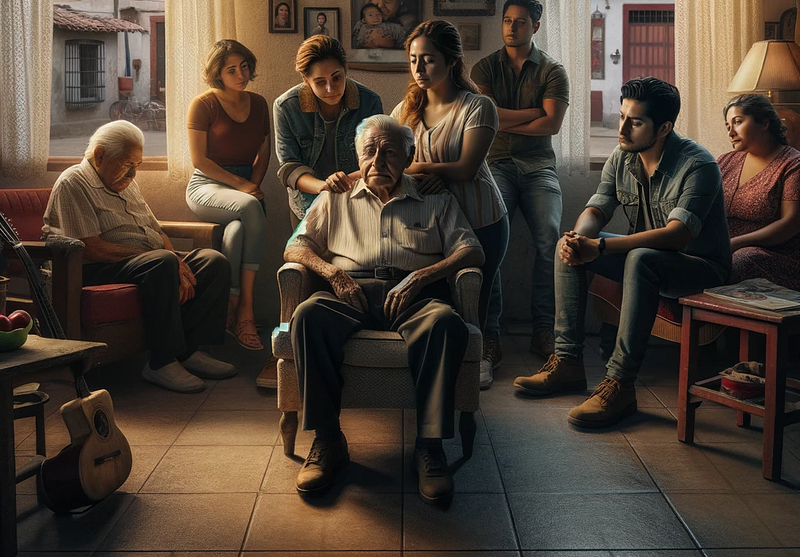
In a small, vibrant town in Mexico, where the streets echoed with the melodies of a rich cultural past and the setting sun cast a soothing golden glow, stood a modest home. This home, brimming with memories, belonged to Eduardo. Once a pillar of strength and joy, he now sat quietly, his gaze often distant, lost in the unyielding fog of Alzheimer’s.
His children, whose lives had unfurled in San Diego, were constantly navigating a world split in two. Their hearts lay stretched across the border, a border that had reshaped their lives when their father was deported. This border was more than just a line on a map; it represented a daily struggle of love, responsibility, and the complexities of a family divided yet unbroken.
Maria, the eldest, was the backbone of the family. As a lawyer, her life was a tapestry of legal battles and caregiving, her visits to Mexico filled with tender moments of trying to connect with her father. She would recount tales of her children, hoping each word would penetrate the mist that seemed to shroud Eduardo’s memories.
José, the once boisterous soul of the family, now carried a gentle sadness. His trips home were a mixture of reminiscing and coming to terms with his father’s fading memory. Long walks around their old neighborhood became a ritual, each landmark a story, each story a desperate bridge to the past.
And then there was Luisa, the youngest, who found refuge in her faith. The local church in their Mexican town had become a vital support, not just spiritually but in tangible ways. It stood as a symbol of communal empathy and assistance, providing meals and comfort, reminding them that even in hardship, they were not alone.
Each sibling’s journey back to Mexico was a testament to their enduring bond. In the warmth of their family home, they shared stories and memories, their laughter and tears weaving a rich tapestry of a family that, despite everything, remained united and strong.
In the quiet home in Mexico, where each corner whispered stories of yesteryears, Eduardo’s condition progressively worsened. Alzheimer’s, like a relentless tide, eroded more and more of his memories, leaving behind a shell of the man he once was. His moments of clarity became rarer, precious instants that his family clung to desperately.
Maria, during her stays, found herself grappling with the heartache of her father’s fleeting recognition. She would lovingly curate photo albums, hoping that the images of their shared past would ignite a spark of memory in Eduardo’s eyes. The struggle was not just emotional; managing his medical needs with limited resources was a constant battle. She coordinated with local doctors, often finding herself lost in translation, navigating a healthcare system that was under-resourced and overburdened.
José’s visits were marked by his attempts to engage his father in activities that they once enjoyed together. He would bring Eduardo’s favorite music, playing the old tunes in the hope of reaching him through the melodies of their past. However, José also faced the harsh reality of his father’s unpredictable mood swings and the physical challenges that caring for an Alzheimer’s patient entailed. The disease’s progression brought new obstacles, from ensuring Eduardo’s safety in the home to dealing with moments of confusion and agitation.
Luisa, in her efforts to provide comfort, often found herself overwhelmed by the magnitude of her father’s needs. She turned to the church for support, organizing community volunteers who could provide respite care. This not only helped the family but also fostered a deeper sense of community within the town. Yet, Luisa struggled with feelings of guilt, torn between her life in California and her responsibilities in Mexico.
In the midst of the daily challenges, Maria, the lawyer daughter, was waging a silent battle far from the eyes of her family in Mexico. She had embarked on a legal quest to secure a humanitarian visa for Eduardo, so he could return to the United States to spend his final days surrounded by his loved ones. This fight was her beacon of hope, a goal that she pursued with relentless determination, navigating the complex and often disheartening maze of immigration law.
Meanwhile, José, during one of his visits, decided to capture a tender moment with his father. As a child, José had learned to play the guitar under Eduardo’s guidance, and music had always been a special bond between them. Sitting beside his father, José strummed the chords of a song that was once a family favorite. As he played, something remarkable happened. Eduardo’s face, usually so distant and lost, softened. A faint but unmistakable smile crept across his lips. It was a rare and precious moment of connection, a brief respite from the grip of Alzheimer’s.
Moved by the moment, José uploaded the video online, hoping to share this glimmer of joy with friends and family. What happened next was unexpected. The video resonated with people far beyond their immediate circle. It struck a chord with thousands, then millions of viewers. The heartfelt scene of a son connecting with his father through music, against the backdrop of Alzheimer’s, touched a universal nerve. The internet was abuzz with the video, as it went viral, capturing hearts and sparking conversations about love, memory, and the bittersweet moments of caring for a loved one with dementia.
The sudden spotlight brought a flood of support and attention to the family’s story. People from all corners of the globe were moved by the family’s love and dedication. Messages of encouragement, shared stories of similar struggles, and offers of help poured in. This outpouring of support bolstered Maria’s efforts, giving her an unexpected advantage in her legal battle. The viral video had humanized the often faceless issue of immigration and illness, showing the world the real people and raw emotions behind the headlines.
As the video continued to spread, it reached advocates, influencers, and even policymakers. The family’s story, once confined to their small community, was now a powerful narrative that echoed in the halls of power. Maria found that doors that were once closed began to open. Sympathetic ears in the legal and political world lent their support, bolstering her case with the momentum of public opinion.
The public outcry was loud and widespread. The rallies were filled with signs reading “Healthcare is a Human Right” and “Immigrants Are Us”. Speakers took to the stages, sharing their own stories, drawing parallels between Eduardo’s situation and the broader narrative of immigration in America. The media coverage of these events further amplified the message, bringing the story into living rooms across the country and around the world.
In this charged atmosphere, the family’s plight took center stage. Realizing that the political and legal battles would be protracted and might not resolve in time for Eduardo, a grassroots movement began. Millions of people, moved by the family’s story and frustrated by the slow pace of change, started pledging a few dollars each to help with Eduardo’s medical expenses. This crowdfunding initiative rapidly gained momentum, transforming from a trickle of support into a torrent of generosity.
The campaign was more than just a fundraiser; it was a testament to the power of collective empathy. People from diverse backgrounds and political beliefs came together, united by a common cause. The funds raised were not just for medical bills; they became a symbol of public support, a tangible display of the power of humanity over divisiveness.
The groundswell of support for Eduardo and his family reached a crescendo, putting immense pressure on politicians in the United States. The issue was no longer just about one family’s struggle; it had become a litmus test for empathy and compassion in governance. Politicians, sensing the shift in public opinion, began to reconsider their stance. The fear of losing public support in the face of such a powerful, emotionally charged movement prompted a reevaluation of Eduardo’s case.
As the story captivated hearts and minds across the U.S., it also caught the attention of the Mexican government. Officials in Mexico, moved by the plight of one of their citizens and the international solidarity it had sparked, stepped in to advocate on Eduardo’s behalf. The Mexican government reached out to their American counterparts, urging them to view the case not just through the lens of immigration policy, but as a humanitarian issue.
The movement had grown beyond anyone’s expectations, becoming a symbol of the broader struggles and injustices faced by immigrants. It was no longer a mere social media trend; it was a powerful force, a rallying cry for change that resonated across borders.
Amidst this unprecedented public and political pressure, the U.S. federal government took action. After much deliberation and in the face of growing international scrutiny, a decision was made. Eduardo was granted resident alien status once again, allowing him to return to the United States legally.
This decision sent shockwaves through the political landscape. It was a clear indication of the power of collective action and the potential for empathy to influence policy. For Eduardo and his family, it was a long-awaited victory, a chance for them to be reunited and to spend their remaining time together in the country they called home.
The case of Eduardo became a landmark in the history of immigration and healthcare policy in the United States. It highlighted the complexities and often the human cost of immigration laws. The story served as a catalyst for discussions and debates on reform, showing that at the heart of policies and politics are real human lives and stories.
In the wake of Eduardo’s case becoming a beacon of hope and a catalyst for change, the family found themselves in a reflective state. The immense struggle they had endured, the public battle they had unwittingly become the face of, had finally borne fruit. Eduardo, now with resident alien status, could return to the United States. It was a victory not just for them, but for many who saw their story as a symbol of resilience and change.
However, as they prepared for Eduardo’s return, the family grappled with the poignant realities of his illness. Alzheimer’s, unyielding and unforgiving, had stolen much of Eduardo from them. He would be physically close, but the father they knew, the man with whom they had shared a lifetime of memories, was fading away in the mist of his own mind.
Maria, José, and Luisa, along with their extended family in San Diego, made arrangements for Eduardo’s care. They found solace in the fact that he would be surrounded by his loved ones, in a place that he once called home, even if he couldn’t remember it. The journey had taught them the value of togetherness, of cherishing each moment, no matter how fleeting or painful.
The siblings reflected on their journey, a journey that had started with a fight for their father’s right to be with his family and had evolved into a much larger battle. They had ignited a conversation about the human aspects of immigration policy and healthcare, one that would continue long after their story had left the headlines.
As Eduardo arrived in the United States, the family gathered around him. There were tears and smiles, a mix of joy for his return and sorrow for the circumstances. In the comfort of his new surroundings, amidst the familiar faces of his children and grandchildren, Eduardo showed occasional glimpses of recognition, each one a precious gift to his family.
The story of Eduardo and his family ends not with a grand resolution but with a quiet, profound understanding. They recognized that while Alzheimer’s might cloud Eduardo’s memory, their love for him remained unshaken. They had fought tirelessly not just for his physical presence but for the right to be together as a family, to support each other through the challenges.