
Brian Eno: The Sound Alchemist

New here? I recommend you learn about the Cool Continuum first. You can also buy the book to access 60+ artist profiles and the practical guide.
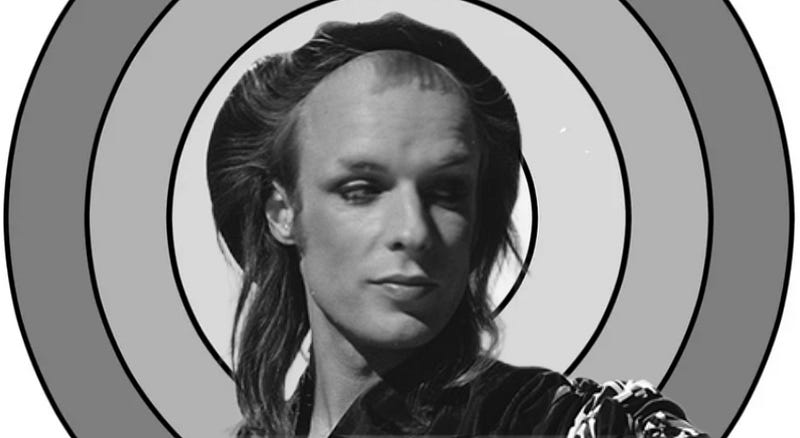
Brian Eno is an artist with a profoundly diverse background. In fact, calling him an “artist” might not adequately capture his vast contribution to culture. Eno treats music as a blend of art and self-expression. His work delves further into science and spirituality, enabling him to approach his creative endeavors from numerous angles.
Eno initially found massive success as a member of Roxy Music, a seminal band that pioneered post-punk and new-wave. Despite the band’s successful run, Eno began to feel constrained. His longing for experimentation seemed to diverge from the band’s direction, led by vocalist Bryan Ferry, who was interested in pursuing a more mainstream route.
Leaving Roxy Music was not a frivolous decision, but one that paid off. Being on his own allowed Eno to establish himself as a solo artist with an innovative approach to integrating rock, avant-garde, ambient music, and pop, among other styles.
Besides being an artist, Eno also excelled as a producer. His innovative approach and forward-thinking ideas brought out the best in a range of artists including David Bowie, U2, and Coldplay. With the latter, he pushed innovation to the limit, exploring the relationship between music and technology further. Eno developed a custom generative music app for Coldplay, which allowed people to contribute soundscapes to one of their songs during live concerts, even without prior musical theory knowledge or experience. Eno continued to delve into generative music, creating a series of apps with Peter Chilvers for people to download and use at their convenience. The apps allow users to create soothing ambient compositions by interacting with the controls, which do not require any musical experience. This is only one instance from a long list of interactive projects, installations, and performances Eno has curated over the years.
Eno is often credited with introducing the concept of ambient music to a wider audience. Initially, ambient was considered extremely experimental and was only popular within limited artistic circles, such as LaMonte Young’s “eternal music” improvisational ensembles and drone music explorations.
However, Eno took the textures, emotiveness, and depth of ambient and successfully applied them to other genres. His classic album “Music For Airports” is often considered the beginning of contemporary new age and ambient music. According to many scholars, his innovative musical contributions are directly responsible for the rise of a unique musical niche, shoegaze, of which he is considered one of the forerunners, even though he doesn’t precisely fit the genre’s mold. Eno’s interpretation of ambient inspired a whole generation of musicians who followed him. Unsurprisingly, Eno later collaborated with one of the genre’s most influential bands, Slowdive.
The above achievements are even more remarkable considering that Brian Eno isn’t formally trained in music. To this day, he doesn’t know how to read or write musical notation. His approach to instruments like the piano and guitar is also unconventional, as he doesn’t adhere to the “rulebook” and uses instruments as tools to create textures and soundscapes rather than merely focusing on traditional melodies. Over the course of his career, Eno transitioned from being an “Outsider” level artist to an “Innovator” on the Cool Continuum. The fusion of relentless artistic pursuit and commercial success is truly awe-inspiring, as Eno continues to set a very high standard for generations of musicians across various genres and formats.
From glam to punk, ambient, generative music, technology, mainstream pop, scores, and avant-garde, Eno’s projects have consistently blurred the boundaries between genres and styles, illustrating that music isn’t about categories and boxes, but an uninterrupted continuum with a spectrum that accommodates the emotional complexities of humanity.
Cool Continuum is a collaborative effort by Jason S. Comely and ChatGPT. For more artist profiles and ideas on how you can make your mark on the art world, follow me on Medium.