
FROGS | EDUCATION
Breeding Vietnamese Mossy Frogs
Tiny amphibians who look just like moss!
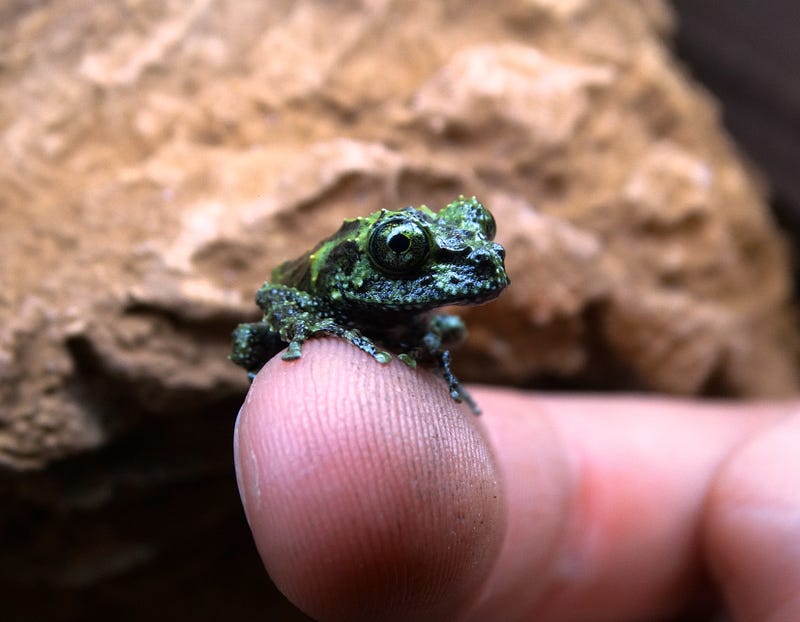
Meet the ultimate camouflage artist, a Vietnamese Mossy Frog, at Cotswold Wildlife Park in England. Reptile keepers have been thrilled by their successful breeding of this species.
The first batch to hatch were eight Mossy Froglets, who hatched under the watchful eye of the dedicated reptile team. In the early stage of their development, the froglets were kept off-show in the Reptile incubation room.
Curator Jamie Craig, said, “We treat the rearing of any amphibian to adulthood as a success. The metamorphosing stages can be very tricky, and we are delighted to have had repeatable successes with our Mossy Frogs. They are growing well, and we hope to create a new display for them.”
They are so well camoflaged in a mossy green environment, that visitors to the park often struggle to see them.
Vietnamese Mossy Frogs (Theloderma corticale) were first recorded in 1903 on the steep mountain slopes of Northern Vietnam. Due to their remote location, they’ve been out of reach for scientists and researchers for decades, and very little is known about this species in the wild.
Their camouflage has been described as one of the best in the amphibian world. Rough, bumpy skin, combined with complex green and black colouring, makes them almost indistinguishable from a lump of moss or lichen, enabling these tiny frogs to blend in perfectly with their surroundings and avoid detection by predators. When frightened, they curl into a ball and remain motionless, mimicking death to avoid further harm.
In the wild, this species breeds by larval development in rock cavities containing water and also in tree holes. It takes approximately one year for a tadpole to become a fully developed adult.
Researchers have discovered that Mossy Frog tadpoles can exist in water for months without developing, but they metamorphose into Froglets within days when the water dries up.
Folklore
Frogs have appeared in legend and folklore in many cultures throughout history. Chinese legends involving frogs date back to 4 B.C. — 57 A.D. Special temples were built specifically for frogs. In these temples, live frogs were encouraged to stay with offerings of food and water. When the amphibians wandered away from their appointed homes, they would be brought back to the temple accompanied by drums and music. In ancient Egypt, carvings and religious statues were made in the image of frogs. Archaeologists have also discovered embalmed frogs in some Egyptian burial sites.
Mossy Frog facts
- Experts at Cotswold Wildlife Park say, researchers have discovered more than a dozen fascinating new species of amphibians and reptiles in the Mao Son and Tam Dao mountain ranges of northern Vietnam since 1982.
- In the wild, their population numbers are threatened by habitat destruction and demand by the global pet trade.
- They are also known as the Tonkin Bug-eyed Frog.
- Some Frog species possess teeth. Known as “vomerine teeth”, they are located on the roof of their mouths. Their function is to grip food in conjunction with their tongues, but they also stop prey from fleeing.
- Frogs do not possess a hard palate. To swallow food, they pull their eyes down into the roof of their mouth, which helps push food down their throat.
- Frogs drink and breathe through their skin. Many frogs have a dedicated drink patch on the underside of their body for this purpose.
- Frogs were the first creature Sir David Attenborough kept as a child.
- In 2014, scientists discovered the first Frog species to give birth to tadpoles (Limnonectes larvaepartus). It is still a mystery how the males manage to fertilise the eggs inside the female. Frogs have no conventional sexual organs to transfer the sperm.
- Scientists have recorded frogs “throwing” their voices, like ventriloquists, making them extremely hard to locate from their calls.


