

SOLAR CELLS BREAKTHROUGH
Breakthrough in Quantum Dot Solar Cells Redefines Energy Efficiency
Korean researchers have broken the ceiling by developing the world’s most efficient solar cells with this innovation
In a world grappling with the urgent need to transition away from fossil fuels and mitigate the environmental consequences of decades of dependence, innovations in renewable energy stand as beacons of hope. The imperative to address climate change, reduce carbon emissions, and establish sustainable energy sources has never been more pressing. The quest for more efficient and advanced renewable energy solutions is crucial in catalyzing this paradigm shift.
Researchers have utilized varied approaches and experimented with different materials to enhance the efficiency of solar cells. The utilization of multi-junction solar cells, with layers of semiconductors tailored to absorb specific light wavelengths, broadens the spectrum of captured sunlight. Tandem solar cells, stacking multiple layers to optimize light absorption, especially when combining materials like silicon and perovskites, contribute to increased overall efficiency.
The integration of perovskite materials, known for their light-absorbing prowess and cost-effective production methods, has proven revolutionary. Advancements in silicon solar cells, employing improved passivation techniques, further enhance efficiency. Additionally, innovations in materials, coatings, and solar tracking systems collectively underscore the dynamic evolution of solar cell technology, reinforcing solar energy’s position as an increasingly potent and competitive power source.

“Previous research on QD solar cells predominantly employed inorganic PQDs. Through this study, we have demonstrated the potential by addressing the challenges associated with organic PQDs, which have proven difficult to utilize.”
~ Sang-Hak Lee, First Author of the Study
Today we delve into one such groundbreaking development that holds immense promise in reshaping our energy landscape — the advent of the world’s most efficient Quantum Dot Solar Cells. Led by Professor Sung-Yeon Jang from the School of Energy and Chemical Engineering at Ulsan National Institute of Science & Technology (UNIST), a team of researchers has unveiled a novel ligand exchange technique, demonstrating exceptional performance and efficiency retention even after long-term storage.
This cutting-edge QD solution incorporates an innovative approach involving the synthesis of organic cation-based perovskite quantum dots (PQDs), ensuring outstanding stability while suppressing internal defects in the photoactive layer of solar cells. The growing interest in quantum dots (QDs) is underscored by last year’s Nobel Prize in Chemistry awarded to three scientists for their advancements in this nanotechnology.
QDs, semiconducting nanocrystals, control photoelectric properties based on size, with perovskite quantum dots (PQDs) gaining attention due to their outstanding photoelectric characteristics. PQD manufacturing involves a simple spraying or application process, eliminating the need for substrate growth. However, employing QDs as solar cells requires overcoming challenges like ligand exchange for reducing distances between QDs.
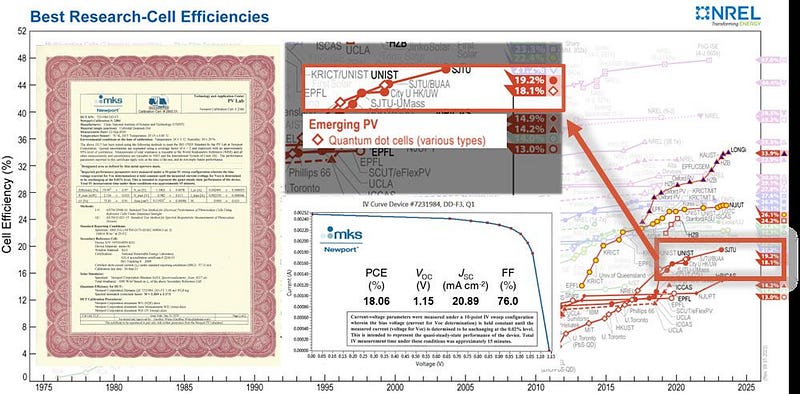
The research team addressed this with an alkyl ammonium iodide-based ligand exchange, enhancing the efficiency of organic PQDs from 13% to 18.1%. These solar cells exhibit remarkable stability, maintaining performance even after two years of storage. The breakthrough allows for simultaneous high efficiency and stability in organic PQD solar cells.
Researchers believe this study not only marks a significant milestone in the realm of organic PQDs but also charts a novel course for the ligand exchange method. Serving as a catalyst, this study opens up new possibilities and holds the potential to revolutionize the landscape of QD solar cell material research in the future. The breakthrough achieved in enhancing the efficiency of organic PQDs, combined with their exceptional stability, paves the way for advancements that could reshape the trajectory of solar cell technologies.
Complete research was published in the Journal of Nature Energy.
➱➱➱➱➱➱➱➱➱➱➱➱➱➱➱➱➱➱➱➱➱➱➱➱➱➱➱➱➱
Read my daily newsletter by subscribing to Faisal Khan on Substack.
Stay informed with the content that matters — Join my Mailing List.
➱➱➱➱➱➱➱➱➱➱➱➱➱➱➱➱➱➱➱➱➱➱➱➱➱➱➱➱➱
Originally published at https://khanfk.substack.com.


