
Breaking News From My Meditation Cushion
After 3 years, it’s time to chart a new course
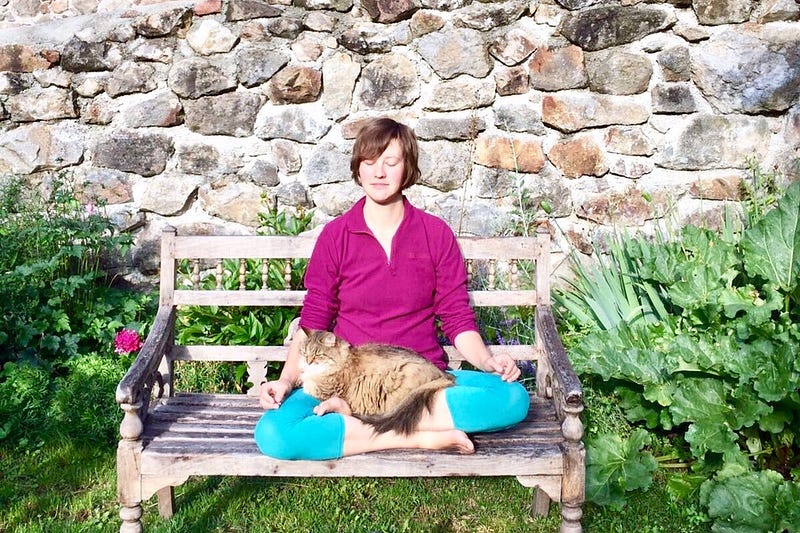
I have been meditating for a little over three years now. This means that I stopped considering myself a “newbie” and started thinking that I was “somewhat experienced.”
A few friends started turning to me to ask about how to meditate. Boy, did I feel flattered.
Well, meditation doesn’t delete the ego that fast. Not over the course of three years. At least not in my case. I still have experiences of pride, shame and other separate-self-induced perceptions. That’s okay.
But until last week, I thought I already had a good idea about how to work with my attention and awareness, in order to see the lasting transformation in my mind. It felt like I was progressing, slowly but steadily. It sometimes even felt like I knew what I was doing.
I even wrote a guide telling people how to establish their mindfulness meditation practice!
And then, last Sunday, I started reading The Mind Illuminated. Only 8% in on my e-book reader, I already know that this book is changing everything about my meditation.
Where do I even start… Maybe with the fact that I am currently in the middle of a postgraduate course on mindfulness, meditation and the use of these practices in psychotherapy. We have group mindfulness practice there, as part of the programme. It is guided by professionals, including academics that work to unify Buddhist teachings with what psychology and neuroscience are discovering today.
I never questioned whether I was in good hands. And maybe I am in good hands — that’s still beyond my ability to judge. But what I realized is that there is one significant detail I have been failing to take into account.
This detail is that there is a difference between practising mindfulness to cope with everyday stress and practising it to attain enlightenment. And, no matter how much I try to cheat myself, the truth is that I am ultimately interested in the latter.
I realised this immediately when I started reading The Mind Illuminated. What I care about is seeing the true nature of reality, even if the path leads through hardship and suffering. And sure, I am interested in diminishing the suffering as well. But not in a superficial way, by distracting myself.
I believe that lasting relief from suffering only comes from seeing the true nature of it.
I am studying mindfulness at the university out a motivation that is very different from the one that brings me to the meditation cushion. While the latter is a truly internal drive, the former comes from a more “worldly” place. I want to learn about meditation from the scientific point of view, so that I can validate what I am doing in front of other people.
And this is not necessarily a bad thing. I don’t believe that it’s a bad thing to try to get ahead in the physical world and to take charge of my life in that realm. And in the paradigm we are currently living, scientific validation is still the “quality stamp” required for the society to accept that meditation is a thing. I’m fine with that and I will tag along — because I dropped the pursuit of fighting against the world.
I’d rather work with it, than against it.
But the question of my own practice still stands. Something is definitely changing, and I am only beginning to grasp what it is.
One notion I got myself used to was that meditation is never a failure. In other words, as long as I sit down to meditate, this is a success in itself. Then it almost doesn’t matter what actually happens during my practice.
But this approach is a double-edged sword. On one hand, it helps overly ambitious/ perfectionist/ self-critical people to take it easy on themselves during their meditation. At least there, they should be able to let go of the “achievement mindset” and the success-failure duality. And for the longest time, I know I needed this approach. I was sick of beating myself up in other areas of my life — so meditation had to be that safe harbour.
And it was — until I started taking it too light-heartedly for where I ultimately wanted to arrive. This is not to say that meditation cannot be a pleasure and a practice of simply letting go. Sure it can, it is for many people, and it has been for me, probably becoming my saving grace.
But at some point, you have to ask yourself what you want out of your meditation. Or, in other words: why are you even doing it?
Dealing with stress, anxiety or depression are all valid reasons. So is improving your relationships, better concentration and other mental faculties. Any ethical reason is valid, I guess. And so is mine: touching upon the true nature of reality.
I was shying away from this true motivation of mine for too long. It arose in me some time ago, but because of this mindfulness-as-a-competence context I was immersed in, I never came to verbalize it. This article is probably the very first time I am doing it.
And I feel both grateful and relieved that I am.
With acknowledging my true motivation to meditate, the need for an adequate technique came along. This is where The Mind Illuminated is showing me a new direction.
The mindfulness training I have received so far is too watered down to actually give me what I am looking for.
Let me explain — because I don’t want to sound like a douche who doesn’t appreciate the teachers she encountered so far. Of course I do. Everything I received until now brought me to who I am and what I’m saying today. So I couldn’t find one reason for not appreciating all that I experienced.
But I think I am starting to better understand the mechanics of meditation practice. And along with that comes the realization that the mindfulness approach I embraced in the past can only take me so far on my path to enlightenment.
In the environment I have been meditating in — including lots of guided meditations — the approach I see is to make you experience a bit of everything. We often did a few minutes of stable attention on one object, then switched to “all-encompassing” mindfulness. An hour later, we did “loving kindness” meditation to envelop ourselves in the feelings of acceptance and safety. Then visualisations. Then we were told to “drop the idea of meditation” altogether and “just be”, without making any effort.
These are all curious experiments and I enjoyed them. But in the end, they make me spin in circles. Because by trying a little bit of everything all the time, I am not really transforming my mind in a lasting way.
I am not charting any particular course for this work.
Reading The Mind Illuminated makes it clear that in order to change the quality of the whole of my conscious awareness, I have to master the basics first. I cannot arrive at broad and alert mindfulness as a default state of being (which is how I understand enlightenment) without mastering stable focus on a single object first. It would be like trying to build the roof of a house without laying the foundation first. This process has to happen in a specific order.
And so, since a few days, I am back to the basics of meditation. All I am trying to do is to keep my attention on the breath in one chosen place in my body for the entire duration of my practice. When I realize that my attention drifts away, I bring it back. And not only do I bring it back — I also take a moment to appreciate my mind for remembering about the breath.
This is the only way to create positive reinforcement, which will gradually condition my unconscious mind to remember what I intend to do here.
Starting back at the “beginning” of meditation practice after three years is humbling. No matter how much intellectual knowledge about meditation I gathered over that time, when comes to the practice I am still a baby. I still can’t continuously keep my attention on the breath without getting distracted.
And that’s fine. Because if I learned one thing from these three years, it is not to judge myself for my meditation progress.
In that sense, taking it easy on myself and maybe even spinning in circles for a while was not a waste of time. It taught me that it is possible to pursue something without becoming attached to any specific results. Meditation has become a default part of my day, like brushing teeth or eating breakfast. It is something I just do, without questioning the reasons, motivations and necessity behind it.
But last Sunday, I finally did question all of those things. I received a new framework in which to continue this inner work. I am experiencing a sense of purpose, intention and excitement that I never felt towards meditation before.
I am infinitely curious where this is going to take me from here.