
Breakfasts and Juvenile Hearts
Grab your ideas because you’ll be grabbing your life
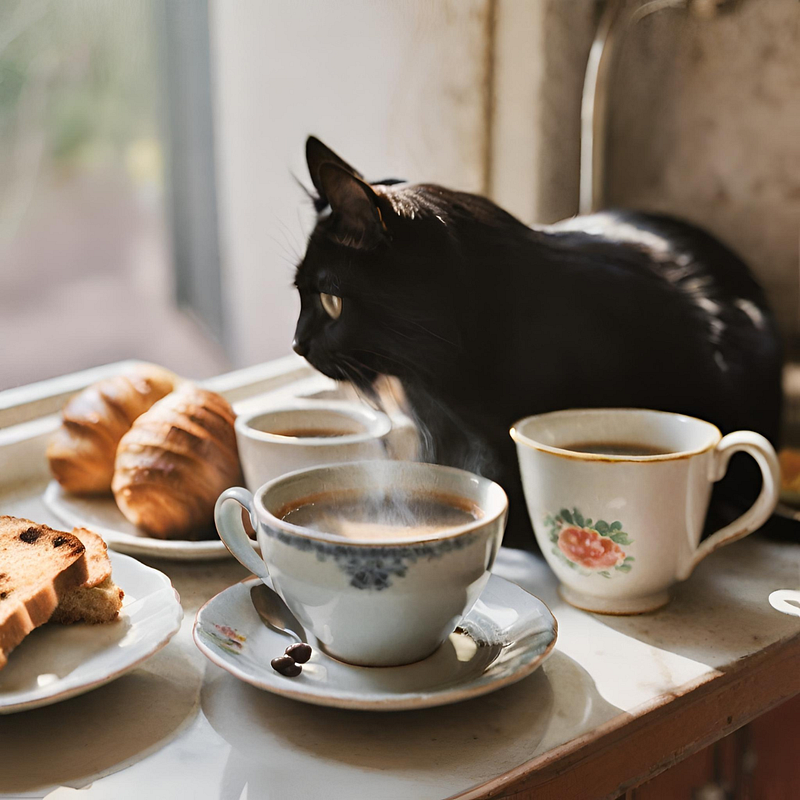
Breakfast is my favorite meal of the day.
It is not just because I indulge in the coffee beans that I grind every morning, the boiling water poured over that ground, and the scent that springs from the kettle into the mug.
It’s a sight flooded with aromas that alone awaken me. I also enjoy the fresh Serra da Estrela goat cheese; if it’s autumn, it pairs well with a pumpkin and walnut jam.
I then play tricks on the diet imposed by my nutritionist and constrained by my conscience, which, still half-asleep, copes very well with this fact after the first bite of that cereal bread and the first sip of that hot coffee.
I rarely leave any coffee on that mug, and even when I insist on not drinking more, I always take it to the office, where it remains, with some leftover all day. Perhaps I desire to cling to that awakening feeling. But it’s not just for this that I love breakfasts.
I’ve always enjoyed the calm of the mornings, the association that comes with the beginning of a new dawn. Many changes, revolutions, and resolutions have always been made in the morning, especially after a good night’s sleep.
In the morning, a thousand and one ideas come to me. They are just like dreams, catapulting but also fading away with awakening. But they are there, almost within reach, in their embryonic phase, wanting to develop, perhaps to come out.
One rushes urgently to any piece of paper or, of course, to the mobile phone to write them down. But the latter option is always a huge risk. Until you get to a place where you can write a few words, the myriad distractions typical of modernity invade our eyes. It’s halfway certain that 90% of those incredible ideas in our minds have faded by then.
The most distracted ones give in completely. And the more concerned I find myself, quickly I find all the dreams they had to be ridiculous in the face of the awful tragedy unfolding in the world.
Thus, the ambition to talk about poetry or the most beautiful prose fades away when we are invaded by countless horrendous news. A person like that, where I belong, can’t take it as if it were nothing, and they leave their ideas behind.
But today, at breakfast, still horrified, I still tried to hold on to some beauty. I picked up old-school textbooks from my teenage years. I looked for excerpts of texts where some beauty can be found. They are all beautiful, even in their sadness, something so Portuguese. But all of them closed in our Portuguese-ness, or they wouldn’t be textbooks of the Portuguese language.
One of them spoke about the heart at the age of 15. Not the almost mechanical and organic pump that pulses blood through our bodies. No, not that way. But the heart and the soul at fifteen. Of course, I immediately started thinking about my age when I was fifteen, and I realized that my fifteen was, as described, a time when everything was heavier. The author said:
‘There’s a lot of crying. At 15, everything is very important. You’re a new person for the first and only time in your life, and the world, difficult and vast, is understood and weighed as it is. (From 16 onwards, you can’t stand it and pretend it’s easier or smaller.)
At 15, everything is very much, and it’s all at the same time. There are many things you want very much, and you suffer a lot for not having them, and you cry out to the heavens how much you really need them, and it seems impossible that no one understands.
And it’s amazing how everyone comes together to prevent us from achieving them. And it’s very sad to know that it will be like this throughout life, which is how long it lasts to be 15 years old.’( Miguel Esteves Cardoso)
I closed the book, and my cat climbed onto the table.
I couldn’t continue reading, but I didn’t need to. In my mind, I continued that text about my own life. Oh… I remembered Claudio, that platonic passion that made me cry my soul out without really understanding why.
So, I confirm there is a lot of weeping without knowing why. Perhaps, looking at things now, they are evolutionary phases and merely that. I closed that chapter and considered what happens next in life.
From that, I now wanted a text about being in your twenties. With more distance from that stupid age filled with haughtiness and arrogance, I thought maybe I could have written a few words. But the television my husband just turned on completely distracts me, finally shattering any intention of writing.
I remembered this while following on social media the life of a cousin of mine of that age.
She could represent that.
It’s tremendous arrogance and merely a continuation of adolescence, with all the confusion one has, but now with the insolence of pretending to know more than everyone else or having more personality for following this or that. She’s so much into everything that is weird and thinks she’s achieved something greater because of that.
Oh my, who hasn’t been there?
I held onto that last thought; I asked for the television to be turned off because I couldn’t bear any more unjust things being said, messages being distorted, and people’s lives being dehumanized.
I locked the doors of my office and let the cat in. The poor animal must see me as a mother. Every day, it’s the same thing. It stays behind the door, meowing incessantly for me to let it in.
Every day, I try to make her lose her dependence on me, and almost as if I were really her mother, I open the door, giving up, and she immediately climbs onto the chair next to the computer.
I have a handkerchief with my perfume lying there, which inevitably also smells like her now.
Stumbling through the office, almost always in vain, trying to organize the stack of books that spreads everywhere, I come across an old notebook that I still thought was recent, but I realize that years have gone by.
That pink notebook was an attempt to establish a written diary at 23, ten years ago or more.
What was written was sad and beautiful. Sad to read something so distressing; beautiful because there were accounts of breathless loves, still some traces of youthful passion and hearts that beat at the mere thought of the person they love.
But notice now, readers, the beauty of the simple prose of someone who at that time wrote simply for herself, without any concern for external criticism:
‘Today, while walking on the street, I saw someone who caught my attention. I saw him from a distance, but I looked at him closely. He was very similar to my teenage love, Claudio, undoubtedly very similar to him. (…) I want to write more because I want to think and live more.
I am still very lost with this thing about working as if I had stopped having my life, and I am afraid of it, in fact, very afraid. And I have to go rest, and damn it, I didn’t even write about the strange man who was in the cellar today.
He wore glasses, drank a ‘crusted’ wine, and took notes in a small black notebook he had with him, not to mention the bag he had hanging around his neck with his money hidden inside his shirt.’
Days later, another entry in the diary recounted with trembling words the anguish mixed with desire when I unexpectedly met on the street the first man who made my ground shake:
‘For the first time in my life, I finally crossed paths with Artur on the street by chance. Worse, at night, when I was with French people near the street of Clerigos and doing the fado tour for the first time.
So I turned to tell them about that bookstore, and on the road while crossing the pedestrian crossing, I came across a car, and it was him.
I’ve thought about looking at someone and thinking he was similar, but that night, it was definitely him because I immediately had my heart racing, my throat dry, coughing, sweating… everything.
I think he didn’t see me, and if he did, he may not have recognized me because of my short hair.
Life is a stepmother.
Most of the time, I still can’t believe that the greatest passion of my life is already married to another woman, not me.’
A part of me froze when reading this account. I felt the pains of that girl pretending to be a woman. And another part of me, almost laughing at the future that also finds itself in the past, finally closed the diary when the last entry in the book, two years later, wrote:
‘Incredible to read about Artur. Incredible that he is divorced. And it’s not a joke. It’s true.’
It must have been one of the last times I wrote a diary, destined only for myself, closed at that time with a thousand and one keys. I put the diary back where it was, amidst other books where I sometimes seek inspiration.
There are so many.
They accumulate in the hundreds in the office, like a collection.
Breakfasts are like this: proteins and energy are ingested for the day that begins. But there are also sweet desserts like this, that, if you’re lucky, give you a journey to your past, which is sometimes close to us if we only open a forgotten book in some closet.
Hello, I’m Araci, a female writer from Portugal. I like to write about my country, Portugal. But I also enjoy politics, economics, and issues concerning the climate crisis I’m witnessing in my life and where I live.
If you have enjoyed this article, maybe you would like to buy me a “coffee” here: https://ko-fi.com/joanaaraci. You can also join Medium now for only 5$ a month! This gives you access to thousands of articles!
If you do it through my referral link, part of your membership fee directly supports me. Here it is:
You can also find more about me here:


