
Breakfast with Billy Collins
Parasocializing with poets and writers can revitalize your mind

Different Books for Different Times of the Day
I often read many books during the same period of time. Right now, for example, I’m reading a recent thrift store acquisition, Shambhala, The Sacred Path of the Warrior by Chögyam Trungpa during fringe moments of the day. His direct style and crazy, lucid wisdom glue the odd, temporal fragments of the day together into a floating mosaic that settles my soul. His thought process also grounds and deepens my respect for Pema Chödron, his most famous student and one of my favorite teachers.
On daily walks in the mountains, I’m listening to psychologist Ethan Kross explain his research on the good, the bad, and the ugly of self-talk and how we can harness it to enhance our mental health in Chatter. He’s a wonderful storyteller and breaks down the complexities of his topic into nicely organized, bite-sized pieces. (Look for an article soon on my Kross insights.)
Bedtime reading on Kindle is We Begin at the End by Chris Whitaker. Warming up to Whitaker’s characters has been a struggle — a scrappy teenage girl and her six-year-old brother, their loving but scattered and addicted mother, the paunchy town sheriff with Parkinson’s (an old friend of the mother’s), and the Bad Guy whose name is, I kid you not, Dickie Darke. Whitaker’s narrator has a bizarre vernacular and style, both of which annoyed and distracted me at first, but for the love of Duchess (the scrappy teen I’m beginning to care about), I’ve learned to accept both as part of the deal.
And breakfasts are with Billy Collins. That golden sliver of the day bursting with promise belongs to poetry, and there is none better than the wit, humor, strangeness, and charm of Collins. Sailing Alone Around the Room is one of my favorites and the collection I recommend to those unfamiliar with his poetry.
Meeting Billy Collins
A couple of years ago, I was browsing the poetry section in Magers and Quinn, a favorite haunt in Uptown Minneapolis. As I looked through the stacks, a 20-something guy standing close by asked if I’d ever heard of Billy Collins. I said I had, and he asked if I could recommend one of his books.
I felt sheepish about responding. At the time, my knowledge of Collins’ poetry was limited to a YouTube video of student Jackson Hille’s recitation of “Forgetfulness” I’d used to teach pronunciation to ESL students at the University of Minnesota (completely charming and highly recommended), and to a few animated poems, Collins presents in his TED talk Everyday moments, caught in time. (If you don’t have time to watch the TED talk now, bookmark it for later.)
I’d used the video and TED talk several times in classes and felt as if I knew Collins’ poetry, but faced with this request for a recommendation, I realized how small was the scope of my knowledge. The customer asked a bookseller for help, picked something off the shelf, and left.
My browsing was now focused. I went to the area with shelved volumes of Collins’ work and chose a copy of Sailing Alone Around the Room, for no reason, in particular, I can recall. Imagine my surprise when I opened the first few pages and found this:
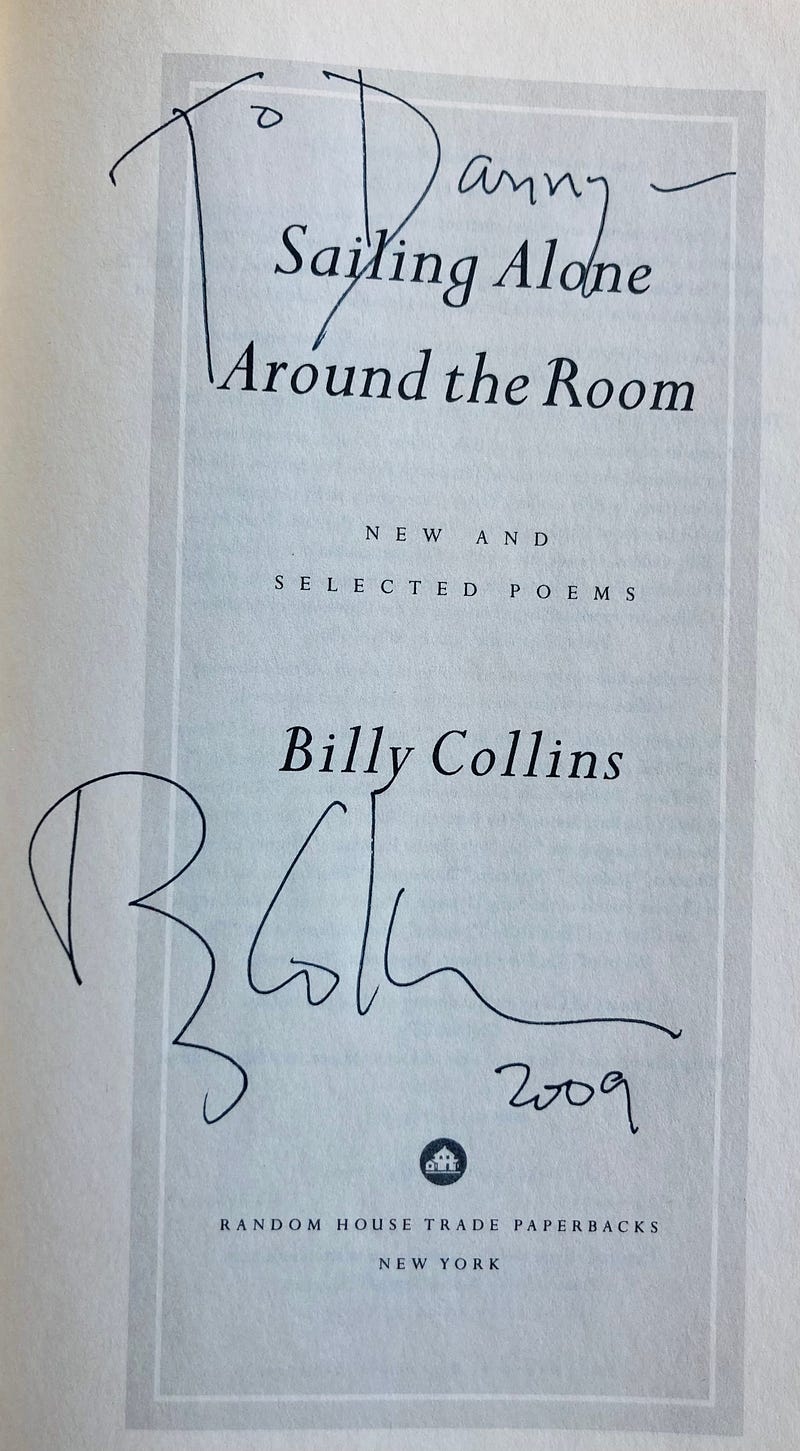
I silently thanked Danny for releasing this copy into circulation again, and Magers and Quinn for not charging extra for a signed book of poetry by a former U.S. Poet Laureate. Even though the autograph had not been meant for me, the evidence that Collins had handled this particular copy, however fleetingly, made it feel that our rapport was moving to the next level. Thus began my deeper relationship with Billy Collins.
Writing Makes Thought Visible
Lately, I’ve had fun using Sailing as an oracle of sorts. I flip through the pages fast, read the poem that comes up, and reflect on how it does or does not relate meaningfully to my life. This morning, I landed on “Tuesday, June 4, 1991” (58).
The poem celebrates the power of writing down experiences to help us fully inhabit and remember the moments of our lives. As we write, regardless of whether we are reminiscing or anticipating, we are completely there, on paper or screen, if for no other reason than the attention required to write or keyboard.
Either way, the main attraction is thought becoming visible, moment by moment by moment. Better still, unlike conversation, traces are left that attest to the experience. Writing does this for us: it is a practice that keeps us present and catalogs that experience.

Out for a Ride
As the poem unfolds, 15 stanzas chronicle an ordinary morning in June. I have no idea what Collins’ experience was in writing this poem, but as his companion, I get to ride in a vehicle with a well-tuned verbal engine that keeps going without the slightest sputter. I look out the window on the passenger side, sipping coffee and taking in the view.
I feel like the secretary to the morning whose only responsibility is to take down its bright, airy dictation
We round another easy curve in the road:
This is what stenographers do in courtrooms, too…
And now I hang on as we take a hairpin turn:
This is what Samuel Pepys did, jotting down in private cyphers minor events that would have otherwise Slipped into the dark amnesiac waters of the Thames. His vigilance finally paid off when London caught fire
I do a quick search and meet Samuel Pepys, a 17th-century British member of Parliament and celebrated diarist whose chronicles recorded The Great Fire of London in the year 1666.
as [my vigilance] does when the painter comes in for coffee and says how much he likes this slow vocal rendition of “You Don’t Know What Love Is” and I figure I will make him a tape when he goes back to his brushes and pails.
I find out more about this love song I have never heard of and discover a beautiful version by Nina Simone.
My Window, His Window
One great thing about socializing with a person on paper is enjoying the freedom from ordinary laws of physics. I gaze out the window of the poem as it twists and turns, and he gazes out another window on the day he wrote it:
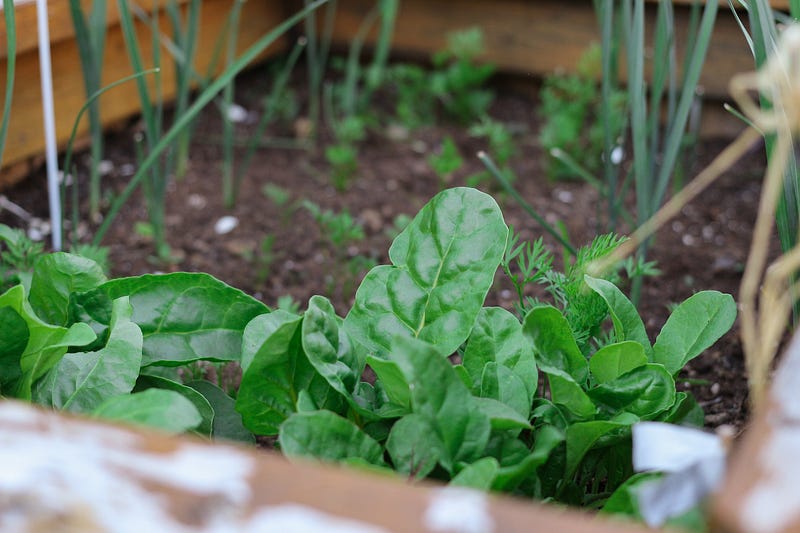
If I look up, I see out the window the white stars of clematis climbing a ladder of strings, a woodpile, a stack of faded bricks, a small green garden of herbs, things you would expect to find outside a window,
all written down now and placed in the setting of a stanza… Yes, this is the kind of job I could succeed in,
an unpaid but contented amanuensis whose hands are two birds fluttering on the lettered keys…
Maybe like me, you wondered what “amanuensis” means. I recommend looking it up and especially listening to its pronunciation. It's the kind of word I could enjoy saying out of the blue, just for the sound of it.
A Fanciful Parasocial Poetry Performance
As guests wait for the reading to begin, I notice Ethan Kross and Chris Whitaker, who happen to be seated next to each other, in a lively conversation. I imagine them trading ideas about the role of self-talk in stream-of-consciousness narration. Can a character’s tendency to be immersed in their personal story suggest emotional instability? I make a mental note to check in with them and to write that one up sometime soon.
Talk among guests subsides and silence gradually descends. At two podiums, several feet apart and oriented slightly towards each other, Billy Collins and Chögyam Trungpa are ready to deliver a unique performance — a dialogue consisting of excerpts from Trungpa Rinpoche’s chapter “Nowness” (Sacred Path) and stanzas from Collins’ poem “Tuesday, June 4, 1991.”
Trungpa Rinpoche:
The way to experience nowness is to realize that this very moment, this very point in your life, is always the occasion…This is one reason that your family situation, your domestic everyday life, is so important. You should regard your home as sacred, as a golden opportunity to experience nowness (96).
Billy Collins:
By the time I get myself out of bed, my wife has left the house to take her botany final and the painter has arrived in his van and is already painting the columns of the front porch white and the decking gray (58).
Trungpa Rinpoche:
Appreciating sacredness begins very simply by taking an interest in all the details of your life. Interest is simply applying awareness to what goes on in your everyday life —
Billy Collins:
It is early June, a breezy and sun-riddled Tuesday that would quickly be forgotten were it not for my writing these few things down as I sit here empty-headed at the typewriter with a cup of coffee, light and sweet.
Trungpa Rinpoche:
Such awareness can help to free you from speed, chaos, neurosis, and resentment of all kinds. It can free you from the obstacles to nowness, so that you can cheer up on the spot, all the time.
And so it continues for several more minutes, two narratives interlaced in a strange and impossible performance, for Billy Collins would not write his poem until four years and two months (to the day) after Trungpa Rinpoche’s death.
Applause is warm and enthusiastic, and the audience asks many good questions. The evening draws to a close, and Billy approaches to say goodnight. “Thanks for arranging this. Breakfast tomorrow?”
“It’s a date.”
Thanks for reading my story.
Who are your favorite authors? Have you ever wondered what they would say to each other if they had a chance to meet for casual conversation?