
Brave Texas Christians Risk Everything to Support Trans Kids
The resistance network they’re forming reminds me of Christian idealism that formed me as a child
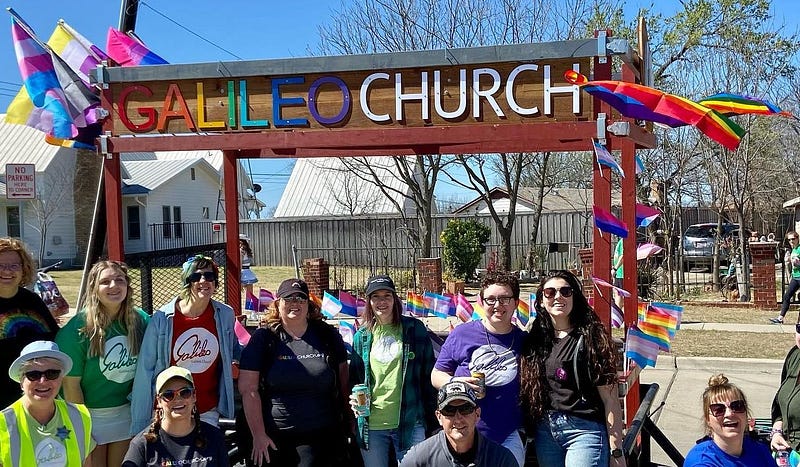
I read a story yesterday that made my heart sing, that thrilled me and filled me with positivity. A Christian church in the Dallas area has launched a resistance network to care for transgender teenagers the Texas government is persecuting.
Those resistance leaders, who are risking arrest and imprisonment, remind me of my youth, of my former Christian idealism, and of the very best impulses of Christianity and Jesus followers — even though I’m a gay man and queer advocate who often feels persecuted by Christianity.
If you’re confused, don’t worry. So am I. Before I tell you about that resistance network, I have to tell you about falling in love when I was 14.
I will never forget the missionary boy who made my heart sing. I was just about to start high school, and, wow, was I ever conflicted. I had long known I was gay, but I was a devoted Christian who had totally internalized hateful Christian doctrines about myself.
“Paul” was a couple years older, and I tried hard to convince myself I had a simple case of hero worship. He and his parents were on sabbatical from the rainforests of Brazil — doing a year-long church fundraising tour. They knew somebody in our congregation, so after they did their rainforest presentation for us one Sunday night — after they passed the hat and took pledges — they announced that Paul would be staying with church families for the summer while they kept moving.
I did not mind!
I tried to deny to myself that his shiny black hair and piercing blue eyes captivated me, that the beginnings of stubble on his razor-sharp jawline compelled my interest. When he tagged along to church camp with our youth group, I desperately tried not to notice the swelling muscles of his shirtless chest as we dove off dead trees into an icy lake.
Brave? Bold? Fearless? Charming? Sweet?
At 16 years old, Paul was all of that. And I was smitten.
His stories around the campfire stunned me romantically, but not in quite the sense you might figure. I’d grown up on romantic tales of courageous Christian missionaries who risked life and limb to spread the Gospel — sometimes dying in hails of arrows, sometimes thrown into government dungeons and executed.
Paul was just a teen, but he’d actually DONE that already!
As we all roasted marshmallows, mouths agape, he almost whispered his story. How he and his parents (with some fellow missionaries) stepped off a dugout canoe into an isolated village on the shores of an Amazon tributary, carrying gifts for children plus crates of Bibles and Christian tracts newly translated into an indigenous language.
As our crackling fire competed with his anxious voice, he explained they had miscalculated, had traveled much further up the river than they realized. (No GPS in those days, youngsters. Land navigation was an arcane art, especially under a dense forest canopy.)
Paul and his folks quickly realized how badly they had erred.
They were not among friends! His linguist parents didn’t understand a word of the villagers’ language. The missionaries tried phrases from other indigenous languages, and from Portuguese, getting nothing back but hostile stares.
Then somebody snarled and raised a bow. An arrow thunked right into the canoe, mere feet from Paul’s mom.
Paul said he’d never, ever felt so scared. A few more arrows flew, none hitting the missionaries. They backed slowly into their canoe. They slowly pushed away from shore. They got down low and drifted away before starting the outboard and roaring downriver, breathing prayers of thanks to still be alive.
“And you’re going BACK next year?” I gasped.
“Yeah, but it’s not that big of a deal,” Paul said, casually spearing a marshmallow. “It’s not usually scary. We made a mistake is all. It’s usually just hot and uncomfortable.”
“Oh. Wow.”
I couldn’t make out his blue eyes across the fire, but I just KNEW they were piercing my soul.
“It’s what Jesus wants us to do,” he explained. “He needs us to be brave for him. He suffered on the cross for us, so I can be uncomfortable and scared for him sometimes. That’s how I see it, anyway.”
How conflicted I felt! Half of me wanted to jump across the fire and throw myself at Paul and then … well, the details were hazy, but kissing was definitely involved. The other half wanted to throw myself at Jesus and devote my life to his service.
I spent the rest of the summer following Paul around like a puppy, which he tolerated with remarkable kindness before disappearing back into mission work.
I never saw him again, but I suspect he’s one reason why I eventually DID devote my life to service, although not to service of Jesus. A year or so after Paul left, I accepted my innate homosexuality and rejected Christianity. Back in those days, progressive Christianity barely existed, and queer-affirming Christianity was even more rare. I saw no path to reconcile Christianity with myself or my emerging science-based, rational understanding of the world.
Nevertheless, Christianity shaped me. Paul shaped me. My idealistic anti-racist Baptist preacher dad shaped me. Romantic ideals of service and sacrifice became core components of who I was and who I remain to this day.
(By the way, I mean none of this to endorse the mission work Christians do in the Amazon or anywhere. I’m simply relating my formative experiences as a child. To be clear, I don’t like the idea of anyone imposing culture on indigenous people.)
Christian enslavement and the Underground Railroad
I’m not quite ready to write about Texas yet. Hang on for one more minute, please. I don’t think I could write a story about principled Christian resistance without mentioning the Underground Railroad.
Look, the history of Christian involvement in U.S. chattel slavery is complicated. White Christians unquestionably used their religion to enable and support the chattel slavery of Black people — for centuries. But White Christians also fought against and resisted enslavement.
Both sides of the story matter.
During the U.S. antebellum (pre Civil War) period, White enslavers used Christianity to justify slavery and to try to pacify enslaved Black people. For example, enslavers printed so-called Slave Bibles that omitted references to the exodus of the Hebrew people from slavery in Egypt. The altered Bibles emphasized passages encouraging obedience and submission, that stressed the restful joys of the afterlife for those who obeyed their masters and toiled hard.
Even after slavery was finally abolished, many White Christians used the Bible to justify Jim Crow laws, segregation, and the criminalization of “mixed” marriages. White Christian defense of segregation lasted right up through the 1980s, when the Supreme Court ruled that the IRS was correct to deny tax exemption to Bob Jones University unless they ended racist segregation on campus.
Bob Jones was then and remains a mainstream, popular, powerhouse Christian institution in Greenville, South Carolina. They continued to justify racist segregation on Christian grounds after the ruling. The summer I fell in love with Paul, Bob Jones still refused to permit “interracial dating” among students or to hire faculty in “mixed” marriages. Administrators justified racism with Christian theology, as did most White Christian churches in the American South and many in the North. Suffering financially, Bob Jones ended their racist practices in the year 2,000.
Finally, in 2008, the university officially abandoned racist theology.
Stepping back to the antebellum period to explore the other side, some U.S. White Christians (especially Quakers and other principled pacifists) took revolutionary moral stands against slavery, not just opposing it, but resisting it. Some of those Christians resisted politically, forming powerful movements seeking to abolish slavery, movements that eventually pushed slave-owning states into seceding from the Union, starting the Civil War.
Other White Christians resisted personally, joining networks of free people of color and enslaved Black people to help enslaved people escape their enslavers — sheltering them as they fled to Canada and freedom. This freedom network was dubbed the Underground Railroad, and while it was not officially Christian, many “conductors” were Christians (Black and White) acting out of Christian idealism.
Underground Railroad conductors resisted at great personal risk. Some were fined into poverty. Others were imprisoned. Conductors who were free people of color were often enslaved or re-enslaved. Enslavers murdered conductors of all status when they captured them. They often shot Black conductors on sight.
When I think of principled Christian resistance, I can’t help but remember Paul’s idealism. So, let’s talk about Texas now
At the tender age of 16, Paul was ready to give up most creature comforts and even to risk his life in the service of others. He knew from direct experience that his service could get him killed. I believe he was deeply wrong to evangelize and proselytize, but I admire his self-sacrifice and idealism.
That’s why I immediately thought of him (and of Underground Railroad conductors) when I read the story about a Christian resistance movement being established in Texas to succor and support transgender youth.
For background, Texas has all but declared war on transgender people, especially trans teenagers. The Republican legislature has outlawed gender-affirming care (meaning puberty blockers and hormone-replacement therapy) for trans people under the age of 18. The law provides a temporary exception for youth already in treatment, but requires their physicians to “wean them off” treatment — at risk of criminal prosecution.
Hospitals and health care networks responded quickly — in many cases before the law even became final — eliminating gender clinics and shutting down practices. Some pharmacy chains discontinued dispensing drugs prescribed for gender-affirmation therapy, leaving trans teens and even adults out in the cold — even when they’re still legally entitled to follow their doctor’s guidance.
This leaves them at high risk of mental health issues, including severe depression and suicidal ideation.
Texas social workers are increasingly investigating the parents of trans children for child abuse, threatening to remove custody from parents who affirm their child’s gender. Courts have stopped some, but not all, of those investigations.
The Pentagon and many corporations have offered humanitarian reassignment to trans people and families with trans children, but that’s small relief for the bulk of queer Texans who lack the means to pick up and move across the country.
Enter Galileo Church of Kennedale, 30 miles east of Dallas
The congregation, which meets in a big red barn, describes itself on Facebook as, “A quirky, LGBTQ-friendly church seeking spiritual refugees in Fort Worth, Texas, and beyond.”
Those aren’t just words!
Members are working hard to to educate the public about trans issues, including promoting a major network-news podcast that interviewed trans youth in their community, giving kids and supportive parents an actual voice in their own lives.
Also, Galileo Church has just announced the formation of the North Texas Trans Portation Network. You can read the details for yourself at the link, but the network is raising money to support trans kids in a 19-county area surrounding them. Details are vague, but the help they offer includes at least transportation out of state for medical care.
I asked a civil-rights lawyer friend to look over the website, and his immediate comment was, “Looks they have excellent legal advice. Somebody very smart made sure they aren’t directly incriminating themselves.”
Then he sucked in his breath and whistled. “God love em!”
My lawyer friend knows as well as I do that Texas prosecutors are moving heaven and earth to target groups that support trans kids. He knows as well as I do that Galileo Church is going to find itself under a legal microscope, that conservative-Christian prosecutors will be as creative as possible trying to shut the network down, up to and including criminal investigations.
Has that stopped the Christians of Galileo Church? Clearly not!
When I look into their eyes in the photo above, I remember Paul’s teenage voice. “It’s what Jesus wants us to do. He needs us to be brave for him.” I remember Christian pacifists and abolitionists who risked life and limb to resist slavery.
As the anti-LGBTQ backlash burns out of control in the U.S. and spreads north into Canada, all people of good need to remember and embrace principled resistance. I’m no fan of mainstream Christianity, I’ll freely admit. Christians have oppressed and persecuted me for being gay all my life.
But I love progressive Christians who model the teachings and the life of Jesus. One thing I most admire about the Christian tradition is its reverence for love-based resistance.
That ethos shaped me as a youth, and I’m reminded of it again — thanks to the loving Christians of Galileo Church.
It’s time for all of us to think hard about resistance. How we will personally resist oppressive governments that ban books and criminalize bodily autonomy for women and queer people? I’m going to take a lesson from Christian traditions.
How about you?

My writing is always free to readers who click my social media links, but if you’d like to browse more, click here to join Medium. To get an email whenever I publish a new story, Click Here.