
Bragging Rights — South Africa Has the Best National Anthem in the World
A powerful prayer that brings all races together
Every time I hear Nkosi Sikelel’ iAfrika (Lord Bless Africa), I’m overwhelmed with emotion.
A group of over 50 performers encouraged us to sing our anthem out loud to celebrate our unity and diversity as we went into strict lock down on 27 March 2020.. This turned into a challenge to record themselves singing it.
Through lack of the right equipment, I could not join in (though I sang). What culminated was this virtual rendition performed by over a thousand South Africans!
History
The poet C.J. Langenhoven wrote Die Stem van Suid Afrika (Afrikaans for The Call of South Africa) in 1918. It was the co-national anthem with God Save the King/Queen from 1936 to 1957, when it became the sole national anthem until 1994.
In 1897, Enoch Sontonga, a Methodist mission school teacher, composed Nkosi Sikelel’ iAfrika. He originally wrote the words of the first stanza in Xhosa as a hymn.
Reverend JL Dube’s Ohlange Zulu Choir performed it at concerts held in Johannesburg where it grew into a popular church hymn. It was later adopted as an anthem of defiance against apartheid, representing the Black struggle for freedom, and was banned by the Nationalist government.
Our first President in the new South Africa, Nelson Mandela, proclaimed in 1994 that we would have two national anthems — Nkosi Sikelel’ iAfrika and Die Stem to encourage reconciliation.
Both were merged to form the current one in 1997.
The lyrics
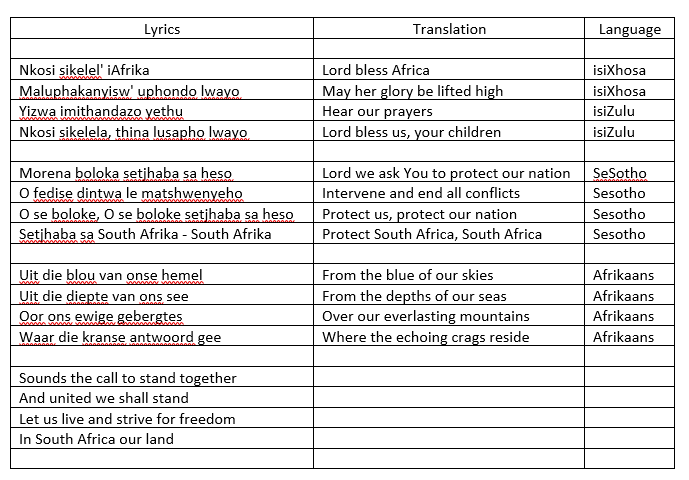
Our anthem is a hybrid of diverse cultures and history.
Although we have 11 official languages, it wasn’t possible to include every one.
The first two verses from the hymn God Bless Africa are written in Xhosa, Zulu and Sesotho.
Verse three in Afrikaans is the first verse of Die Stem , the country’s national anthem during apartheid. The fourth verse in English has the same melody but new lyrics.
Encore
Here’s another rendition before a rugby international between France and South Africa three years ago. (In case you forgot — we won the Rugby World Cup for the third time in 2019!)
In 2017, The Economist voted our anthem the best in the world.
I agree, but I’m biased. I’d love to hear your thoughts!
Thank you for being here.


