BP Energy Outlook: Solar and wind will be the largest sources of electricity by 2050
Oil and gas concern BP has released its latest forecast of global energy development BP Energy Outlook 2023.

As in previous years, there are three scenarios in the document:
- The most conservative is called New Momentum
- The scenario for a faster energy transition is Accelerated
- The scenario in which humanity reaches zero emissions by 2050 is called Net Zero.
In keeping with tradition, BP notes that scenarios are not predictions. “Rather, the scenarios help illustrate the range of outcomes that are possible over the next thirty years.”
BP sees no alternative to the energy transition. The company does not provide a single scenario with an increase in carbon emissions until 2050.
Oil consumption falls in all scenarios, and only in the New Momentum scenario does it plateau until 2030.
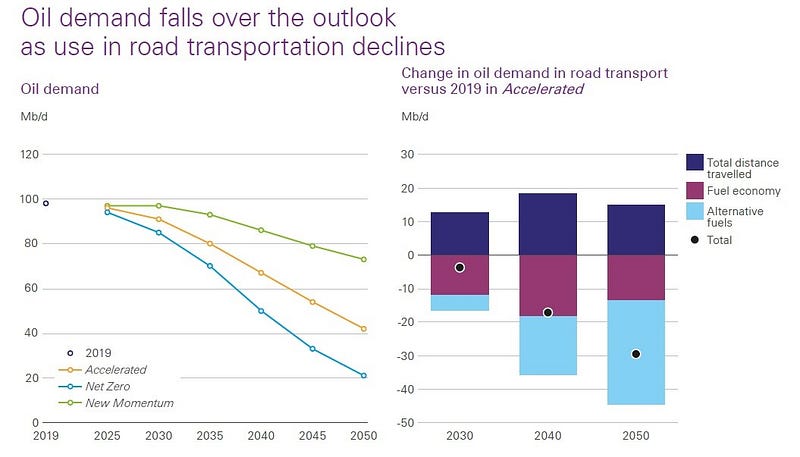
Oil prospects are directly dependent on the development of the transport sector, and BP is optimistic about new transport technologies. For example, in the Accelerated scenario, the share of traditional gasoline and diesel vehicles in the global fleet will decrease to 20% by 2050.
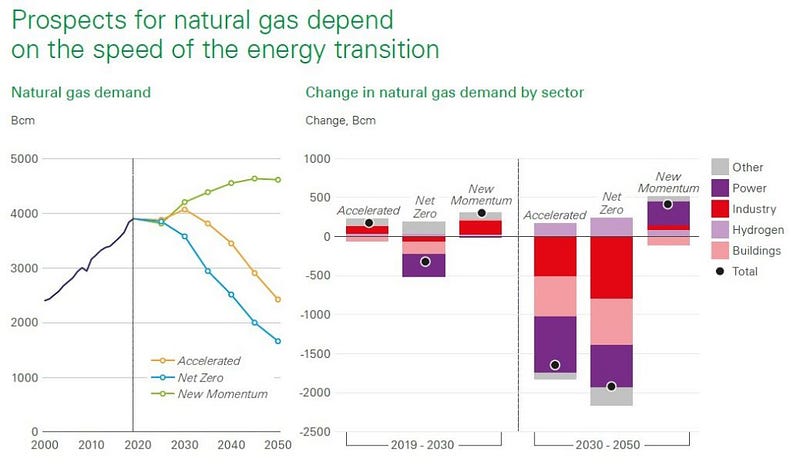
With regard to natural gas consumption, there is a wide range of options. In the New Momentum scenario, demand grows until the end of the forecast period, in the other two scenarios, it decreases after 2030 due to an increasing shift of the economy to low-carbon fuels.
Coal is the fuel that is losing ground the most due to the growing dominance of low-carbon energy, BP notes. Its share of global electricity production falls from almost 40% in 2019 to just over 10% in the New Momentum scenario by 2050 and to near zero in the Accelerated and Net Zero scenarios.
With great optimism, BP looks at the development of renewable energy, mainly solar and wind energy. Installed capacity in this sector will grow rapidly in all scenarios and could exceed 20,000 gigawatts (GW) in a Net Zero scenario.
In terms of power generation, solar, and wind power will be the world's largest electricity producers. In the most conservative scenario, the total share of solar and wind generation in 2050 will be 46%, and in the other two scenarios 67% and 68% (see the top graph). This roughly corresponds to the recently published scenarios of the International Energy Agency (IEA). We also note that the production of electricity based on solar and wind in 2050 will exceed (and by a lot) the current generation of the entire global energy system in the Accelerated and Net Zero scenarios.
In conclusion, let’s look at the prospects for the consumption of “low-carbon” hydrogen. In the Accelerated scenario, global H2 consumption in 2050 will be 292 million tons, and in the Net Zero scenario, about 460 million tons. I note that hundreds of forecasts and scenarios for the hydrogen economy development have been published worldwide. On the one hand, everyone agrees that the volume of hydrogen consumption will grow. On the other hand, there is a wide range of estimates. For example, according to the Hydrogen Council, the volume of hydrogen consumption in 2050 will be 660 million tons, and according to the DNV GL forecast, hydrogen production in 2050 will be about 330 million tons.