
Boy-Love: A Culture of Pedophilia in The Ottoman Empire
A sunny day in the harem, two hands clasped, male lovers intertwined. It could have been love, yet the air of innocent promiscuity dries up upon hearing the shockingly young age of the passive-penetrative party.
What may seem like a social taboo in western countries was all too common in the streets and peg houses of Turkish cities. Far from being an acceptable model for modern-day LGBTQ+ acceptance and activism, this form of homosexuality was and always will be pedophilia.
West Versus East
“Sodomy is honorable, because he who supports boys has more status. Men like them more than their own wives. Many of the Turks and renegades [European Christians converted to Islam], even senior, influential men only want boys for wives. They boast of never having had sex with a woman their whole lives. Rather, they despise females and don’t want to set eyes on them.” — Spanish historian Diego de Haedo, 1600
It is well known that the West was the bringer of hetero-normative relationships and expectations to the East during the Industrial Age of the 19th and 20th centuries.
Before the influences of modernization and globalization began, however, homosexuality was not a socially erroneous prospect in the Ottoman Empire. Nor was the sexual appetite for young boys.
One can compare the positive attitude that existed amongst the Turks towards sodomization to be comparable to that of ancient Greece or Rome. Where taking a young servant boy as a lover was a socially acceptable and perhaps even an expected transaction.
It is hypothesized that the Turks, upon becoming “The Ottoman Empire” borrowed this lifestyle from the Greeks.
Indeed the act of sodomizing boys and adolescents was extremely common in the Ottoman Empire amongst men of every caste and wealth, upon which we will elaborate.
Throughout this piece, the term “young boys” will be used. That is to illustrate that the sexual partners in question were between the ages of 7 and 15.
The Peg Houses
Peg Houses — also known as boy-love brothels.
These brothels were as common as any other throughout the Ottoman territories. They comprised a building, usually adjacent a marketplace or square, in which a bath was placed and a series of benches ran down the middle.
These long benches had wooden anal plugs fashioned to them at intervals in various sizes, going from small to big. The more experienced and “educated” a boy prostitute became, the larger a peg he sat upon.
The boys would spend their day sitting on a lubricated peg until chosen by a suitor, upon which time they would stand up and bend over the bench.
There were multiple types of peg-houses including bath houses and a more illustrious type that employed feminine young boys. Who they dressed as women and trained them to performed erotic dances for the clientele, as well as various other sexual acts.
Slave boys, usually of European descent, who had not yet reached puberty often staffed these brothels. Clients of these peg-houses often preferred the boys who had not lost their “bloom of youth”, preferring them to be no older than 13.
The Seraglio and The Sultan’s Favorite
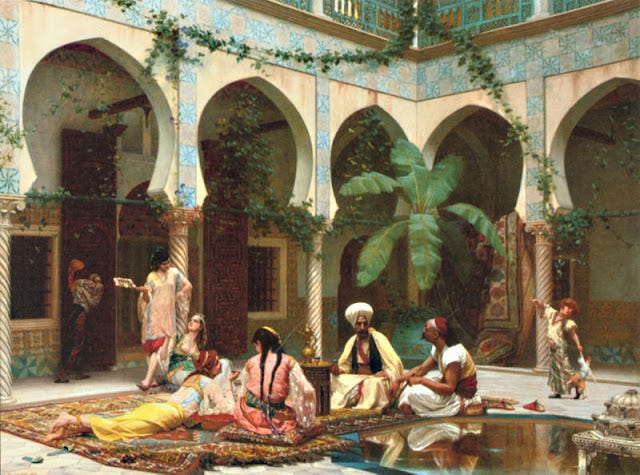
“Those living in the northern countries (European Christians) are [seen by the Turks as] insensible of pleasure; it is only those boys that have the true smack of voluptuousness” (Drake, 1966)
A practice known as the “boy-tax” encouraged the ferocious sexual appetites of the Ottoman elite.
Christian European countries under threat of invasion by the Ottoman Empire were asked to pay suzerainty every year to the Ottoman Sultan in the form of money, usually gold ducats, and a collection of fine young boys.
Most of these boys became Janissaries, an elite military task force, but the most handsome were hand-selected to serve in The Sultan’s seraglio (Harem) as beck-and-call lovers.
This tax or “tribute” as it’s come to be called in modern Europe was well known among Balkan and Byzantine leaders. The treatise by which the tributes were agreed upon (which exempted said countries from invasion as long as they met the contractual terms) outlined a definite number of young boys who should be sent to the Ottoman Empire each year.
Those who spent time in the Empire, however, were under no illusions as to how the boys would be used. Hence a certain apprehension and even refusal to pay the so-called boy-tax.
For example, in 15th century Wallachia (part of modern day Romania) under the reign of Vlad Dracula, the Ottoman Sultan requested he send 500 boys under the age of 16 as tribute.
A request which the Prince later refused and for a principled reason; his own young brother, Radu (Later Radu The Handsome — for obvious reasons) became the concubine of Sultan Mehmed at only 11 years old.
With his exceptional looks and the overbearing quality of Mehmed’s personality, he could not refuse. Though it does not take much to understand power dynamics were also at play in these “relationships”.
Hundreds of beautiful boys serviced not only the Sultan but also his generals and lords. After being incorporated into the household, they lived out their lives in a portion of the palace called The Seraglio, also ironically referred to as “The Bird Cage”, in service to the ferocious sexual appetites of grown men.
Slavery
Much like the boy-tax, the Ottomans also reaped young boys directly from their homes and communities as part of a military expedition or invasion.
There is an excerpt from a 15th century man, a former boy-lover and slave of the Sultan, who documented his experience and describes this process of enslavement. Not for the faint of heart, it reads;
“Slave buyers followed Turkish armies, each dealer marching 50 to 60 children on foot back to Turkey, manacled hand and foot. At night, he writes, one suffered at hearing the moans and tears of the boy chosen for the night to endure the slave-merchant’s lust. Even those as young as 7 could not protect themselves from violation, save for the most beautiful who were reserved as gifts for the Sultan.” (Drake, 1966)
He goes on to say that the ones whom the Sultan rejected were given to friends or bath houses, or sold in marketplaces.
We must not understate the Ottomans desire for “exotic” European children as lovers. This is mentioned as a primary motivation for the continual invasion of European localities.
During the siege of Constantinople, Sultan Mehmed II (who was described by friends as a “notorious boy-lover”) gave a speech in which he colorfully highlighted what treasure awaited them, should they be successful. Describing “boys, gentle, beautiful, aristocratic young boys, enough for all.”
When the walls of Constantinople fell, an untold and unabashed amount of rape and enslavement took place, especially of children.
Hundreds were set aside only for the Sultan, but that wasn't enough for him. Mehmed purchased an additional 200 boys from his own soldier's collection of war booty, but that still wasn’t enough for such an incorrigible man.
The Sultan and his soldiers devastated the city, even killing the parents of beautiful boys before kidnapping and enslaving the child.
A Greek collaborator, a nobleman called Notaras, had an extremely beautiful son of 14. The Sultan demanded the boy for his pleasures. When Notaras refused, he and his whole family were executed and the boy taken to the Sultan’s palace.(Drake, 1966)
By the 19th century the continued power of the Ottoman Empire meant the Greeks had come to expect that the Turks would take as lovers their sons. This is evidenced by the fact that Greek fathers began training their own sons for anal intercourse, as described below:
“Many Greek fathers prepared their young sons for anal intercourse (presumably on the part of Turkish captors). The training, according to a scholarly article in Rassegna di studi sessuali began at age 7 or 8 and was both mental and physical. Greased wooden cylinders of gradually increasing size were used for anal dilation, being left in nightlong. Almost 90% of Greek boys in Asia Minor reputedly practiced “le Vice” with each other and many were taken to satisfy the lusts of neighboring Turks.” (Drake, 1966)
Enslavement of young Christian boys became a major contributing factor to the red-hot European hatred of the Ottomans.
Homosexual Erotica
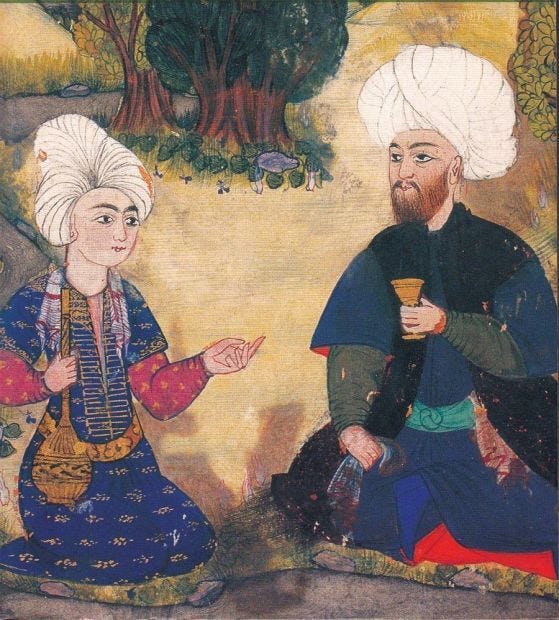
Above, an eerie Ottoman style miniature. Creeping uneasiness accompanies when looking at them. Our shared mind morbidly wondering whether the child next to the grown man is a son — or a boy whore.
Using young boys and teens as sexual objects and prostitutes was so common in the streets of Turkish cities, naturally they became a feature in many works of erotic art.
Considering these pieces were fabricated by individuals who lived within the reaches of the Ottoman Empire and who were more than likely an eyewitness to the events depicted, we can use them as a reliable source of evidence for the historical narrative.
For example, the piece below suggests the Ottomans routinely used young boys for activities like group sex. Note: to western eyes, these miniatures may seem criminal, if not entirely shocking.
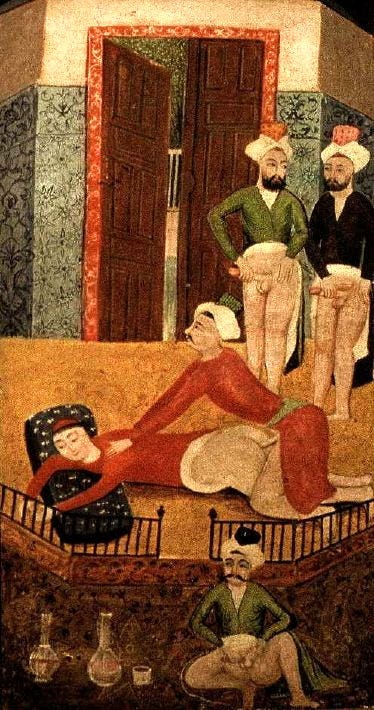
These pieces of art painted an image of the Ottoman Empire in the minds of Westerners as a highly taboo and morally reprehensible place where law and order did not exist. Hence the reputation that quickly developed in European circles, who rightfully dubbed it the “capital of sodom”.
None-the-less, it was a well known secret that Christian noblemen and others who could pay for the expense came from their European homelands to the streets of Edirne, Ankara, Bursa, or later Istanbul to take part in the immoral pleasures that peg-houses and boy prostitutes provided.
Best wishes and thanks for reading!
A.

Source:
“What Ottoman Erotica Teaches Us About Sexual Pluralism” by İrvin Cemil Schick (2021) https://aeon.co/ideas/what-ottoman-erotica-teaches-us-about-sexual-pluralism
Jonathan Drake, “International Journal of Greek Love”, https://www.greek-love.com/near-east-north-africa/turkey/le-vice-turkey-pederasty (1966)
Khaled El-Rouayheb, “Before Homosexuality in the Arab-Islamic World”, 1500–1800, University of Chicago Press, (2005)
Stephen O. Murray, “Homosexuality in the Ottoman Empire” Berghahn Books, (2007)
“LGBT in The Ottoman Empire” Wikimedia Commons. (2022) https://en.wikipedia.org/wiki/LGBT_in_the_Ottoman_Empire


