
‘Boy-crazy Tween Lesbian’ — Oxymoron, or Surprisingly Common?
Are boy-crazy phases mere rites of passage for repressed baby gays who still have yet to accept their sexuality?
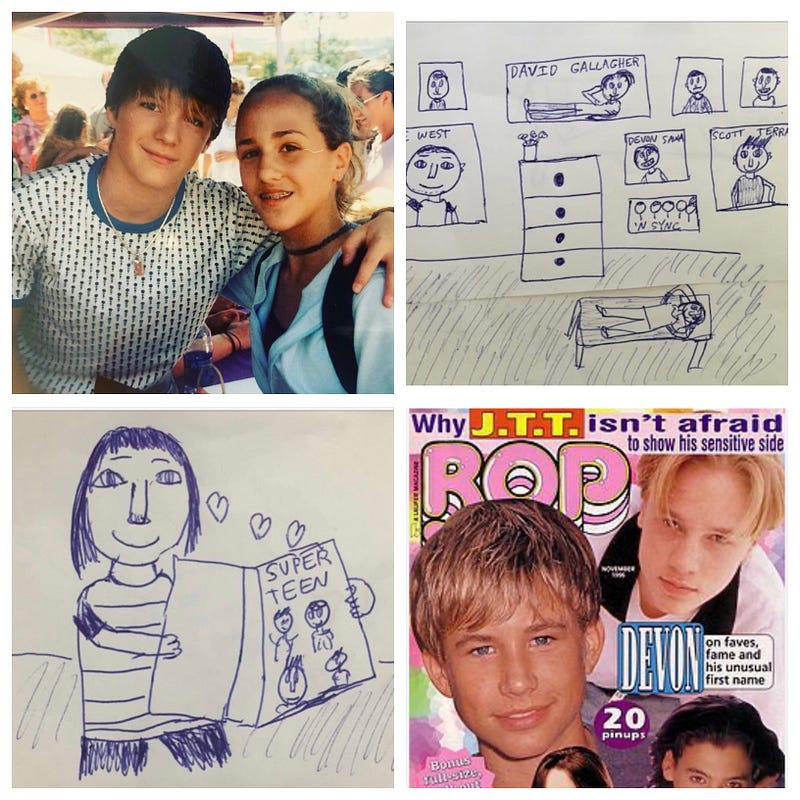
The lesbian I am now scratches her head at the boy-crazy preteen I once was.
Every month I’d rip open the latest issues of Super Teen, Tiger Beat, and J-14 to unearth the latest batch of dreamy celebrity pin-ups. The faces of Stevie Brock, David Gallagher, and Jonathan Taylor Thomas plastered every inch of my walls (a note to the evangelical Christians: exposure therapy truly does not work as a cure for homosexuality).
Urban Dictionary would later describe my brand of infatuation as:
“Distinct from slutty in that a girl who is boy-crazy doesn’t necessarily hook up with a lot of guys and might not be sexually active, but she incessantly talks about how cute boys are or that time that cute boy smiled at her.”
This phase turned out to be purely a tween girl one preceding the revelation of my gayness.
My question now is: Why? And do other young lesbians go through something similar? Are boy-crazy phases merely rites of passage for repressed baby gays who still have yet to accept their sexuality?
Let’s explore.
What kinds of boys are we talking about?
Maybe my pin-up plastered walls were the equivalent of the insecure straight man’s giant Hummer. Though I can’t say for sure whether I was compensating for my gayness, what does call my attention is that it was never full-grown men who interested me. I liked boys before they joined the ranks of the rugged and matured.
Actors like Shane West and Colin Farrell stole my sister’s heart, while younger-looking, angelic-faced tweens got their hooks into mine.
I saw men as intimidating and unrelatable. Boys were soft, gentle, and more accessible. They just weren’t as foreign or threatening. Our differences seemed less glaring, the chasm between us not quite as vast (especially since I was a bit of a tomboy myself).
Boy-craziness gives a sense of control and of being in charge — a socially acceptable outlet for prohibited or unacceptable impulses.
Before my first girl crush came for me, I had always consciously selected my crushes.
The simple process involved a mental culling through an assortment of aesthetic and personality features. My mind would deem certain ones attractive, then proceed to crush on whichever boys had them. The agency involved in this process was what appealed to me most about it.
Different from my boy crushes, there was nothing conscious, deliberate, or discerning about the selection of my first girl ones. I was only 12 when the first of them came at me like a devil-horned wrecking ball (*not to rip off Miley Cyrus’ metaphor, though the pages of my high school diary can attest to my having coined it first).
Not only did this unsettle me, it also splintered apart any illusion of control I’d once perceived myself to have had over the crush-choosing process.
I wanted to have that control. I wanted to choose who I liked. All the other girls seemed to be doing this, after all.
Not having it felt scary. By immersing myself in the land of boy-crazy, I could keep the foreboding feelings at bay.
Comp het and male validation plays a role.
For my tween self, boys’ interest and approval were tickets to feeling worthy and wanted. A high score on a test or a nice lunch with a friend felt nice enough, but (unfortunately) the times I felt most validated were when a good-looking or popular boy chose to take 20 seconds of his time to flash me a smile, or say what’s up, or ask me where I’d gotten my shoes.
And as Emily Crivograd put it, comp het is “the theory that women act or believe they are attracted to men because of a patriarchal society.”
Beyond comp het, a homophobic society led queer author Jen Winston to also dive headfirst into “straight culture”: “I knew life would be easier if I squished down the gay stuff and pretended to be straight. As a result, I became performatively ‘boy crazy,’ obsessing over cookie cutter hunks like Josh Hartnett and Sean Faris.”
And lastly:
Our conception of “crush” is also different as a pre-teen and not necessarily sexual.
Looking back, the teen crushes I had were more aesthetic appreciations than genuine attractions. When my mind lit up with fantasies starring Stevie Brock and Scott Terra, all I ever imagined us doing was cuddling. Or holding hands. Or engaging in any other number of innocent Disney-approved activities.
Scott Terra would be wearing his puka shell necklace and Quiksilver shirt as we slow-danced. His blond-brown hair would be spiked up, and his warm hands would rest like heated pillows against my lower back.
Though comforting, it wasn’t a sexual fantasy in the slightest.
The verdict?
Before I set out to write this, I wondered if it was just me. In the weeks since, I’ve attended a gathering at which a lesbian acquaintance admitted to having a huge crush on Justin Bieber.
I perked up when I heard this. I now think that perhaps queer girl tween boycraziness, if not a rite of passage, is at least more common than I once thought.