
Defence
Bouquet of Barbed Wire
Fencing for defence against people, pests and armour, barbed wire is nasty stuff and Russia has laid it for 800 km in Ukraine
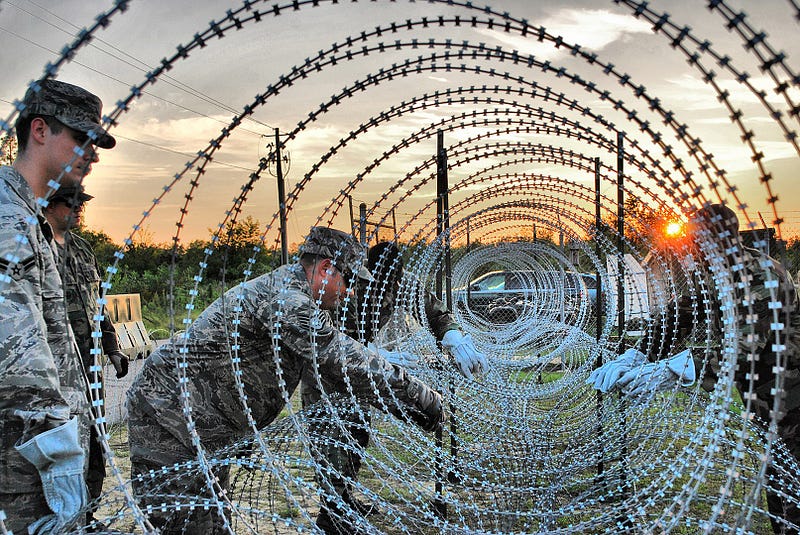
I was writing a story about the defences that Russia had built along its illegally held territory in Ukraine and I came up against barbed wire. For some people it’s fascinating stuff and they collect samples. For others, it’s death, slowing down the advance of troops.
Or for stopping people escaping from a country.
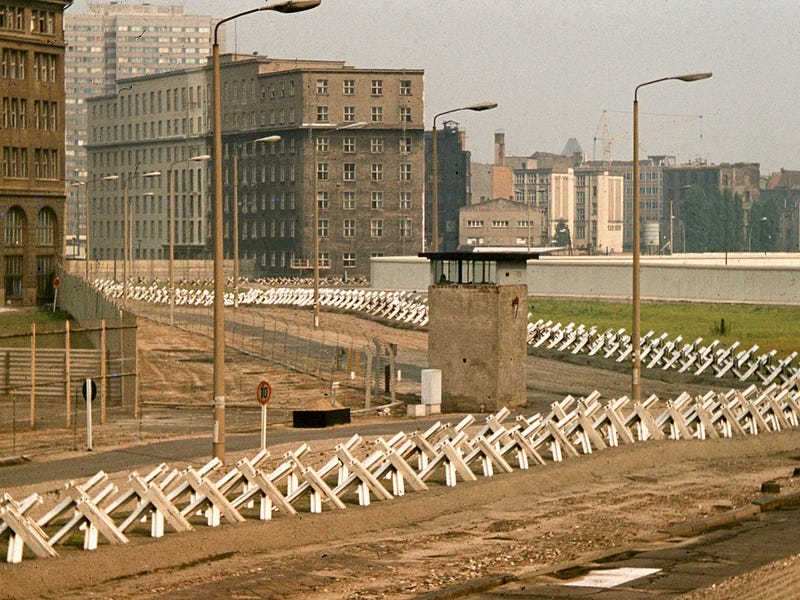

The point is…
Most people know that barbed wire is a fencing material characterized by sharp, pointed barbs. Originally invented to secure livestock and protect farmlands, barbed wire has since evolved into a versatile tool used in military fortifications, prisons, and border control.
It originated in the US in to control cattle as the prairies were being carved up by ranchers. The first patent in the United States for barbed wire was issued in 1867 to Lucien B. Smith of Kent, Ohio, who is regarded as the original inventor. Joseph F. Glidden of DeKalb, Illinois, received a patent for the modern invention in 1874 after he made his own modifications to previous versions and got round Smith’s patents.
The main types are single or double strand and razor. The wire may be presented rolled on drums or as ‘concertina’ rolls. With suitable insulation the wire may be electrified — either to kill (usually people) or deter pests.
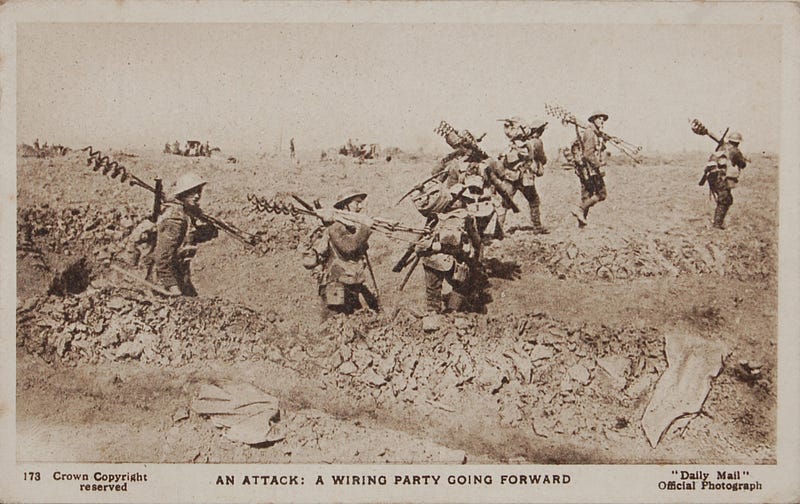
Fixing barbed wire requires posts to attach it to. These are usually wood, steel or concrete. Steel screw posts are quick to install and in war zones as seen below.
Concertina rolls are quick and convenient to deploy and may be stacked, constrained by posts (as in the headline picture).
Barbed wire in war
Barbed wire was first used in warfare during the American Civil War. Its deployment in military operations marked a significant shift in defensive tactics and battlefield fortifications.
In the early stages of the war, both sides relied on traditional methods of defence, such as trenches and wooden palisades. However, as the conflict intensified and casualties mounted, there was a need for more effective defensive measures.
The first use of barbed wire in warfare is credited to the Confederate forces led by General Robert E. Lee. In 1863, during the Battle of Fredericksburg in Virginia, the Confederates employed a rudimentary form of barbed wire made from telegraph wire to impede the Union Army’s advance.
Barbed wire gained further prominence during World War I, where it was extensively used to fortify trenches and create defensive obstacles on the Western Front. The static nature of trench warfare necessitated the creation of intricate networks of barbed wire entanglements to hinder enemy movements and protect soldiers.
These wire entanglements were often several layers deep, creating formidable obstacles that slowed down or prevented enemy troops (and tanks) from advancing. Barbed wire was paired with other defensive elements like machine guns, artillery, and mines to create an integrated defensive system.
Almost as sheep are guided by fences, so barbed wire fences could be placed so as to steer enemy forces to killing grounds.
Beating barbed wire in war
Overcoming barbed wire defences requires careful planning, specialized tools, and, in some cases, the support of additional equipment or tactics. Here are some common methods used:
- Wire cutters are specifically designed tools used to cut through or sever the strands of barbed wire. Different types of wire cutters, including handheld tools and larger hydraulic or pneumatic cutters, may be used depending on the thickness and strength of the barbed wire. This is slow and the users are exposed during the cutting process.
- Bangalore torpedoes are long, cylindrical explosive devices used to clear obstacles, including barbed wire entanglements. They consist of a metal tube filled with explosives that can be placed next to the wire entanglement and detonated, creating a gap or destroying sections of the wire. If you’ve seen the film ‘Saving Private Ryan’ then you probably remember the scene on Omaha Beach where Tom Hank’s character calls for a Bangalore torpedo. There are modern versions of this, such as the M58 MICLIC (more later).
- Demolition charges, such as satchel charges or shaped charges, can be strategically placed near or attached to barbed wire entanglements. The explosive force can rupture or dislodge sections of the wire, creating breaches or clearing paths.
- In some situations, armored vehicles equipped with specialized attachments or tools can be used to push through or roll over barbed wire obstacles. These vehicles may have bulldozer blades, rollers, or wire cutters attached to their front ends, enabling them to clear a path through the wire.
- Flamethrowers or oxy-acetylene cutters can also be used to burn through barbed wire.
Overcoming barbed wire defences often requires a combination of tactics. Providing cover and suppression fire with small arms, machine guns, or heavier weapons can suppress enemy forces and allow engineers or assault teams to approach and breach the wire.
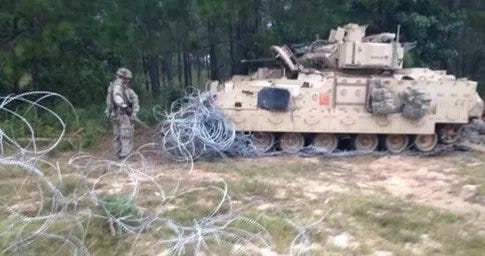
I had thought in my ignorance that tanks could drive straight through, making a gap for infantry, but that’s not always the case. It seems that barbed wire can actually jam up the tracks of tanks, winding round the drive sprockets and eventually throw a track.
The finer points
Barbed wire manufacturers and collectors have several ways of classifying this nasty stuff:
- Barbs are typically made of hardened steel and can vary in length, shape, and spacing. They are designed to deter and impede intruders by causing injury and entanglement.
- The wire gauge refers to the thickness of the wire used in barbed wire manufacturing. Thicker gauges provide greater strength and durability, making them suitable for heavy-duty applications. Thinner gauges are more flexible but may be less effective in high-security scenarios.
- Strand Configuration: Barbed wire can consist of a single strand or multiple strands twisted together. The configuration impacts the overall strength and security of the fence. Single strand barbed wire is simpler and cost-effective, while multiple strands provide enhanced security by reinforcing each other.
- Barbed Wire Twist: The twist of the wire refers to the manner in which it is wound during manufacturing. There are two primary twist patterns, right hand twist and…yes…left hand twist. The right hand twist is most common.
- Point Style: The design of the barb’s point can vary, and different styles offer distinct advantages: Long-pointed barbs have elongated points, maximizing their piercing ability and providing a higher level of security whereas…yes…short-pointed barbs with shorter points are less aggressive but still offer a deterrent effect, most often used in less secure environments or for animal containment. Shorter is cheaper.
- The distance between barbs along the wire affects the level of security and the ability to prevent intrusion. Close spacing provides a denser barrier, while wider spacing may be more suitable for low-security applications or animal enclosures.
- Barbed wire is typically made from galvanized steel, which is resistant to corrosion and provides durability. In certain cases, stainless steel or other specialized alloys may be used for added strength or specific environmental conditions. Coatings such as zinc or polymer can be applied to further protect against rust and increase longevity.
Collecting barbed wire
Beyond its functional utility, barbed wire has attracted a community of collectors Known as “dibbers” or “wiremen,” fascinated by its historical significance and aesthetic appeal. It takes all sorts, I guess. And they wear gloves…
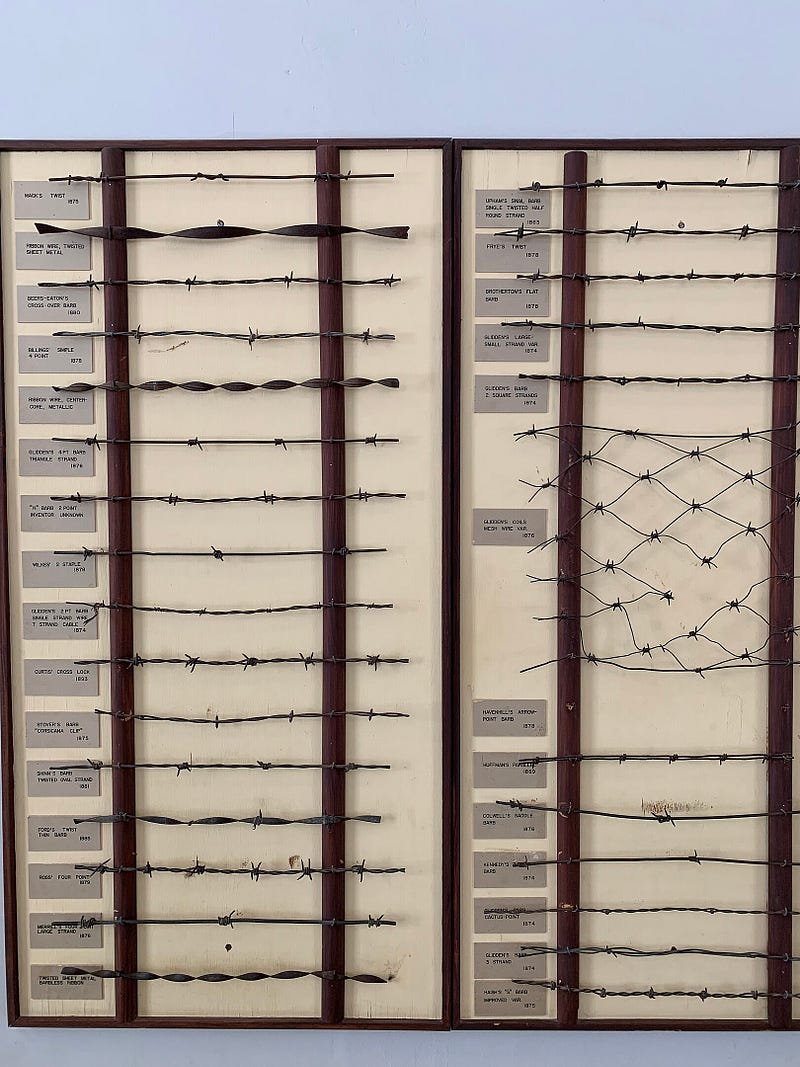
Barbed wire collecting began in the early 20th century, with enthusiasts preserving specimens and documenting the different variations. These collectors often acquire barbed wire through auctions, online platforms, and direct exchanges with fellow collectors. As collectors of all sorts do. My son-in-law used to own a DUKW and a Willys Jeep. As I said, it takes all sorts…
And now…
Barbed wire has been rolled out by the mile in Ukraine by Russia. 800 km the story says. Ukraine has probably laid out out some as well.
But the Ukraine Armed Forces have the modern version of Bangalore torpedoes there, known as the mine clearing line charge, M58 MICLIC supplied by the US. They clear an 8m wide road through minefields, and presumably barbed wire as well. It literally makes the ground shake.
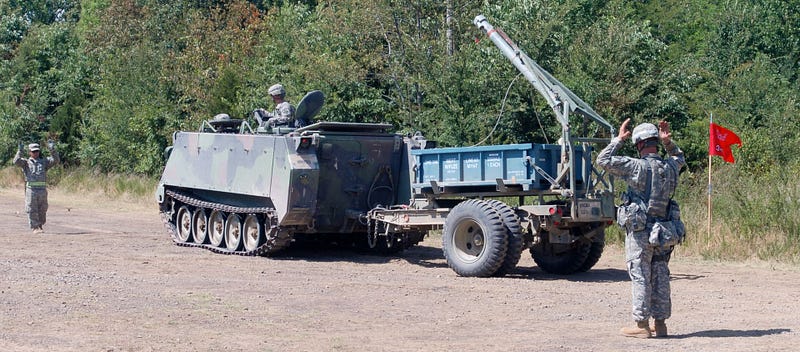
Armour and other transport can follow the cleared road through, but when it comes to entrenched positions with barbed wire protection then I imagine it has to be dealt with using the usual methods — or flanked.
However, much barbed wire cutting and minefield clearance has to be done secretly when preparing for a major offensive, as is happening in Ukraine as I write.
Using MICLIC makes it pretty obvious where an assault is starting — unless it’s a feint.
But it’s in use in Ukraine…
And this story’s title? I couldn’t resist it.
‘Bouquet of Barbed Wire’ was an edgy, multi-part UK TV drama.
Follow me and I guarantee variety in your inbox with some unusual perspectives! I write on a wide range of topics that interest me including humour, tech, space, geopolitics and travel. I also write about…
…pointed problems

My novels are available at my Gumroad bookstore. Also at Amazon and Apple