
#30DAYSOFSCIKUCHALLENGE
Boundaries or Bridges
Day 8 Prompt: Evolutionary Biology-inspired Sciku
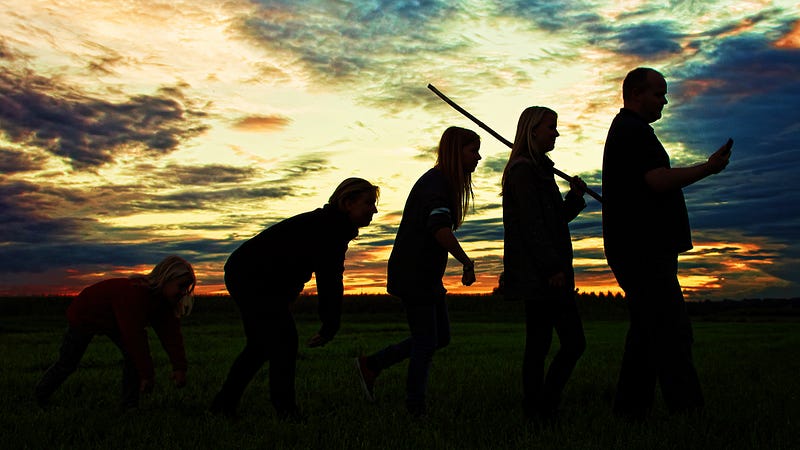
diversity & pressure fit today and ready to evolve it’s a paradox
This time of the year often brings mixed feelings — the excitement of new promises and possibilities, but also the prospect of failure and disappointment — balancing the comfort of things staying the same with the desire to change and evolve — you know the usual — eat healthily, exercise more, keep the house cleaner; call loved ones more often, stop being angry, etc., etc.,
Biologically speaking, evolution refers to the change in a species' characteristics via natural selection over several generations. Essentially, the Theory of Evolution relies on the idea that all species are related and that changes are gradual. These changes are dependent on there being a diversity of genetic variation. While incremental, these changes lead to significant advantages for individuals to adapt to their environment and successfully pass down these changes to their offsprings.
There is a paradox — According to the theory the life forms that exist today are here because they were able to change when past environments disappeared. Yet, organisms evolve to fit into specific environmental niches.
One of the fundamental questions in evolutionary biology then is — How is the ability to fit precisely into a current setting reconciled with the ability to change?
Recent research provides some clues based on the evolution of colorful pigments in bird feathers throughout North America. In the words of the lead author of a recent study Alex Badyaev — “the boundaries of current adaptations become bridges between successive adaptions in evolution,” In other words, the mechanisms that appear to make organisms locally fit (i.e., stress-buffering) and those responsible for change (i.e., change inducing) are distinct and likely occur sequentially in evolution.
The ongoing research will undoubtedly uncover the origins of molecular and developmental mechanisms implicated in stress-buffering and change inducing processes in evolution. So might be — the struggle to stay the same and continuously change might quite literally be rooted deep in ourselves, likely in our DNA.
As we welcome this new year and consider our own needs to savor the moment and aspire for change within our selves and our environment — perhaps this is a moment to be mindful of our time and space on the evolutionary ladder, to honor our boundaries, to celebrate all of our differences, to find bridges and to find a way to get along — it really does take us all to be successful in the evolutionary game!
Happy New Year!
*This is Day 8 of the #sciku challenge — science-inspired haiku ( so #sciku?) prompts to get you inspired — Our dear readers — why not spend some time each day creating and having a little fun — if you do — publish it anywhere on medium, just tag it with — #30DaysOfScikuChallenge.
**If Haikus/SciKus are not your thing, feel free to exercise your artistic creativity and write another form of a science-inspired story — I can’t wait to read what you come up with.
Tagging Katie Michaelson Timothy O'Neill, Jenine Bsharah Baines, Antoinette Nevitt, and anyone else who feels inspired to follow and/or play along with this fun #30DaysOfScikuChallenge and today’s prompt: Evolutionary Biology
What to read next? Give this a look —


