
Botticelli And Tears
The Birth of Venus
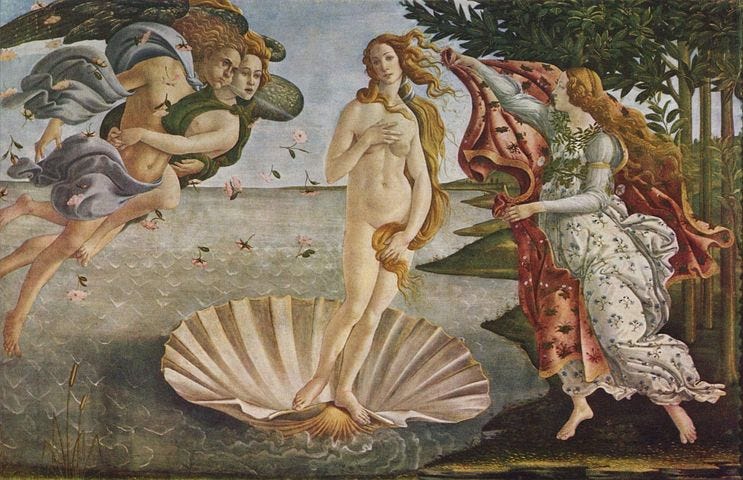

I had seen this picture many times in books, and to be totally honest I can’t explain why it became so important to me.
Perhaps it was because unlike most other Renaissance art, it didn’t concentrate on religious iconography. It was simply a romantic and particularly beautiful painting of the birth of Venus, the Roman goddess, whose functions encompassed love, beauty, desire, sex, fertility, prosperity and victory.
In Roman mythology Venus was huge, comparing with her Greek counterpart, Aphrodite. In fact Julius Caesar claimed she was his ancestor.
The painting is magical, even though there are some obvious oddities about it. For example Venus stands at an impossible angle, leaning too far to her left, and her neck is unnaturally elongated; flowers seem to be suspended in the air and there are no shadows anywhere.
The painting really is mystical, definitely other-worldly, imaginative rather that practical.
To see this painting and enjoy it involves putting to one side what you think of as normal, and to allow yourself the suspension of reason.
How it came to be painted is not entirely clear; it is possible that Botticelli knew of the famous lost masterpiece Venus Rising From The Sea by Apelles.
According to Pliny the Elder Alexander The Great offered his mistress Campaspe to Apelles as a model for the Venus painting, but Apelles fell madly in love with her so Alexander gave Campaspe to him as a gesture. Different times.
Venus rising from a shell wasn’t a new idea; in fact a number of Roman images showed Venus in a giant shell, and Botticelli may well have seen small versions of the motif in terracotta, and perhaps he was aware of the life-sized fresco of Venus laying in a shell in the House of Venus in Pompeii.
When we got to Florence I was very aware I was close to the painting, but I didn’t go and see it straight away.
I first went to the Galleria dell ’Accademia to see Michelangelo’s David, which of course is stunning, but it was Botticelli I was here to see and finally I walked into the Uffizi.
I strolled past rooms full of Madonna and Child paintings, surely the most painted scene in history, and finally I reached it.
And as I came into the room where the painting was there was nobody else there — one of the greatest paintings the world has ever known and there it was — I was standing in front of it completely on my own.
It was huge, much bigger than I had anticipated, and as I walked across to it a strange thing happened; I felt a tear roll down my cheek.
Now this may not seem a particularly odd thing to you, when faced with a classic work of art it’s not unusual to feel a huge well of emotion and tears can easily be a part of that, but I’m not really the type to cry.
I stood in front of it for a long time; I imagined what it would be like for Botticelli painting this wonderful thing back in 1480 something, and I wondered who walked in and chatted to him while he was working, shared a glass of wine and a bit of gossip, joked maybe about the scandals of the day, normal things. While in front of him was slowly appearing a masterpiece.
I wondered who had financed it. There was some talk that it was the Medici family, but that’s never been proven.
Anyway, whoever it was deserves a huge debt of thanks.