
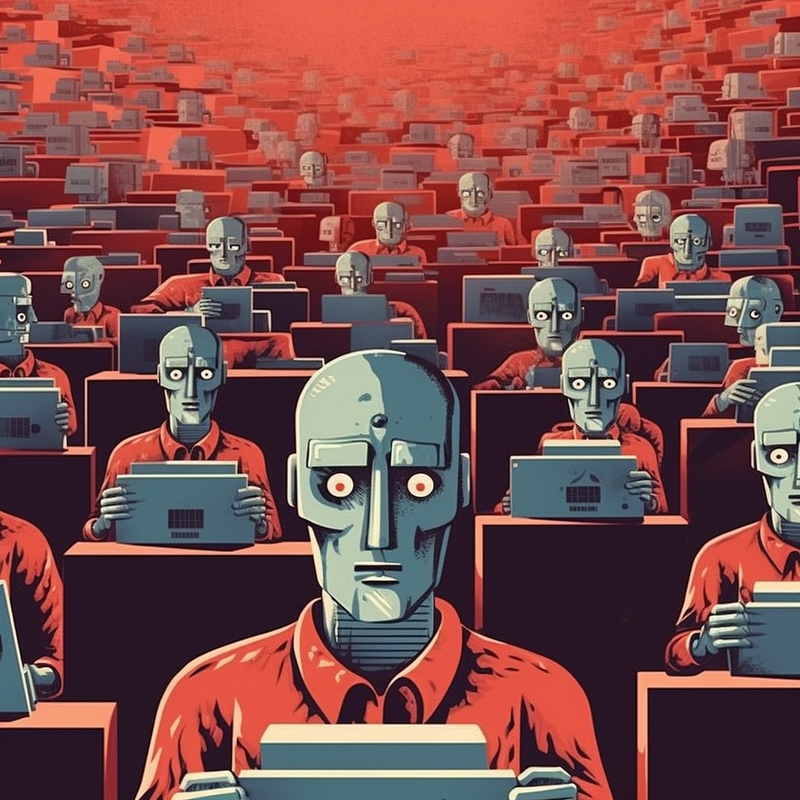
Bots in the Shadows: The Untold Story of Internet Automation and its Consequences
In the vast expanse of the digital universe, a silent workforce tirelessly toils away. Unseen, unheard, they are the tireless laborers of the internet, executing tasks at lightning speed, shaping our online experiences, and increasingly, our offline realities. They are the internet bots, the invisible architects of the digital world. As we navigate our favorite online stores, read the news, or scroll through social media, we often overlook the presence of these digital entities. This blog post aims to shed light on the world of internet bots, exploring their economic impact, their role in job displacement, and the pressing need for regulation and taxation.
The Rise of Internet Bots
In the early days of the internet, human users dominated the digital landscape. But as the internet evolved, so too did its inhabitants. Today, we share our online world with a multitude of automated entities known as internet bots.
Bots are not a new phenomenon. In fact, they have been part of the internet ecosystem since its inception. Early bots were simple programs designed to perform repetitive tasks, such as indexing web pages for search engines. But as technology advanced, so did the capabilities of bots. Today, they perform a wide range of tasks, from powering virtual assistants and chatbots to automating social media posts and even trading stocks.
The rise of bots has been nothing short of meteoric. According to a report by Security Magazine, bots accounted for nearly half of all internet traffic in 2022. This represents a significant increase from previous years and underscores the growing role of bots in our digital lives.
But not all bots are created equal. Some, like search engine crawlers, are beneficial, helping to organize the vast amount of information on the internet. Others, like spam bots or malicious bots used for cyber attacks, can be harmful. This dichotomy presents a complex challenge: How do we harness the benefits of bots while mitigating their potential harms?
As we grapple with this question, it’s important to remember that bots are not just lines of code. They are powerful tools that can shape our online experiences, influence our behavior, and even impact our economies. As such, understanding their rise and their role in our digital world is not just a technological issue, but a societal one as well.
So, as we stand on the precipice of this new bot-dominated era, we must ask ourselves: Are we prepared for the rise of the bots? And more importantly, are we ready to navigate the challenges and opportunities they present?
The Economic Impact of Bots
In the intricate web of the digital economy, bots have carved out a significant niche for themselves. Their influence is pervasive, driving both growth and challenges in equal measure. The economic implications of this bot-driven economy are complex, multifaceted, and worthy of our attention.
Bots, in their various forms, have become indispensable tools in numerous industries. They streamline operations, enhance productivity, and offer unprecedented levels of speed and efficiency. For instance, customer service bots can handle a high volume of inquiries, providing instant responses and freeing up human agents for more complex interactions. Similarly, trading bots in the financial sector can execute transactions in fractions of a second, capitalizing on fleeting market opportunities.
However, the economic benefits of bots are just one side of the coin. The other side reveals a landscape fraught with challenges and costs. Malicious bots, designed to disrupt services, spread spam, or launch cyberattacks, pose a significant threat to businesses. These activities not only disrupt operations but also necessitate substantial investments in cybersecurity measures. While these economic considerations are crucial, they only represent one aspect of the broader implications of the rise of bots. Another pressing concern is the potential for job displacement, a topic that requires our attention.
A case study by F5 for a major retailer highlighted the economic impact of malicious bot activity. The retailer found that improved bot management could prevent nearly $50,000 in revenue loss per year due to fewer site outages. Additionally, they could prevent about $1 million in revenue loss annually from a decrease in lost user accounts and customer churn due to poor user experience.
Beyond individual businesses, the rise of bots also raises broader economic concerns. As bots become more sophisticated and prevalent, they could potentially displace human jobs, leading to economic and social repercussions. This potential for job displacement underscores the need for careful consideration and proactive policy-making in the face of rapid technological advancement.
To navigate the bot-driven economy, it’s clear that our understanding of their economic impact must evolve. We need to consider not only the immediate benefits and costs but also the long-term implications for our economy and society. As we explore this topic further, we invite you to ponder this: How can we strike a balance between harnessing the benefits of bots and mitigating their potential harms?
Job Displacement by Bots
The advent of bots and automation has brought about significant changes in the job market. According to a study by the World Economic Forum, by 2025, machines and algorithms will be performing more current work tasks than humans compared to 71% being performed by humans as of 2018. This shift is expected to displace 75 million jobs but also create 133 million new ones, a positive outlook for the job market.
However, the transition may not be smooth for all. A report by McKinsey Global Institute suggests that by 2030, intelligent agents and robots could eliminate as much as 30% of the world’s human labor, displacing the jobs of between 400 million and 800 million people.
A recent study from Carl Frey and Michael Osborne suggests that 47% of U.S. jobs will be automated within the next 20 years. This automation is not limited to manual labor jobs. With the advancement of AI and machine learning, even jobs that require a certain level of expertise and knowledge are at risk.
On the other hand, automation also creates new jobs and opportunities. For instance, while robots have displaced unskilled workers on assembly lines, they have also created new jobs for machinists, advanced welders, and other technicians who maintain the machines or use them to perform new tasks. Brookings Research.
The question then becomes, are we prepared for this shift? Are our educational institutions equipped to train the workforce of the future? And how do we ensure a smooth transition for those whose jobs are at risk? These are the questions we need to address as we move towards an increasingly automated future.
The Need for Regulation and Taxation
The rise of AI bots has presented a unique challenge that requires our immediate attention — the need for regulation and taxation. The rapid advancement and ubiquitous nature of AI bots have led to a call for a more structured approach to their governance.
In 2023, the European Union and the United States made strides towards bridging the AI regulatory gap. The EU, while pushing ahead with its AI Act, has been working closely with the US government to establish minimum standards before the legislation comes into force. The policy process is expected to be completed by the end of 2023, but it would still take one or two years for the act to come into effect. Interim measures are needed to bridge that gap.
Brad Smith, Microsoft’s president and vice chair, has called for faster regulation of AI. He believes that AI has more potential for the good of humanity than any other invention preceding it, but it also presents significant challenges that need to be addressed. Smith supports the creation of a new government agency to regulate AI systems, ensuring their safe development and deployment.
The call for regulation is not just about ensuring the safe and ethical use of AI bots. It also touches on the economic implications of their widespread use. As AI bots continue to perform tasks traditionally done by humans, questions about their economic contribution have arisen. If AI bots are performing work, should they not also be subject to taxation? This could serve as a means to fund the social services and infrastructure that they utilize and to mitigate the economic impact of job displacement.
The rise of AI bots presents both opportunities and challenges. As we continue to harness their potential, we must also address the pressing need for their regulation and taxation. This will ensure that we can reap the benefits of this technology while also safeguarding our economic and social structures.
The digital landscape stretches out before us, a vast expanse teeming with possibilities and fraught with challenges. The rise of AI bots, like the rise of any transformative technology, is a double-edged sword. They have the potential to revolutionize industries, streamline processes, and create new opportunities. On the other hand, they pose significant economic and social challenges that we must address.
These are not easy questions, and there are no simple answers. But they are questions we must grapple with if we are to navigate the challenges of the digital age. As we look to the future, we must strike a balance between harnessing the potential of AI bots and mitigating their risks. We must ensure that our policies and regulations evolve in tandem with this rapidly advancing technology.
In the words of the great science fiction writer Arthur C. Clarke, “The only way to discover the limits of the possible is to go beyond them into the impossible.” As we venture into the realm of AI bots, we are indeed stepping into the realm of the previously impossible. But with careful thought, informed discussion, and proactive policy-making, we can ensure that we navigate this new frontier in a way that benefits us all.
The answers to these questions will shape our digital future. This journey is one we undertake together, requiring collaboration and shared decision-making. It’s through this collective action that we can navigate challenges, seize opportunities, and ensure technology benefits us all. As we conclude, consider this: What role will you play in this transformative era of AI bots?
Thank you for reading all the way to the end! Your engagement is what makes this journey worthwhile for me, and I truly value your thoughts and opinions.
👉 Let’s Keep the Conversation Going:
- What was your biggest takeaway from this article?
- Is there a point you agree or disagree with? I’d love to hear your perspective.
- Do you have a personal experience that relates to the topic? Your stories make these discussions richer.
- Are there any questions or topics you’d like me to cover in future posts?
🙏 Your Voice Matters: By taking a moment to comment, you’re helping to elevate this conversation and make these discussions more dynamic and accessible to a broader audience.
So, let’s keep the dialogue alive and flowing! Your interaction is not just welcomed — it’s encouraged!
Thank you for being an integral part of this community. I’m eager to hear your thoughts!


