NBA FINALS ANALYSIS, PART 3
Boston Myth Busting 2022
Since the media won’t own up for their bad predictions, let’s hold their feet to the fire.
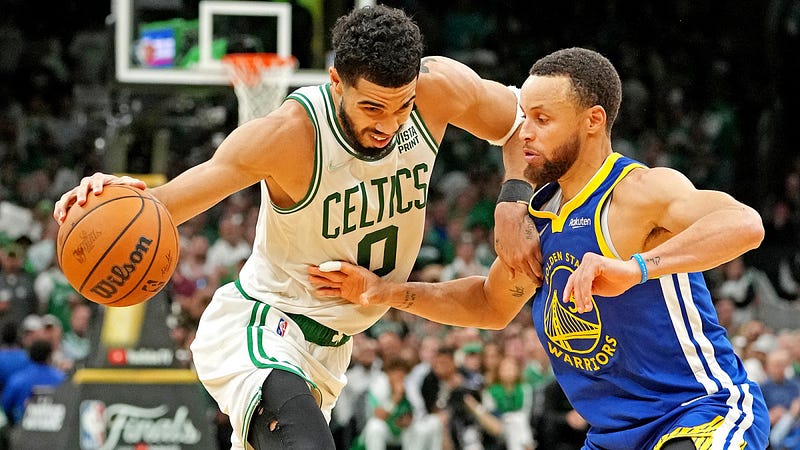
With the NBA Finals complete, the media talking heads are focused on the draft to avoid their collective brain fart about the Boston Celtics.
Boston had a historic mid-season turnaround where they had the best record in the league for the last three months of the season. But there were basically a .500 team against other elite teams during their hot streak, and this pattern continued in the playoffs.
During their amazing run to the Finals, the Celtics would alternatively shoot out of their minds to win one game, then shoot themselves in the foot and blow a game in a hail of turnovers.
Despite reaching the Finals, most pundits now concede they would have never beaten the Bucks if Middleton was healthy. I would add that if Jimmy Butler was healthy (even without Tyler Herro), the would have lost to Miami. Butler was just that good in the games when he wasn’t hobbled.
Add the Dallas Mavericks to that list of teams who would beat the Celtics in a series. The Maverick swept their season series and held Boston to under 100 per game. And don’t forget about that team from the Bay Area.
There’s no shame in admitting Boston was probably the fifth or sixth best team in the NBA.
But this is not the first time the media goes into PR overdrive to recreate the myth of the Celtics’ (now 60-year-old) Mystique. I wrote about this same phenomenon in 2019.
So how did Boston go from having the greatest turnaround season in NBA history to being the better, more talented team in the Finals?
Many of the media narratives were driven by the do-whatever-it-takes to increase network ratings.
Like the empty stat that Boston was the only team with a winning record (9–7) against Steve Kerr’s Warriors. Meanwhile, they neglected the fact that four of those wins came during the two seasons when Golden State missed the playoffs due to all their injuries. Not to mention the fact that when a team is winning championships, they don’t care about lower ranked teams during the regular season.
Besides the hyperbole about Boston’s defense (which was excellent, but not as good as the Warriors), the media created four myths to support the idea that Boston was going to win the Finals and brought out a fifth from past Warriors title runs.
Myth #1: the Warriors couldn’t handle the Celtics youth, size and athleticism.
When the Warriors played the Grizzlies, they played against a lineup that was even bigger, stronger and more dynamic than Boston. Ja Morant is faster than anyone on the Celtics and the best finishing guard in the world. Steven Adams and Jaren Jackson III are bigger and stronger than the Celtic centers. JJ3 is younger and more athletic as a stretch big than Al Horford and a better outside threat than Robert Williams. And Memphis has an incredible bench that went 20–2 in the regular season when Morant was injured. While Tatum and Brown had an edge as a big wing scorers, the Grizzlies had five big wings who could defend and run the floor (Brooks, Bane, Clarke, Tillman, Anderson). Unlike Tatum and Brown, the Memphis wings never had to play 40–44 minutes per game, so they were able to pressure the Warriors non-stop.
Myth #2: Jayson Tatum was a top-5 player who could be the #1 option on a championship team.
The first fallacy was pointing to Tatum’s selection to the All-NBA first team as proof of his top-5 status. If LeBron, Durant, Kawhi and Paul George were healthy all year, not one person would put Tatum above them.
Even worse, Tatum’s Game 6 performance against Milwaukee gave more fuel to the Boston media mafia’s narrative about Tatum’s superstardom.
But if you watch his highlights in the game, you will see he was guarded by a pupu platter of perimeter defenders on Tatum that ranged from statues (Brook Lopez) to terrible (Grayson Allen, Bobby Portis) to washed (the corpses of Wesley Matthews and George Hill), to little guys that were easy to shoot over (Connaughton and Holiday).
Here are the highlights from Tatum’s “historic” 46-point night that saved Boston’s season in Game 6. The ease of these baskets looked more like a Summer League game than a playoff elimination game.
In the Finals, Tatum was guarded by three excellent, physical defenders in Wiggins, Green and Gary Payton II. They all exposed his poor ball handling skills and lack of quickness.
People built up wild expectations for him and when he couldn’t shred the Warriors’ defense Tatum became the target of a lot of unfair criticism. After the Finals, even the homers like Bill Simmons admitted has wasn’t ready for this level yet.
Can Tatum improve and make another jump?
Certainly, but he’s going to need to do a lot of work on his handle (he’s still a turnover machine), decision-making (too many forced drives into a crowd, then regressing to into hero ball in crunch time), and ability to hit floaters and mid-range pull ups as a counter to defenses that know how he likes to score.
AND he has to stop being a whiny little bitch about the calls. I can’t overemphasize this point because the Celtics got most of the whistles in their series (+31 in free throw attempts, 28 less fouls committed, Draymond Green fouls out a record three time in a six game series, and Stephen Curry called for one less foul than the Edward Scissor Hands of Basketball, Marcus Smart).
Tatum spent way too much time complaining to the refs instead of running back on defense and the Warriors were deadly in transition.
The series was close enough that every complaint to the refs hurt Boston.
Myth #3: Boston’s offense was so potent the Warriors defense would crack.
Wild shooting variance by Horford (5 of 7 three pointers in Game 4), Tatum (7 of 15 three pointers and 46 points in Game 6), and Grant Williams (7 of 18 three pointers in Game 7) saved Boston season three times against the Bucks. Then, they made 20 three pointers to avoid going down 2–0 in the series against Miami.
It seemed like people grabbed on to a bunch of outlier events as if they were sustainable.
Here’s reality:
Al Horford is a league average 3-point shooter (career .361 3P%, on 3.6 attempts per game since 2015 when he changed his game). This season, he shot worse but more frequently (.336 3P% on 3.8 attempts per game) but went Super Sayan in the playoffs (.480 3P% on 4.3 attempts per game). He had the greatest game of his life against the Warriors to start the Finals.
Derrick White is a below average 3-point shooter (career .340 3P%, on 4.3 attempts per game) who shot out of his mind in a couple of playoff against Milwaukee and Miami. He had the greatest game of his life against the Warriors to start the Finals.
Marcus Smart is a streaky, but below average 3-point shooter (career .321 3P%, on 4.8 attempts per game, .331 3P% this season on 5.1 attempts). He, too, had one of his best shooting nights ever against the Warriors to start the Finals.
Without that miracle shooting trifecta (I wish someone could figure out the probabilities of this freak occurrence) in Game 1, the Warriors win the Finals in 5 games.
One analyst pointed out their record-breaking point expectancy of 1.1 points per shot based on the quality of their shots during that fourth quarter deluge of three-pointers. Did anyone stop and think that if Boston only scored 1.1 points per three-pointer, instead of going 9 for 12, the Celtics would have lost the game?
For the first 4 games of the Finals, Boston hit 64 of 151 3-point shots (42.3%). The only Celtics player who ever shot at the level consistently was Tatum’s rookie season when all he did was shoot wide open corner 3s.
You know who has shot consistently over 42% from beyond the arc? Stephen Curry (9 seasons), and Klay Thompson (3 years).
Boston’s offense was not only unsustainable, but impotent:
- In Game 2, they scored 64 points before clearing the bench down 29 points
- In Game 4, they only scored 54 points in the first half, despite hitting 8 of 14 three-pointers. In the second half they were held to 43.
- In Game 5, they scored 88 and down by 16 before clearing the bench in the last minute of the game
- In Game 6, they scored 88 points and were down by 13 when they cleared the bench
Boston finished the Finals making over 40% of their three-pointers despite the Warriors ability to contest shooters . Imagine if they shot below their season average like they did against Miami.
Would they have been swept?
Myth #4: Boston’s bench was stronger and Jordan Poole wouldn’t be able to stay on the floor.
This one was by far the wildest swing away from the truth. Just look at the NBA bench stats for the regular season:
The Warriors were the best in the NBA with a +11.4 point differential. Memphis was #2 at +10.1. The Celtics were #14 at -0.7.
The Warriors were #2 in rebounding, assists, and steals, while Boston was at or near the bottom. The Warriors were #2 in FG%, while Boston was #17.
The only area where Boston was elite was they were #2 in three-point shooting (.381 3P%) while the Warriors were only #17 (.338 3P%).
Maybe that’s why people thought so highly of the Celtics bench.
With respect to Jordan Poole, he was terrible in Game 1, but the coaches figured out they could bring him into the game with Looney to have enough size and rim protection.
Per NBA.com stats, Poole was the second best guard in the league at finishing at the rim, behind only Jaylen Brown. His speed driving to the basket warped and stretched the Celtics defense (even if he had a couple of shots blocked by Robert Williams), so he consistently had space to shoot from beyond the arc.
Poole made the jump from G-League last year to role player to starter this season for the Warriors while they waited for the return of Klay Thompson. After the All-Star break, his averages jumped from 16.4 ppg, 3.1 reb, 3.5 ast to 23.5 ppg, 4.1 reb, 5.2 ast, while shooting a Curry-esque 46.5/40.8/93.
Poole played a key role in bench scoring and killed Boston with his irrational confidence 3-point shooting (.412 3P% on 6.8 attempts the last five games, plus the 3rd quarter buzzer beaters that turned around the momentum in Games 2 and 5). And he torched Pritchard, effectively reducing Boston’s Finals roster to 6 1/2 players (Grant William was so bad he only counts as a half).
In Game 4, Steve Kerr made a series-changing line up decision. He started reserve Otto Porter in place of Looney to space the floor better, and to protect Porter’s limited defensive skills. (Porter and Poole couldn’t be on the floor at the same time). This move allowed Looney to anchor the defense, while Poole provided the scoring punch. The Warriors never lost again.
Myth #5: Stephen Curry really isn’t an all-time great player who can lead his team to a championship.
We have heard that nonsense for years, all because of a stupid, unpardonable error in the 2015 Finals MVP vote. Yes, Andre Igoudala played inspired defense against LeBron James, but the Warriors system revolves around Curry’s gravity, off-ball movement, and selflessness.
This year’s version of Finals Curry may have been the best of his career. Over the last couple of years, he has put on some extra muscle and it shows in how well he finishes at the rim.
Of course, everyone knows about his incredible shooting in Game 4.
But Curry’s defense was where he showed something we have never seen before. On the Ringer’s NBA Show podcast the day after the Finals, Seerat Sohi revealed an amazing defensive statistic at the 21-minute mark.
Although Boston tried to target Curry by attacking him in isolation, he gave up less than one point per chance to Tatum (0.714 ), Brown (0.9 ), and Smart (0.83).
(Boston thought they were going to wear Curry down and instead he became their defensive stopper. Do you understand the enormity of that statistic? Let me make it clear now.)
Although Boston tried to target Curry by attacking him in isolation, he gave up less than one point per chance to Tatum (0.714 ), Brown (0.9 ), and Smart (0.83).
Looking back at the media’s analysis during the playoffs, it was fair to ask if the Warriors could they regain their early-season form.
For the Finals, the only real issue was how the Warriors could handle the Celtics size and athleticism. They answered it by winning on the boards (+18) and points in the paint (+14) over the last three games of the series.
And yet, far too many talking heads continue to talk about the Celtics’ self-inflicted wounds, instead of how the Warriors figured out their opponent, broke their spirit and dominated at the end of three straight games.
The definition of greatness is consistency and commitment through every high and low and regardless of the magnitude of the situation.
Not a Cinderella run.
Give credit to the Celtics for having one of the greatest turnaround seasons in NBA history.
But give Steph and the Warriors their damn respect.