
Booked to Die: Still the Perfect Bibliomystery Nearly 30 Years Later
A Book Review
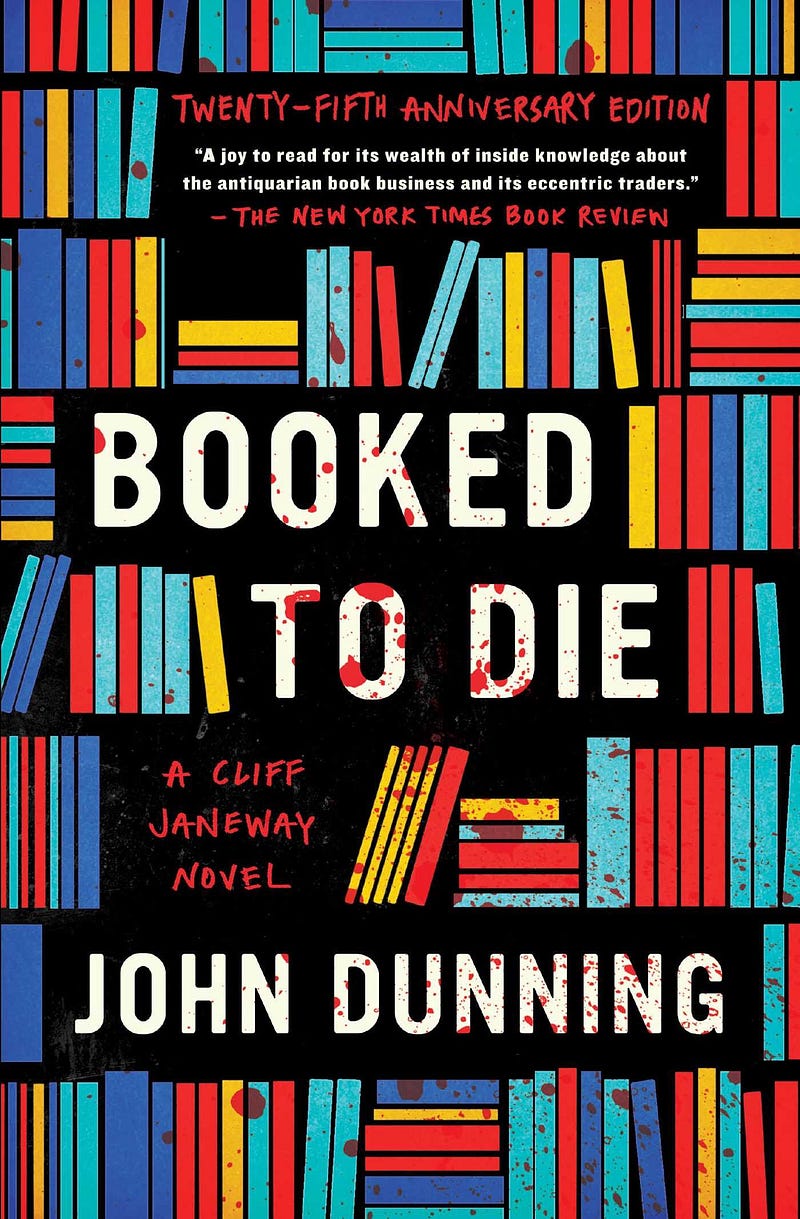
Readers are always on the lookout for the next great book, the one that will grab their attention and not let go. Yet even though we’re looking for it, every so often a book catches us by surprise; even more rarely that book becomes part of the very world it seeks to chronicle. Both were the case with John Dunning’s Booked to Die, the first in the remarkable Cliff Janeway Bookman series.
Booked to Die is the story of burned-out cop Cliff Janeway, who quits the police force to become a rare book dealer. Janeway has turned in his badge; he keeps both his gun and his penchant for solving crimes. The mysteries now revolve around the new world of rare books he inhabits, which puts this book squarely in the genre of bibliomystery.
A bibliomystery is one in which a book or manuscript is central to the plot of the novel. The definition can be expanded to include mystery novels in which libraries, librarians, bookstores, booksellers, publishers and/or authors play a key role in the story. The genre existed well before Booked to Die, going back at least as far as Agnes Miller’s The Colfax Book-Plate in 1926 and continuing through the first book in Robert B. Parker’s Spenser series, The Godwulf Manuscript, in 1973. But because of its massive success in 1992, Dunning’s contribution was a turning point, placing the genre squarely in the public eye.
In some ways, Dunning opened the door for many of the later, more mainstream (and hugely popular) bibliomysteries, including Arturo Perez-Reverte’s The Club Dumas, Diane Setterfield’s The Thirteenth Tale, Matthew J. Sullivan’s Midnight at the Bright Ideas Bookshop, and Carlos Ruiz Zafon’s The Shadow of the Wind. Yet even among these great bibliomysteries (and if you are a regular reader, you know I adore The Shadow of the Wind) Dunning’s Booked to Die is something special.
What stands out in Booked to Die is not simply the solving of a mystery, though Dunning takes the reader on a non-stop thrill ride in doing so. This novel is unique because it gives the reader a behind the scenes look at the world of rare book dealers, as well as an education into rare books themselves, without ever bogging down the narrative. In the end, watching Janeway scout through a pile of books in an East Denver thrift shop is as interesting as witnessing the brutal fight that ends his career as a cop. And Dunning gives us some twists at the end that would surprise even Sherlock Holmes.
John Dunning is himself a rare book dealer in Denver, and Booked to Die made the leap into the real world of rare books in a way he never could have imagined. The initial print run was a minuscule 6,500 hardcover copies, at least in part because Dunning had not published a book in more than ten years. He says he doubted that even that small number would sell out; he was wrong. The book sold out overnight and has since gone through at least five hardcover printings and more than 20 paperback printings.
That first hardcover print run is now one of the most collectible books on the market. Unsigned copies regularly sell for up to $500.00 and signed copies for close to $2,000.00. With a novel this good and print run that small, Dunning should have seen this coming. Cliff Janeway certainly would have.


