
Book Reviews, the Good, the Bad, and the Ugly
Tip for leaving quality book reviews

If you are having trouble viewing this content here’s how to fix that.
It doesn’t take very long to write a small book review. Reviews help readers know whether or not the book may be a good purchase for them and it lets writers know what resonates with readers.
But what to write? What if you don’t like the book? What makes for a helpful review and a non-helpful review?
So far the book I released this past week has received 3 reviews and all are astounding. They are thorough, point out what they like about the style of writing, the book, and who they might recommend would enjoy it.
I’ll demonstrate with a few examples of the good, the bad, and the ugly, as well as provide some handy tips of ‘do’s and ‘don’t’s.
The GOOD
Here are examples of excellent reviews (these are of “organic” by Christina Ward)
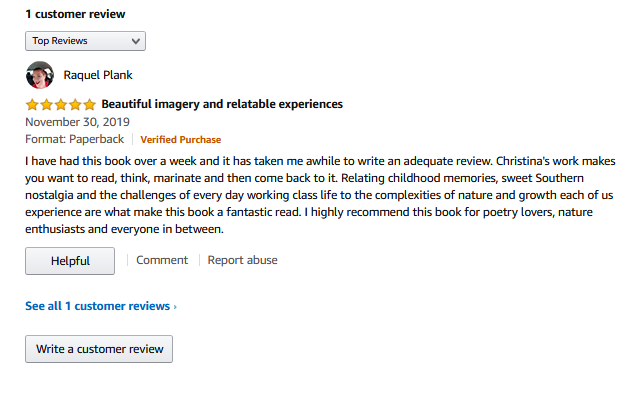
This review is very thorough. The most important points are:
- An emotional reaction to the work
- A great description of the style of work
- Who the reader would recommend read the book
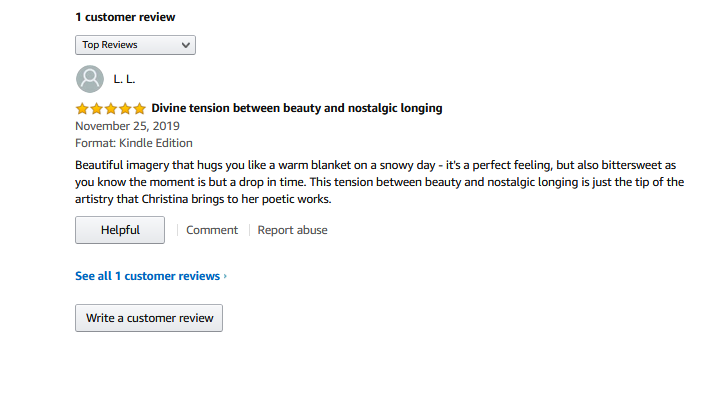
Another well-written review:
- Provides an emotional reaction to the work.
- The review targets the type of reader who would enjoy a poetry collection
- The descriptive language shows that the reader put thought into crafting a well-thought review, which is encouraging and more meaningful to other readers. Credibility is established.
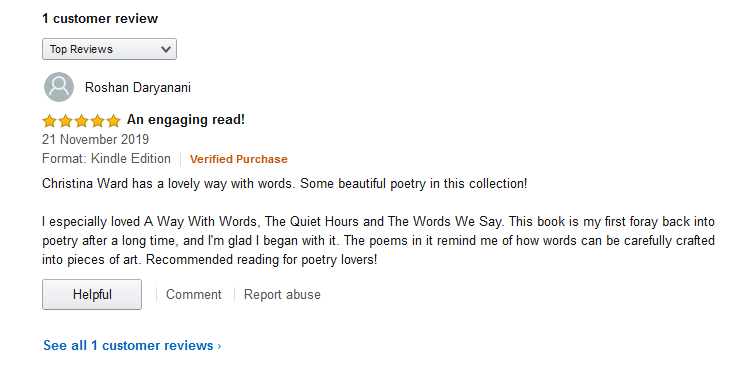
This review, like the others above, is a great example of a thoughtful review.
- The reader named specific parts of the book they really enjoyed.
- The reader made it personal and told how this book fit into their reading choices.
- The reader recommended a specific audience for the book.
Helpful reviews.
Now that we’ve covered some excellent brief reviews, let’s consider what makes for a helpful book review.
- Be honest, but kind. If the book was not your favorite read, it is ok to say that the book “isn’t your thing” but follow it with something positive. “It wasn’t my favorite book but it is well-written and would resonate with “xyz” kind of readers.”
- Tell how the book affected you or impressed you.
- Point out the strong points of the book and potential weaknesses if it is a glaring issue for you. Remember that book reviews are as much for the reader as the author. If you make your review helpful, a potential reader of the book can tailor their decision to purchase or read the book. Give a good “flavor” of the book so the reader knows what they are getting into.
- Check for the book on Goodreads and Amazon — reviews are needed for both sites. Write a blog post. Or Tweet the book link with a brief statement on the book. I’ve had authors personally reach out to me to thank me for a well-written review, and they share it everywhere. It’s great exposure for you as well if you are a writer or blogger.
- Be specific but don’t give away spoilers and ruin the book for everyone else. If spoilers are included, do so late in the post so it will be easy for a reader to see your “spoiler alert” and proceed with caution or leave before their eyes catch that part about so-and-so dying at the end and how it reduced you to tears.
The BAD
Let’s talk about the BAD. Here are a few examples: (These are random reviews I found on Amazon.)
As disturbing as it is to receive bad reviews to the author, these are truly helpful to gauge the readers’ reaction to your work. Some bad reviews are good for you and your reader as they are full of helpful information, even though the stars are lacking. Here are a few examples of very helpful bad reviews, and a few not-so-helpful ones. (All are screenshots of 1 star reviews on a John Grisham book.)

Good information about a potential formatting and editing issue.

Good information to help the squeamish or violence-sensitive readers know to steer clear. It helps readers know what type of scenes they will experience in the book. However, 1 star? Perhaps it was not this person’s cup of tea, but another may truly enjoy it.

Reviews are not excuses to rant. Although this reader did establish a bit of credibility, it also seems the reader was a bit harsh on the content because they know legal issues. Not all readers will read it with such scrutiny.


These last two shots are examples of truly unhelpful and pointless reviews. First of all, there is no real explanation. What exactly is meant by “heart is not in it” or “stole the plot”? Most readers will know to take these types of reviews with a grain of salt but the book is left with 1-star reviews that are useless to other readers.
Tips for leaving bad reviews:
- You can still be kind.
- Be specific about what you didn’t like about the book, but also point out what works in the book. Keep this balanced and readers will feel you are giving an honest review.
- If you hated it, you hated it, but lashing out at the author is pointless and cruel.
The UGLY
Some reviews definitely fall into the “ugly” category. Anne Rice has been very vocal about bad reviewers actually bullying writers with bad reviews.
“They’ve worked their way into the Amazon system as parasites, posting largely under pseudonyms, lecturing, bullying, seeking to discipline authors whom they see as their special prey . . . They’re all about power. They clearly organise, use multiple identities and brag about their ability to down vote an author’s works if the author doesn’t ‘behave’ as they dictate.” — Anne Rice tells The Guardian.
Some authors have taken legal action against slanderous reviewers. Here are a few awful ones, though I hate to even bring any attention to these Negative Nancy’s.
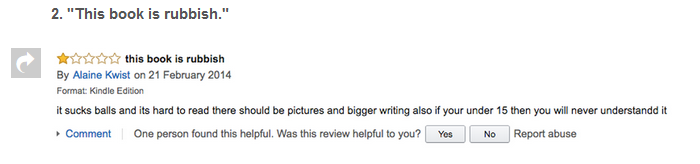
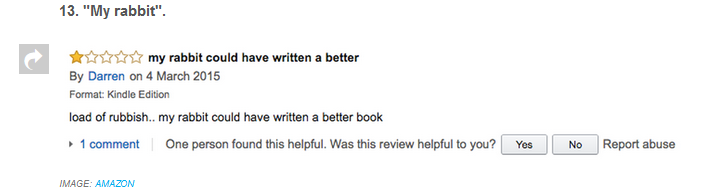
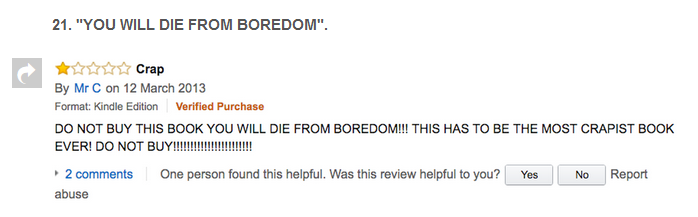
Clearly, in the third example, the reader did, in fact, survive reading the book and live on to write the “MOST CRAPEST REVIEW EVER!!!!!!!!!!!!!!!!!”
These folks should leave the book reviewing to people who can add something of value to the conversation. All this negativity is doing it tarnishing the reputation of a writer’s work and muddying up the reviews for those who are looking to gauge whether or not to buy. Save the silliness for your Twitter feed.
In summary, think of a book review as a chance to help steer that book into the right hands, the right readers. It is also an opportunity for you to share your thoughts, thank a writer, and share with other readers who may be interested in the book. Book reviews are gold to a writer; handle that with care. Imagine you wrote the book and think of what kind of feedback you’d like on your work. This may be the best way to leave constructive, helpful, valuable feedback.
Read, read, read — and review!
Christina Ward is a poet, author of “organic”, and an advocate for humans being better humans. She loves reading and reviewing books.


