Book review
Book Review: The Eagle of the Ninth by Rosemary Sutcliff
A masterpiece on many levels
Another Folio
I have a weakness for Folio Society books. For one thing, they are a reprint house, and they do not choose duds to publish. Classics, bestsellers, masterpieces, gems, treasures. Every book they select and publish has proven itself in some way.
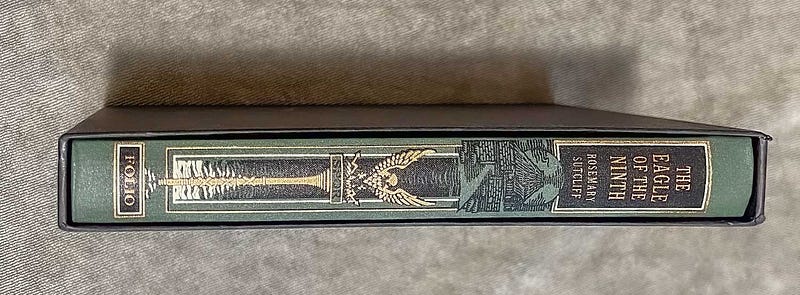
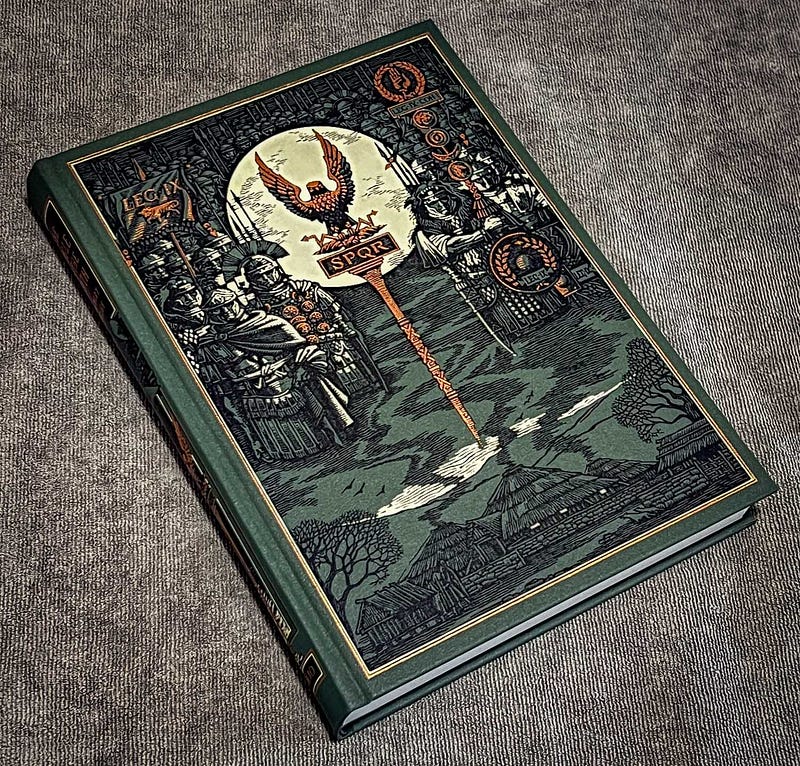
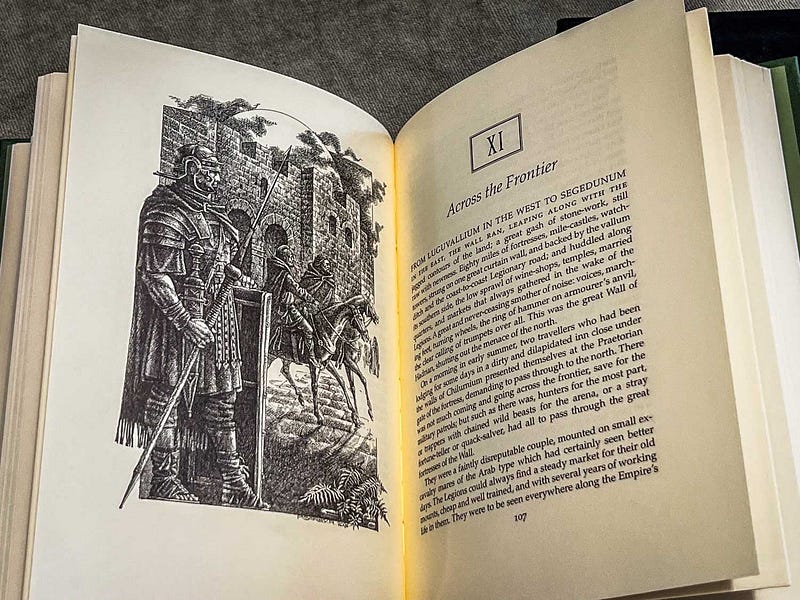
The standards of printing, binding, illustration, and presentation are high. Careful thought has gone into every aspect of the book’s appearance. A Folio book will be visually appealing and sturdy, protected by a slipcase, itself generally provided with a thematic design.
Naturally, the high standards are reflected in the pricing and assembling a Folio bookshelf is not cheap.
I regard these as my personal library of essential books. Those that everyone should read, if not possess, and those that have touched me in some way. I cannot afford to buy them new, so I always have my eyes open in thrift shops and online sales for new treasures.
This book — a classic tale of adventure in Roman Britain and beyond in the search for and attempted recovery of the lost eagle standard of a vanished Roman legion — is a handsome addition to any collector’s bookshelf.
Just a note. There are few spoilers here. Nothing beyond what a reader will find in a blurb or dust-jacket notes.
A friend from school
I first read The Eagle of the Ninth as a teenager. I was a voracious bookworm in those days, chomping my way through the school library and I enjoyed this one so much I’ve had it high on my mental list of “must get this one for keeps”.
I think I have a ragged old paperback somewhere in the shed but my heart was captured by the Folio edition. One of a matched set — it is the first in a trilogy — all designed to a theme and something clicked.
Prices for this set, now out of print, can go up to several hundred dollars. My budget is rather more modest and so I have been keeping my eyes open. One popped up online for forty dollars and a little more for postage and — it didn’t take much self-persuasion — I hit the “Buy” button.
It arrived, I carefully unpacked it, admired the three-colour embossed cover design, opened it up, read the introduction, and looked up some hours later, well into the story.
The place
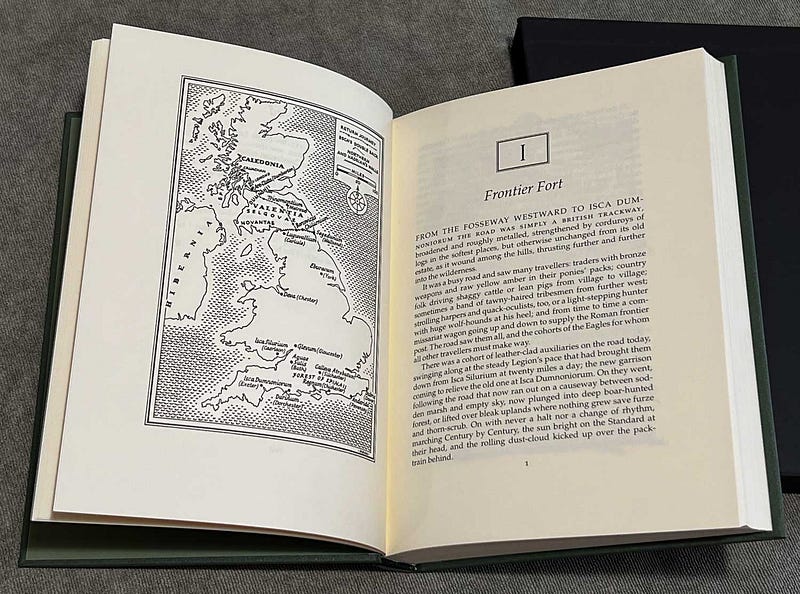
Roman Britain in the Second Century CE. England was settled, Wales uneasy, and Scotland a lost cause with the Roman border pulled south to Hadrian’s Wall.
The Ninth Legion had marched north in 117 CE and vanished. Marcus Aquila, son of one of the senior officers of the legion, has arrived in Britain to take up his post in the West Country.
Marcus is a professional soldier. Brave, competent, keen, if not experienced. His ambition is to command one of the top legions and — eventually — retire to the ancestral farmlands in Italy. For now, though, he has a job to do.
The pace
Rosemary Sutcliff tells a cracking story. From the opening pages, where Marcus leads his troops to the frontier garrison, to the end of the book, there are few opportunities for rest. Poor Marcus is always dealing with some problem or other, often life-threatening and urgent.
This is a novel that has no sag. You can read page after page, looking for a paragraph or even a sentence that is mere “filler”, and you will look in vain.
Even the descriptive passages, redolent with detail, set up events to come and underscore the ever-present gulf between Roman and Briton.
It was very early, the sun not yet up, and the mist lying like a white sea between the hills. Scent would lie low and heavy on such a morning, and he sniffed the dawn chill like a hound. And yet he could not find his usual pleasure in the fine hunting morning, for he was worried. Not very worried, but enough to take the keen edge off the blade of his enjoyment; turning over in his mind the rumour that had been drifting through the fort for the past day or two — the rumour of a wandering Druid having been seen in the district.
The whole book is like this. There are chapters of fierce action and in between the stage is cleared and re-set for the next incident, every conversation, every word of description adding to the tension of foreigners in a frontier land.
In the second half of the book the atmosphere becomes ever more brittle. Safety is a long and perhaps impossibly far distance away. Nothing can be taken for granted; a minor victory is found to be flawed, with conflict and worry flowing in through the tiniest of chinks.
This is a book to be read in a sitting, just to see what happens next and what fresh encounter must be resolved.
Two sets of eyes
We meet Marcus Aquila, Roman centurion, in the first pages. We see the action through his eyes alone. He is a man of the Middle Sea set here in a chill and misty land. The solidity of empire is fragile on the border. A tribal uprising, a winter wind, and wild Britain nibbles away at the stonework and order.
A fifth of the way in and we meet Marcus’ companion Esca, a British slave. Like the land, Esca is not quite tamed, and as the story progresses he and Marcus learn of each other’s ways, and of course we readers are informed at every exchange.
Esca is both a counter and a companion. Together they embark on the quest for the lost Eagle of the Ninth Legion, passing from Roman villa in the settled South to thatched hut in the far North. The slave becomes a friend as the hunt progresses and more than that as the hunters become the hunted, with both men depending on each other for survival where every shadow, every noise on the wind, every rustle of leaves is a threat.
Through this odd partnership we learn more of the relationship between Rome and Britain than any amount of musing and exposition on the part of the author, no matter how cunningly concealed.
A third of the way in, we find a key passage, one that artfully presents the contrast between Rome and Britain. Marcus and Esca compare a Roman dagger and a British shield:
“Look at the pattern embossed here on your dagger-sheath,’ Esca said at last. ‘See, here is a tight curve, and here is another facing the other way to balance it, and here between them is a little round stiff flower; and then it is all repeated here, and here, and here again. It is beautiful, yes, but to me it is as meaningless as an unlit lamp.’
Marcus nodded as the other glanced up at him. ‘Go on.’
Esca took up the shield which had been laid aside at Cottia’s coming. ‘Look now at this shield-boss. See the bulging curves that flow from each other as water flows from water and wind from wind, as the stars turn in the heaven and blown sand drifts into dunes. These are the curves of life; and the man who traced them had in him knowledge of things that your people have lost the key to — if they ever had it.’ He looked up at Marcus again very earnestly. ‘You cannot expect the man who made this shield to live easily under the rule of the man who worked the sheath of this dagger.”
And what a writer!
Rosemary Sutcliff, crippled as a child, brings her disability and pain into the story. Marcus is grievously wounded in an early battle and is never quite whole again after. He limps at the best of times, and if he exerts himself, his reward is pain and a reduction of ability.
He can run from imminent danger but not for long. Medicine and healing, such as they were in those days, form one of the themes of the book.
A subject with which the author must have been all too familiar. She spent most of her life in a wheelchair and, judging by the feeling she puts into her portrayal of pain, must have been very familiar with it as a companion.
Marcus, as commander of a border fort, is required to respond to an attack on the outpost by the locals, doubtless whipped up by the Druid we heard about in the extract quoted above. There are difficulties and surprises, and Marcus receives a fearful, life-changing wound, one that takes him out of the regular service, gives him — and we the readers — a new set of companions, and sets him on the path of the lost Eagle standard of his father’s vanished legion.
Without giving too much of the plot away, this means more difficulties, more pain, and some surprising friendships formed.
Perhaps a word or two about Rosemary Sutcliff’s research. She turns out to be wrong in some of her history but it hardly matters. Even on flawed ground, the story is a ripper, and what she does get right is excellent.
There is a very real sense of atmosphere, place, and time in this book. This is a story firmly rooted in the culture — or cultures, really — of Roman Britain and the characters all have their goals and objectives.
Often passionately held and in conflict with each other. As a writer, Rosemary holds many plot threads in her hands and weaves them together with great skill and timing. There is always something going on in the foreground, and behind, in multiple layers, other plots bide their time, ticking over with occasional mentions until it is their turn to occupy our attention fully.
I really cannot stress how useful this book is to the budding writer. Study up on the structure and how it is all pieced together so perfectly; you will never go short of readers after learning how to work the magic.
Other themes
Oddly enough, for a book about soldiers and conflict, battle sequences and actual fighting take a back seat. There is one battle described directly, a couple more told at second or third hand, and beyond that, conflict rarely gets to the stage of people cutting each other up.
A lot of the effort of the characters involves finding ways to resolve conflict without resorting to violence. A characteristic of a good military commander, by the way. Winning without fighting is the ultimate sign of a wise leader.
So, in a sense, this is a more cerebral read than one might expect, given the topic and setting.
Almost an anti-war story, published in the mid mid-twentieth century after the United Kingdom had fought in two extremely costly wars.
Honour is an undercurrent through the narrative. The soldiers have loyalty to Rome, their god(s), their legion, their fellow soldiers, their family and — not least — to themselves. The British seem to have rather less of this, though as a conquered — or in some places, unconquerable — people, they have older and deeper loyalties.
For Marcus, once he is invalided out of the service, he looks to salvage the honour of his father and the reputation of his legion by retrieving the lost Eagle. It doesn’t work out completely as planned but in that process we see another significant change in Marcus, and you’ll just have to read the book for yourself!
The relationship between Marcus, Roman through and through, and Esca the British slave also changes as both characters develop through their now joined lives. Loyalty and service to each other presses them closer and in a sense you may ignore the quest for the Eagle of the Ninth; this is the story of a pair of strong characters and their growing relationship.
Wrapping it all up
A classic story — otherwise Folio Books would never have chosen it as a project — full of atmosphere and excitement. A real page-turner, and an object lesson in how to write a great story.
An excellent introduction to the time and place. Roman Britain is endlessly fascinating, not least for the attempts of the United Kingdom to recreate much of the majesty in their own global empire, when London became an imperial capital surpassing Rome in reach and power.
A century ago, English schoolchildren were taught Latin as a matter of course, with the classic histories and texts of Rome on every library shelf. In that sense, this book must have appealed to a generation of parents casting about for tales that their children could appreciate.
The Folio Society edition adds a layer of class and style in its handsome presentation. Even more so as a trilogy, and I fear that I shall have to keep my eyes open for bargain-priced copies of the other two in the set.
Ten out of ten, Rosemary Sutcliff. This is a book that is a success in so many aspects. I loved it.
Britni