
BOOK REVIEW & RECOMMENDATION
Book Review: Lost on a Mountain in Maine
A 12-year-old boy gets separated from the Boy Scout troop he was hiking with on Mount Katahdin in Baxter State Park, Maine. He would wander in the wilderness for nine days
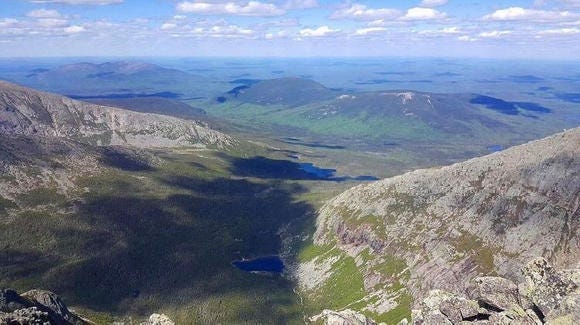
The clouds float lazily above Knife’s Edge on the right. Notice how that ridgeline looks like a serrated knife’s edge?
Note: This post contains affiliate links. As an Amazon Associate, the author earns from qualifying purchases.
The book is autobiographical, written by Donn Fendler, after he retired from the US Army. He lived to be 90 and crossed over on 9 October 2016. He told his story (mostly at elementary schools) about those nine days, the importance of faith, and a never say die attitude.
Lost on a Mountain in Maine is available for Kindle from Amazon. Although they call this a “children’s book,” I found it fun and exciting.
How He Gets Separated
Donn Fendler got ahead of his father, walking with an older guide’s son, Henry. An older gentleman called to them. While Henry spoke to an older gentleman, Reverend Charles Austin, Donn said he would go back with his father and left. Suddenly, the mist of a cloud settled in around them.
No one would see him again for nine days. The boy would drop from 74 pounds down to 58, lose his pants, and toss his tennis shoes because he thought they had shrunk. It is more likely his feet were too swollen to fit in them any longer. It is estimated that the boy covered 80 miles during those nine days of walking barefoot in the Maine woods.
One of the guides from the area, Earl W. York Jr., said, “The stones are so sharp on parts of Mount Katahdin that a pair of new, heavy sneakers will not last over six trips, even when the regular trail is followed.” And this boy traversed most of that area in his bare feet after leaving his “shrunken sneakers.”
If you’ve never been involved in this phenomenon, you might not understand how quickly this can happen, or how he got separated from the rest so easily.
I remember in 1977, while I was stationed in Mannheim, Germany, we took a unit trip to Garmisch-Partenkirchen up in the German Alps. I went out the back door of the hotel to smoke a cigarette. A CLOUD SURROUNDED ME while I was smoking, and I couldn’t see anything. I had to drop down on my hands and knees to get back to the hotel. It was unreal.
The Sign That Likely Would Have Led Him to Safety
They were close to the Knife Edge when Rev. Austin met them. The Knife’s Edge, in the photo above, has drop-offs in some places that drop 1,500 feet. This sheer granite wall connects Pamola (what the local natives call “the demon spirit”) and Baxter Peak.
What you must understand is in hiking, a “trail” doesn’t always mean a clearly marked path.
The Hunt Trail is only marked with daubs of white paint on trees and rocks in some places. Sometimes, in this area, there are arrows pointing toward the Katahdin summit, Baxter Peak. It would be difficult to see those marks with the mist and the hail.
Donn tells us about crawling through the “pucker bush,” which is actually Wax Myrtle. Most hikers avoid it like the plague. It’s just too thick and abundant to walk through.
After the sleet and hail, Donn came out of the pucker brush and saw a sign for Saddle Trail. However, he remembered hearing about being “full of landslides and loose rocks.” He worried that although it was a marked trail and it would lead him somewhere, “perhaps to some lonely spot miles and miles from camp.”
So, he decided, “No, I mustn’t take it.”
However, Saddle Trail, if he could have traversed it safely, would have led him to Chimney Pond and Roy Dudley’s camp, where people were that very night. Of course, the young lad had no way of knowing that.
During that first night, there were 40 mph winds and at times, even though it was July, the temperature with wind-chill dropped to 40 degrees.
It’s a wonder he didn’t get hypothermia out there, especially with wet clothes and no shoes or pants.
What Makes the Story So Endearing
Despite the terrific hunger, cold temperatures at night, the insects (mosquitoes, leeches, blackflies, and moose flies), black bears, and other dangers, young Donn never loses hope. He always imagined that right around the next corner, he would be rescued.
For those who would trivialize the insects, one veteran guide, Harry Kearney, said, “The moose flies are by far the worst, but the bite of the copperhead — a tan, translucent fly, about half an inch long — can cause blood-poisoning unless cared for immediately.”
When asked if he was glad to see daylight come? He emphatically replied, “No!”
Daylight meant walking on his swollen, throbbing feet, hunger, anxiety, and burning bug bites. Plus, he worried he was moving away from civilization rather than toward it.
Donn Fendler Found
Created and uploaded by GreatMountainLLC.
What America Thought While He Was Lost
27 July 1939, in the Boston Transcript, “But after the searchers had turned back, and after the press had pronounced this return hopeless, thousands of mothers in America did not give up hope. They scanned the papers daily for word; they watched their own sons a bit more closely. There was a stout trail of hope being blazed for this boy.”
There Will Be a Movie
After all these years, according to a story in the Bangor Daily News, the film is getting closer to reality.
There was a documentary in 2011 created by Derek Desmond and Ryan Cook, with commentary by Donn Fendler, but hopefully, the film will come to the big screen soon.
Donn Fendler reflects on the 75th anniversary of his being ‘Lost on a Mountain in Maine’
Created by the Bangor Daily News.
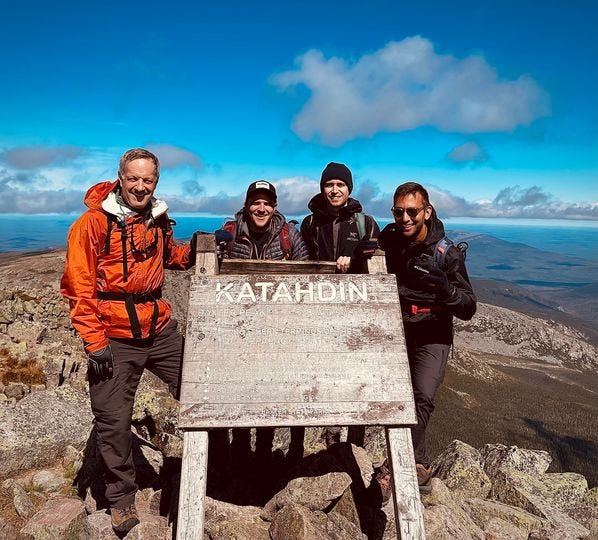
According to the Lost on a Mountain in Maine Facebook page, “We know it’s been quite some time since you’ve heard from us, but rest assured we’ve been working hard behind the scenes to bring Donn Fendler’s incredible journey to life as a narrative feature film.
We’ve partnered up with some really great people, including the folks at Balboa Productions (Sylvester Stallone’s production company), who believe in Donn’s story just as much as we do. We are moving forward with filming this summer and will have more details for you soon as we lock in our cast and the rest of the creative team that will help bring this film to life.”
Follow the movie’s progress on Facebook or on their website, GreatMountainLLC, and pick up the book.
If you enjoyed this book review, you might also like the story Jon Legere and I put together about hiking Mount Katahdin, Why Don’t You Take a Hike — Up Mount Katahdin in Piscataquis County, Maine.

Stephen Dalton is an Old Town, Maine native, a retired US Army First Sergeant with a degree in journalism from the University of Maryland, and a Certified US English Chicago Manual of Style Editor. Also, a Top Writer in Investing, Nutrition, Travel, Fiction, Transportation, VR, NFL, Design, Creativity, and Short Story.
Website | Facebook | Twitter | Instagram | Reddit | Ko-fi | NewsBreak | Simily
Not a Medium member yet? Do you want to have access to tens of thousands of stories every day and support those who write them? Click below to join today and help us writers tell our stories. By signing up, a part of your membership will help me without any additional cost to you. It only costs $5 per month, and I’ve made money every month since I became a paying member, and you can too. Thank you.
If you’re already a member and want to get an email whenever I publish a new story, click below. Thanks.