
Generative AI, Books
Book Review: Generative AI for Data Analytics
A preliminary review of the book Generative AI for Data Analytics by Artur Guja, Marlena Siwiak, and Marian Siwiak on how to use generative AI tools to assist you in your journey as a data analyst
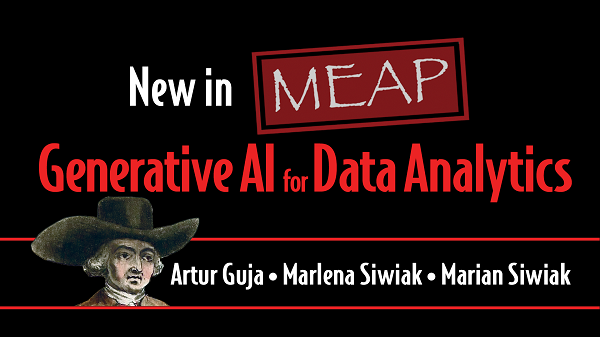
Over the last year, we have been assisted in developing articles, videos, and tutorials on how to use generative AI to perform a given task. Most focus on specific examples and how to implement them through generative AI. The book Generative AI for Data Analytics by Artur Guja, Marlena Siwiak, and Marian Siwiak is different because it helps you see generative AI as your personal teammate (despite its limitations). Let’s see how the book is organized.
The Book outline
- Introduction to the use of Generative AI in Data Analytics
- Using Generative AI to ensure sufficient Data Quality
- Descriptive analysis and statistical inference supported by Generative AI
- Utilizing Generative AI for result interpretation and formulating recommendations
- Basic Text Mining using Generative AI
- Advanced Text Mining with Generative AI
- Scaling and Performance Optimization
- Risk, Mitigation, and Trade-offs
APPENDICES
Appendix A. Specifying multiple Dataframes to ChatGPT v4
Appendix B. On debugging ChatGPT’s code
Appendix C. On laziness and human errors
What I have learned from the book
Throughout the book, I felt like generative AI was my partner in problem-solving. The authors’ problem-solving strategy involved a synergistic collaboration between humans and machine intelligence. Instead of relying solely on the generative AI tool to dictate the solution, the authors engaged in an interactive dialogue, treating the tool as a trusted advisor.
The authors use the following problem-solving strategy:
- Leveraging Generative AI for Initial Guidance: The authors begin by seeking the generative AI tool’s insights into the problem’s structure and potential solutions. ChatGPT, the specific tool employed, provides a high-level overview of the problem, identifying the main steps involved in its resolution. This initial guidance serves as a valuable starting point, framing the problem and establishing a foundation for further exploration.
- Converting AI insights into actionable implementations: For each identified step, the authors engage in a deeper discussion with ChatGPT to understand how to translate these steps into actionable plans. The tool generates detailed explanations and provides specific examples.
- Human-AI Collaboration for Problem Resolution: The problem-solving process is not simply a passive reliance on the generative AI tool’s output. Rather, the authors actively engage in a collaborative dialogue with ChatGPT, treating it as an intellectual partner. This human-AI collaboration allows for the exchange of ideas, the refinement of solutions, and the adaptation of strategies to address specific challenges.
As a result of this collaborative approach, the authors successfully solved their problems with the assistance of the generative AI tool. The process not only led to effective solutions but also fostered a deeper understanding of problem-solving methodologies and the potential of generative AI in supporting human endeavors.
My overall score
I like the mindset defined in the book. From the beginning, you learn the foundations of how to use generative AI for data analytics.
The book’s suitability extends beyond aspiring data analysts seeking to acquire a foundational understanding of data analysis concepts. Experienced data analysts can also benefit from immersing themselves in the generative AI mindset. The book provides valuable insights into how experienced data analysts can integrate generative AI into their existing skills, expanding their analytical capabilities and unlocking new avenues of exploration.
For aspiring data analysts, the book serves as a comprehensive guide, meticulously crafting a path from novice to proficiency. The authors’ gentle pacing and clear explanations make the material accessible to readers of all backgrounds, fostering a deep understanding of the subject matter.
Experienced data analysts, on the other hand, can leverage the book to cultivate a generative AI mindset, empowering them to reframe their approach to data analysis and embrace the transformative potential of this cutting-edge technology.
In essence, the book’s versatility caters to both aspiring and experienced data analysts, offering a valuable learning resource for individuals seeking to expand their knowledge and enhance their data analytics expertise.
Summary
“Generative AI for Data Analytics” unveils the secrets of transforming raw data into actionable insights through generative AI.
Whether you’re a data newbie or a seasoned pro, this book is your guide to mastering the art of data analysis with generative AI. For aspiring data analysts, it’s like having a personal mentor, gently leading you from novice to expert.
And for experienced data analysts, it’s a chance to level up your skills and embrace the future of data analysis. Imagine being able to uncover hidden patterns and make informed decisions with unprecedented accuracy—that's the power of generative AI in your hands.
So, grab your copy of “Generative AI for Data Analytics” and embark on a data-driven adventure. Discover the secrets of this transformative technology and unlock the true potential of data analysis.
Happy reading!