Book Review — “Feel Good Productivity” by YouTuber, Ali Abdaal
An in depth and honest review about YouTube star, Ali Abdaal’s book “Feel Good Productivity”. Should you read it?
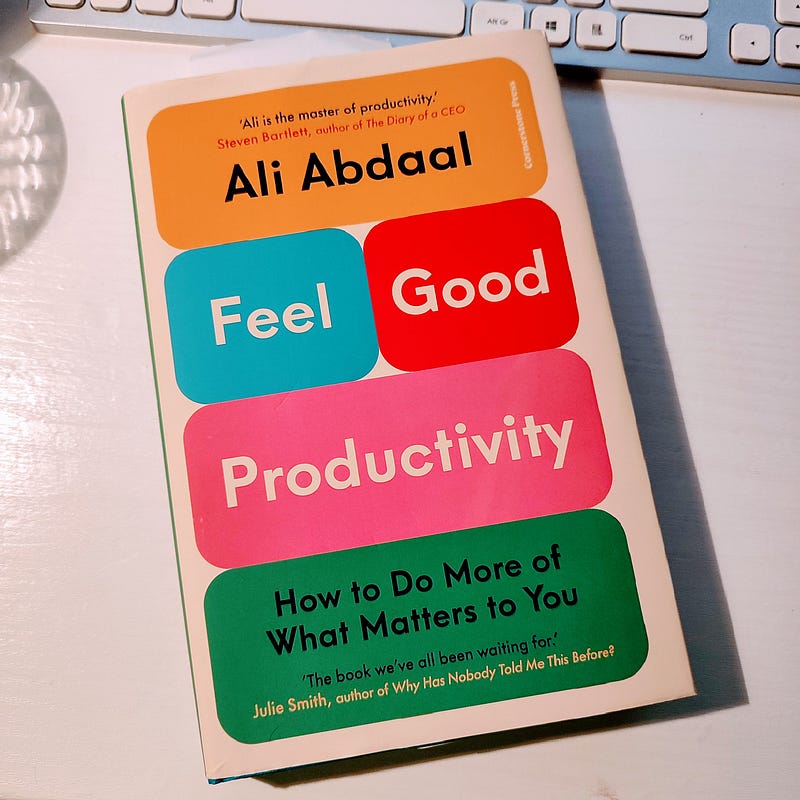
It’s hard writing a book. It’s even harder finishing a book. But finishing a first book to high peer acclaim, whilst having a vast audience pre-ordering with baited breath, and getting best seller status with two weeks of publishing? It must be a unicorn.
Like many of the people who have read Ali’s book — “Feel Good Productivity; How to Do More of What Matters to You” — thus far, I am a follower of his YouTube channel and Deep Dive podcast. A lot of hype was generated around his book starting from around July 2023 and continuing beyond its release date just after Christmas 2023. It was clear throughout all Ali’s videos where he promotes this book, he was very proud of it.
I mean, I ordered it back in August 2023 … so I only waited … 4 months?
If you don’t know Ali Abdaal he is one of the biggest lifestyle and business YouTubers with a multi-million pound yearly turnover and around 10 people on his team. He started out his career as a doctor but was always interested in coding and making money on the side. He attributes a lot of his personal drive to a single incident; when he spent around £2000 buying an old, broken Macbook. Scammed out of his hard-earned savings, he resolved to making the money back, and more besides.
The ‘productivity’ world has had a lot of negative press in the last year or two so I feel it was ambitious to use the word in the book title. But since no other word really describes what he does, it was probably a no-brainer; his mantra or raison d’etre is feeling good whilst being productive.
But does the wide level of expectation and promotion around its release bode negatively for the way it is received across his YouTube audiences and beyond? Therefore for this book review, my questions are;
- Does the book stand up to the hype in terms of content?
- Did I enjoy it?
- What are other people saying about it?
- Who would I recommend it to?
I’m going to try and focus on the content of the book, Ali as an author and not on productivity per se, although admittedly it’s hard to untangle some of the ‘productivity’ challenges.
Judging a book by its cover
First off, I really like the book cover. It’s very Notion-esque with its vibrant, contrasting colour, tag-style blocks for each section of text. Given the popularity of Notion as a task and life management app and the centrality it has in Ali’s life, this design comes as no surprise.
It’s also smothered from head to toe, front and back with recommendations from other authors in the sphere. This is probably testament to the number of people he engages with on a regular basis through his business and on his podcast (which I would recommend listening to), and the respect which they have for his work. Well done to Ali and his team for getting it on so many authors’ side tables.
But this was a bold move. It means high expectations from the outset.
An objective look inside the cover
This book, as the subtitle suggests, is about finding ways to enjoy the work you do. By enjoying your work more, you will naturally get more done. Ali pictures it as a self-sustaining cycle; feeling good ➡ energises you ➡ increases your productivity and so on.
The book is split into three parts which Ali says is to help his audience engage with the content. It’s a tactic he uses in his YouTube videos where ideas tend to come in threes or fives.
These headline, one-word sections, are “ Energise”, “ Unblock” and “ Sustain”. These are further sub-divided into three chapters, each with some experiments to ‘try at home’.
Ali’s aim is to “ offer you a philosophy; a new way of thinking about productivity that you can apply to your own life in your own way. (His) hope is that you leave this book an amateur ‘productivity scientist’”. You will leave with a ‘toolkit’ to ensure “ feel-good productivity (in) your own work, relationships and life”.
“Energise” introduces us to the “energisers that underpin positive emotions”, deliberately alliteratively titled; “Play”, “Power” and “People”. This section discusses how work should be more playful, how we can stay in control, and finally how our relationships with other people influence how we do things. “Unblock” is all about the dreaded procrastination and how we can discover and prevent what’s stopping us from starting. It’s about identifying our fears, and by doing so we can take the steps to progress. The last main section “Sustain” suggests ways to keep things going in the longer run; keeping everything sustainable to avoid burnout. Ever tried writing your own eulogy? No? Then this section is for you.
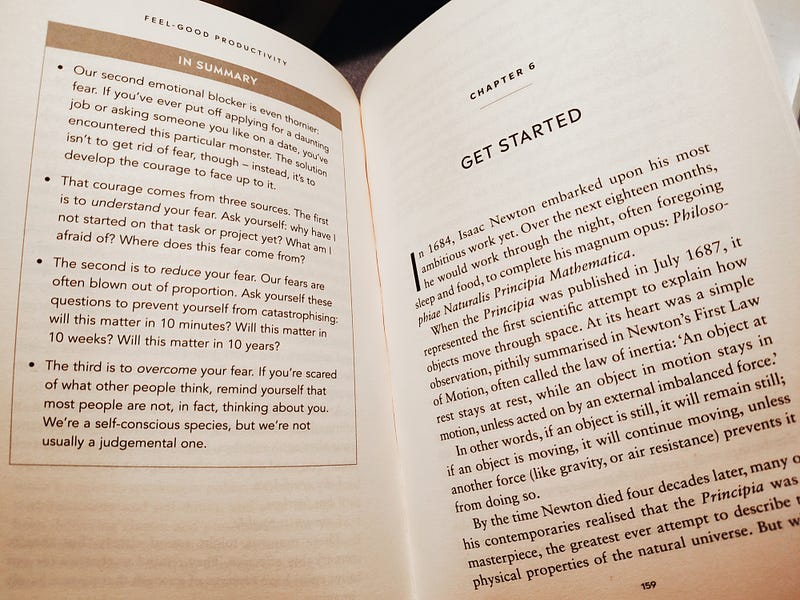
Throughout the book, along with some ideas in the main text, Ali shares many experiments to try at home. Some, I felt aligned with things I’ve read elsewhere, such as “fake it until you make it” which pretty much embodies “The Batman Effect”, and some are more problematic for me. Like if I were to “Embrace (My) Curiosity” I would not get anything done! But others like getting over fears by saying them out loud and “The Energy Investment Portfolio” were novel (to me). All in all there are plenty of ideas to try which Ali wraps up with his own style and spin, so even if they were more well known ideas he has plenty to bring to the party!
At 270 pages (hardcover version, 2023) and due to its writing style, it’s a pretty quick read. I probably would have read it in one day had I not had a small person needing constant attention… but what was my opinion about the book?
A more subjective look inside the cover
I did feel a slight sense of irony in Ali’s book and I think it’s something he does get criticism for a lot. He makes his money from talking about productivity; he starts out the book with his experience being a doctor but moved onto YouTube when it started really taking off. The ‘being a doctor’ experience is perhaps more relevant for many of us and it is therefore more tricky to put the book into context when you aren’t running your own business and have much less control over what you do.
Some of the tips Ali gives in the book are only really suitable for people who have at least some control of their time, and/or have money to ‘buy back’ some of their time. The ‘feel good’ philosophy might still be relevant, but it is much more of an uphill challenge for those with families and struggling to make ends meet.
That being said he has got to where he is through hard work, perseverance and rugged determination so that on its own deserves celebration. And as he has done that by living the principle of this book, we should all stand up and listen.
Given I have watched his YouTube channels for many years, I was particularly interested to find out the similarities and differences between him being on a camera and him writing on a page. His light-hearted YouTube style comes across in the book, but it surprised me with the number of studies he used throughout. Not in a bad way, just in a ‘this is different’ way. When I think about it, it’s obvious his inspiration and references should be in the book, but for some reason I didn’t expect it as he rarely shares the science behind his videos.
Something which speaks to me as a scientist and PhD student, is his use of ‘experiments’ to suggest ways you can ‘try this at home’. And like experiments if it doesn’t work then we can try something else. And if it does, then we can build on it. I’m not sure his aim of being a ‘productivity scientist’ was necessarily the right term, but it embodies the idea of exploring and trying shifts in mindset and techniques. Some of the experiments are not altogether clear how you might enact them. In some cases only one real example is given which may not be relevant to you.
As mentioned in the above paragraphs, a lot of the concepts in this book are not new per se. Any piece of secondary literature (i.e. books) will be an amalgamation of ideas gone before; concepts will be taken from the primary literature, which in itself builds on ideas gone before. Therefore it is in essence a collection of research and ideas gone before — including on his YouTube channel — but that doesn’t mean Ali doesn’t contribute his own spin and tips to make a book which ultimately stands as unique; ensuring you feel good about the things you do so you can do more of them. I therefore really like the combination of evidence he uses to craft his story.
What do others think?
It seems the world is reading his book. At the time of writing he has made both the New York Times and The Sunday Times bestseller lists.
Over the couple of weeks it has taken me to put this blog post together, his Amazon reviews have increased 10-fold. Starting at just 42 reviews and coming out at 4.1 stars just over a week ago, to now 433 reviews and a very respectable 4.6 stars, he is now entering Amazon’s ‘Most Read Non-fiction Books’ at number 10.
But not everyone is so impressed… I picked out some of those dreaded one and two-star Amazon views to see what some of his less enamoured readers have to say. The general consensus from the negative reviews is that he has repackaged what has gone before, either from his YouTube channel or from someone else, and that the level of depth doesn’t go beyond that of a blog post or even a Tik Tok… I can understand where these opinions come from. There isn’t really anything in addition to his YouTube work, only a bit more about the science behind those concepts. As a piece of secondary literature it is challenging to be considered ‘completely novel’ after all we are reframing and discussing how primary research can be applied rather than conducting studies and reporting their outcome. But what makes it unique is how it comes together as a ‘feel good philosophy’.
Ali cut out a lot of words from his book; I think it was in the region of 50,000, so I suspect there were many areas he originally went into much more depth. He is however, a master of information and knowledge transfer, so he probably chose a concise message over a copiously supported technique.
A couple of negative reviews made comparisons with best-selling, Atomic Habits by James Clear which is fair given it is in exactly the same genre of books. Yes, the format and layout is similar, but I have both books and the messages are very different. And the authors writing them are very different. With Ali’s book, I kind of feel like he is sitting next to me, telling me about all the interesting things he has read and done. These two books complement each other very well and I wouldn’t blame Ali for taking inspiration from Atomic Habits, assuming he did of course.
We don’t need to remake the wheel, but adding another one can make the journey a bit smoother.
I would recommend this book to anyone feeling low in work energy
I blog on this website in the context of PhD students and academia, but I would recommend this book to anyone as a first pass when you are feeling low and/or discombobulated about work. If some of the suggestions help you to get through one more day, then ultimately, it’s worth the time to read.
Three of my favourite ‘experiments’ I’ve implemented are:
- I now have a “what would this look like if it were fun?” post-it note at the bottom of my computer screen and if you buy the book, there is a link to a free mobile wallpaper with it on so I’ve put that on my phone too.
- Talking about my fears out loud (when I go for some exercise in the morning, and it’s dark….and there is no-one around but some sheep…)
- Asking ‘what’s the next step’, like literally the smallest thing I could do to make progress…
It might not give you the answer to all life’s problems, but it will help you to find some ways you can feel a bit better, to make you a bit more productive, so you get a tad more energy so that you can keep going for another day.
It’s an easy read, easy to grasp and written for the time-poor person. Dipping in and out at your fancy does not take away from the enjoyment of the book.
For those who have read many other books in the ‘productivity’ and ‘habits’ spheres, you may be disappointed at the lack of new science, but Ali’s feel good philosophy is refreshing and enlightening.
I highly doubt Ali would have been as successful as he has without applying the principles he discusses in the book. Therefore, productivity aside, is Ali himself not evidence that making sure we feel good about what we are working on, will lead to success? Whether that’s money, work, relationships or playing video games, feeling good makes a world of difference to us and the people around us.
Wait, there’s more… Like what you read? I write a weekly newsletter called Brain STREAM which contains insights, blog tl;drs and generally interesting and useful things about the world of research. Subscribe using the link below — it’s FREE!
Originally published at https://www.knowledgeecology.me on January 12, 2024.