
Bonsai — Beautiful, Or Tortured?
My Trident Maple Bonsai tree, Japan, and random thoughts.
I know what you thought as you read the title. Is this guy crazy, and maybe I am? But it is something I think about from time to time.
I have 23 Bonsais, a count constantly changing. I consider them my children, each one different and unique.
I have been interested in Bonsai since I lived in Japan and bought my first one from a Japanese garden center. That was a very long time ago. I would sit on our balcony with Mount Fuji in the distance. A beautiful view and one I enjoyed daily while having my morning coffee. It was a view that could have been on a postcard. How lucky was I to live here with that incredible view? The Bonsai was on our balcony, sharing space with Mt. Fuji.
Looking at my first Bonsai, staring at it for long periods, I wondered many things. Who was the first person who came up with the idea of taking a tree that would typically grow to 30 feet high and putting it in a tiny shallow pot keeping it small?
And why would you do that? What’s the purpose? This was before I learned anything about Bonsai, just random thinking while enjoying my coffee before I sped off to work and the crazy day that was sure to follow.

My staring and thoughts were interrupted — “ding dong” — the doorbell and my ride to work had arrived. After the doorbell rang, I saw a gray flash run past my view. It’s our gray Persian cat who has run to the back bedroom. You know, we were not supposed to have pets. So when the doorbell would ring, it was our habit to take “Boy Friend,” an unfortunate name my wife gave the cat, to the back bedroom. We didn’t want anybody at the door to see Boy Friend, especially a housing official or nosey neighbor. After doing this long enough, the cat now automatically ran to the back bedroom whenever the doorbell sounded. Even after we moved back to the States, this behavior continued. I know, I know, we were newly married, had no children yet, and we were already terrible cat parents.
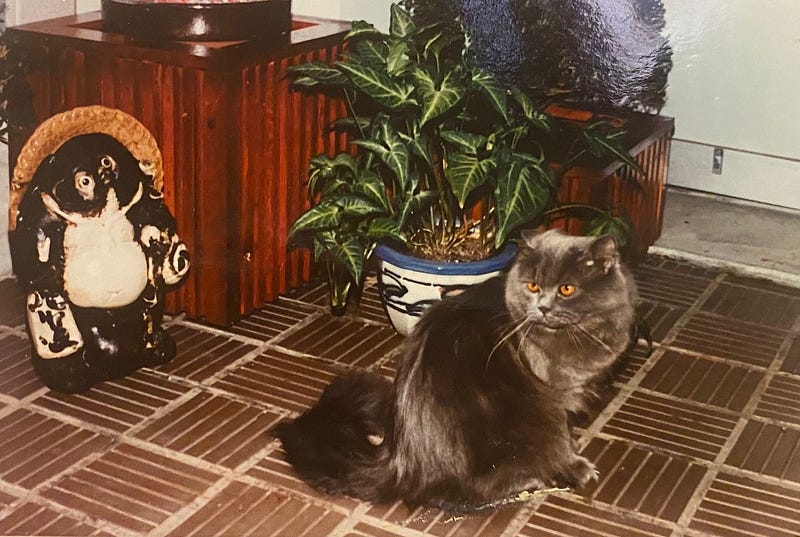
I made the wood planters in the picture, proud of myself for putting the high school shop training to good use. I searched for a picture of my first Bonsai, but none could be found. Our Tanuki is watching Boy Friend with caution. Tanuki is one of the mysterious creatures/spirits in Japan, called yōkai in Japanese mythology. Very Interesting subject with ties to Bonsai culture, maybe I’ll write about it someday.
I ended up killing the first Bonsai.
I murdered it.
I didn’t know why it happened. Too little water, too much. Wrong sunlight, wrong fertilizer. Now that I say the word fertilizer, I’m not sure I gave it any. After murdering my first Bonsai, I vowed not to torture anymore. Then a co-worker gave me one for a Birthday present. Oh shit, here we go again; what to do.
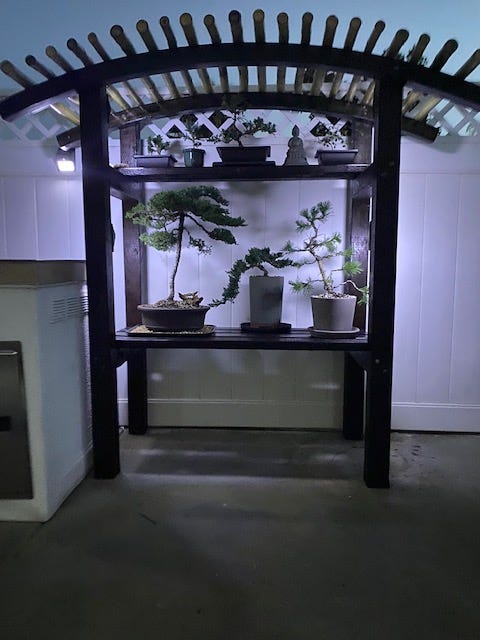
I managed to keep this one alive after learning a bit more about Bonsai. That’s a key piece of advice; underline it. Learn about something before buying it. We got along famously after I knew what I was doing.
Alas, two years passed, and I had a set of orders to Norfolk, Va, and would have to leave the Bonsai that I managed to keep alive for two years behind. One of the downsides of military life is moving every few years and giving all your plants away. The intelligent people didn’t buy plants, but we loved them, and the cycle continued.
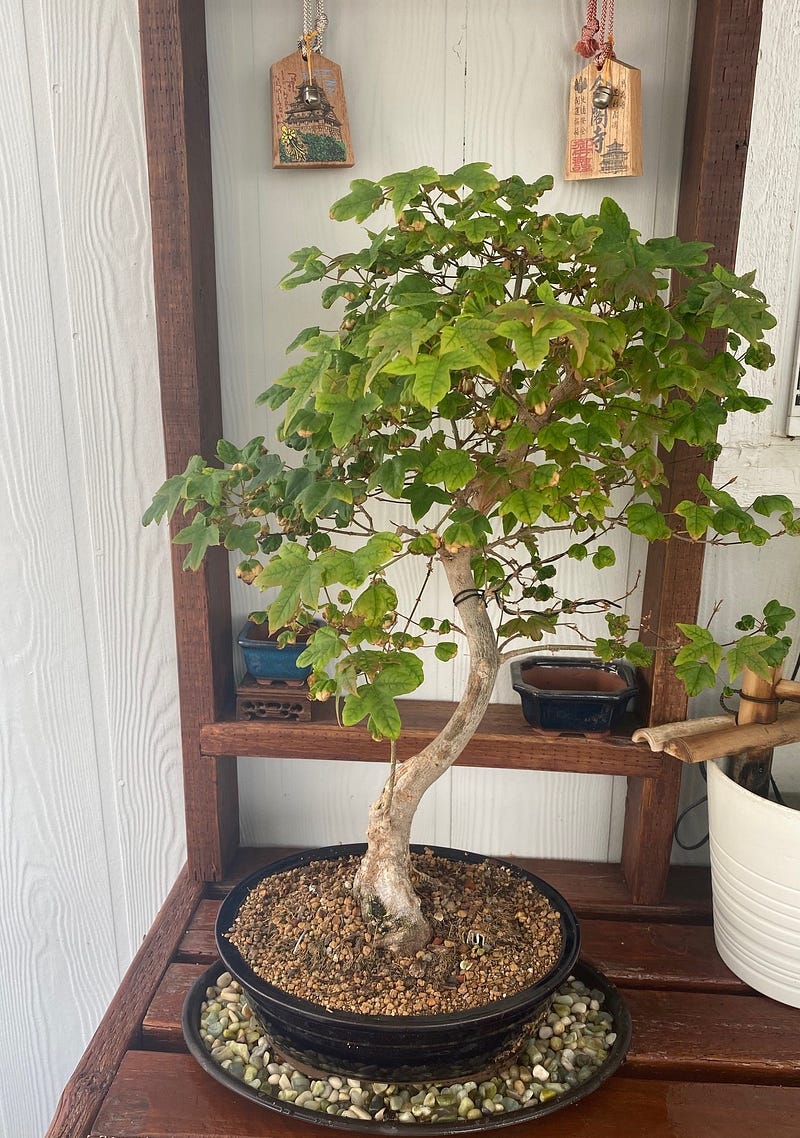
But today, I wanted to talk about Mable the Maple. Mable is a 16-year-old Trident Maple Bonsai (Acer buergerianum). I named her Mable because I like saying “Mable the Maple,” so sing-song, she was dying to be called Mable. Sorry, wrong choice of words. . . dying.
Trident maples are native to China and Korea, with gray bark that becomes scaly and flaky with age. Flaking reveals the inner bark, which is orange-brown, which gives the bark ornamental flair. I like to think she is blushing.
The leaves have three forward-pointing lobes with a trident shape. She has dark green leaves that change to yellow, orange, and red in the fall. Like most women, she can’t decide which color she likes on any given day.
I’m looking forward to Fall, as Mable is quite the show-off.
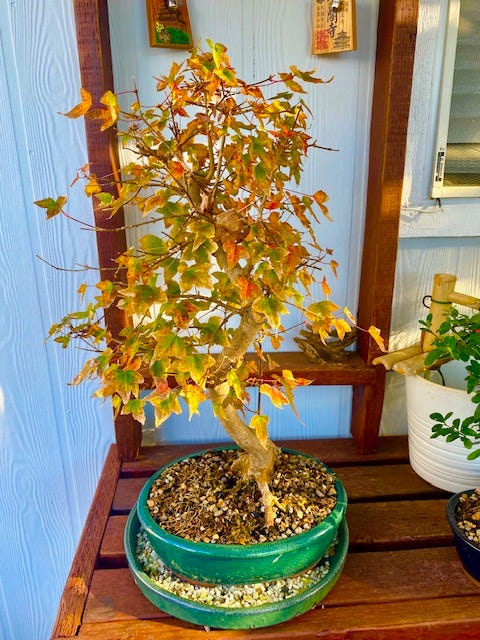
Mable hasn’t been looking as well recently. She is a little scrappy with some browning on her leaves. I’m sad for her as she is a proud and majestic girl. And feel responsible for her current condition. I think I’m doing all the right things. We had scorching weather for a couple of months, with temperatures as high as 106 degrees Fahrenheit. (41.1 degrees Celsius) All of my maples are looking a bit squidgy around the edges due to the heat. I have her under our trellis with a 50% shade cloth to avoid the scorching sun. But I can’t control the hot air. I tell her, “hold on, sweety; the cooler weather is coming.” She brustles in the breeze to acknowledge me.
Bonsai are re-potted every few years with a pot that is only slightly larger to restrict root growth, which helps to maintain their miniature size. I tell her, “your new pot is coming soon, and you will have virgin soil to expand your roots.” She brustles again in excitement.
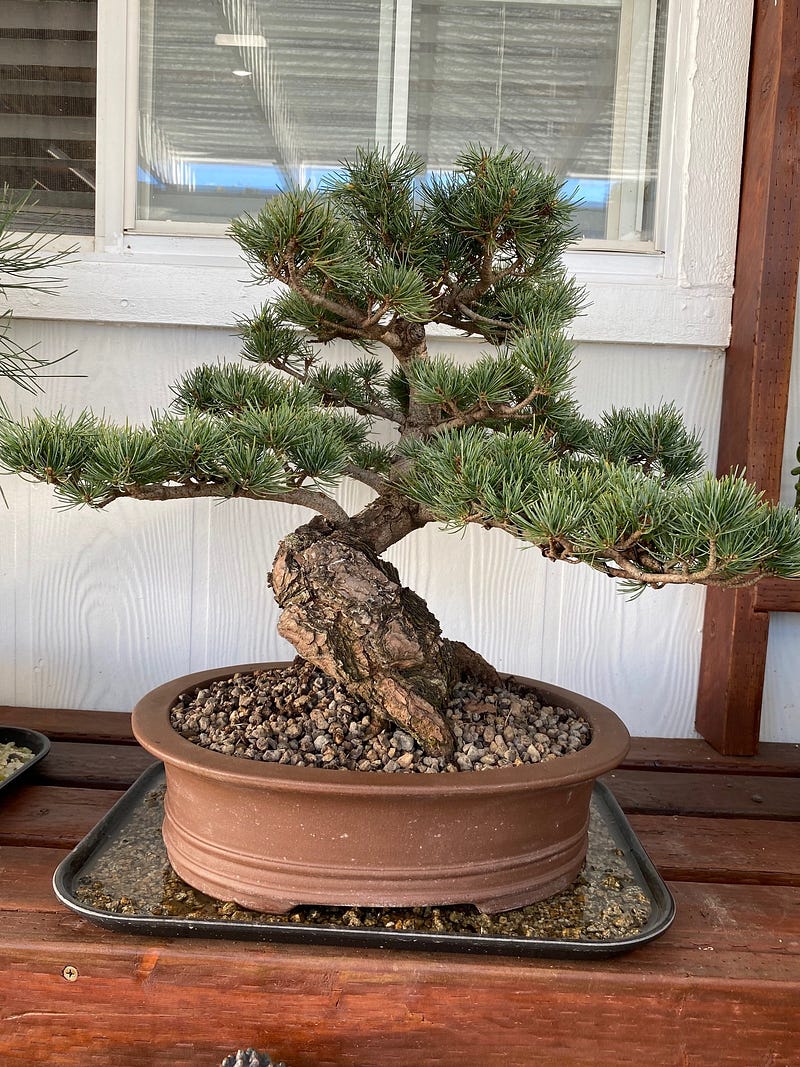
But, I think to myself, is this torture? Keeping a tree small, only two feet tall, when she might like to be free and grow to 35 feet. Only giving her roots 14 inches of space. Should I take Mable to the forest and plant her, releasing her spirit to grow free? I think about such things. We have already established that I’m crazy.
Or would her time in captivity doom her to death? Much like releasing a zoo animal into the wild.
Having all the right minerals, fertilizer, and water for 16 years, would she adapt to conditions in a forest? Who would protect her from a hard freeze?
The object is not to make the tree look like a Bonsi but to make the Bonsi look like a tree. — John Naka
I tell myself that Mable was born a Bonsai, and it’s her destiny to be a beautiful miniature tree. Just as in life, some people are tall, and some are short. Both are equally important and valued. Mable is just short. Nothing wrong with that. . . right.
Embrace your destiny.
Some Bonsais are over 100 years old, so she can grow just as old as her cousins in the wild, which makes me happy. Mable can take comfort in knowing that I have become better at caring for bonsais from my days in Japan.
I give Mable a toast with my iced tea glass, “here’s to your long life, girl. May you grow to become a 100-year-old Bonsai.”


