
Bono, U2, Springsteen and an All-Encompassing “Yes.”
On seeing U2 at The Sphere.
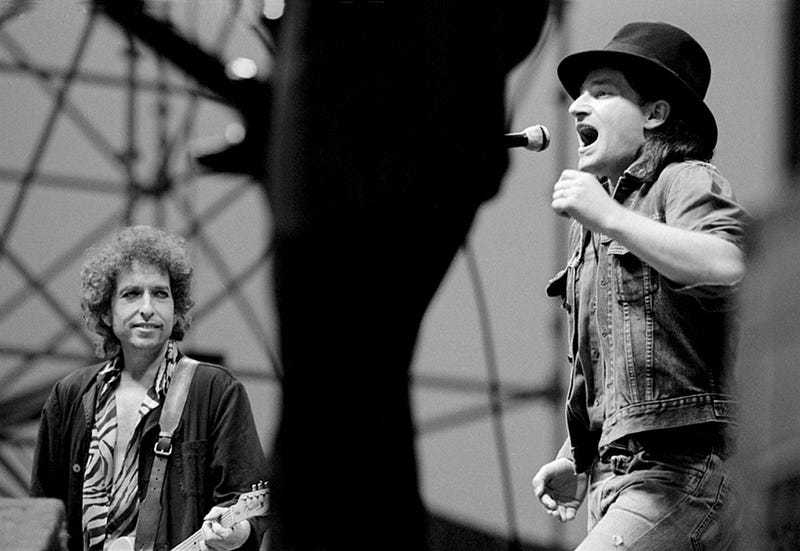
In his upcoming book There Was Nothing You Could Do, which is about how Bruce Springsteen’s “Born in the U.S.A.” album changed both his career and musical superstardom in general — a book I was honored to be asked to provide a blurb for — author Steven Hyden writes about how Springsteen, when he exploded onto the scene, allowed rock critics a narrative link between Elvis Presley and Bob Dylan. “For the (mostly white male boomer) music critics of the eighties, Bruce was a vessel into which they could pour their admiration for those older legends,” Hyden writes. “It was as if they had found the perfect rock star — he could move like Elvis and write like Dylan. The pelvis and the brain had finally been fused into one.” But there’s a pivotal moment, after Springsteen released “Nebraska” and “Darkness on the Edge of Town,” when Springsteen chooses sides. As Springsteen told the story when he inducted Dylan into the Rock and Roll Hall of Fame, the first time he heard Dylan’s “Like a Rolling Stone,” he was in car with his mom. She turned to him: “That guy can’t sing.”
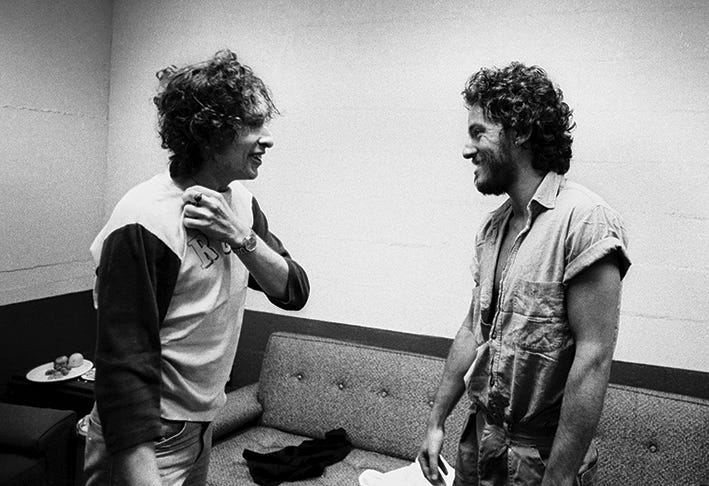
The critic Griel Marcus once wrote there were two sorts of rock stars: Those like Elvis, the sort of performer who “gives an all-encompassing Yes to his audience,” an all-tents monoculture superstar who will do their own thing but also believes in appealing to everyone at all times, and those like Dylan, who are resolutely themselves and would say, as Hyden puts it in the book, “Hell no” to welcoming the wrong kind of fan into their fold. Elvis (and, later, Eddie Vedder, or, for that matter, Taylor Swift) was a “all-encompassing yes” rock star; Dylan (and, later, Kurt Cobain) was a “Hell, no” rock star. (The “Hell no” is Hyden’s appellation, not Marcus’.) After the acclaimed but quiet early post-”Born to Run” albums, Springsteen decided: He was more like Elvis. He did not believe that being a rock star, or making music, or doing anything, was supposed to be exclusive, or purposely difficult. He wanted to reach the masses, to appeal to people in a way that felt universal. “Bruce could see that Bob Dylan was no uniter like Elvis,” Hyden writes in the wake of Springsteen’s mom’s comment about Dylan’s voice. “[Dylan’s] music demanded that you side with him or against him. But it did not matter either way to him.” Springsteen chose to be universal. And then he made “Born in the U.S.A.” And the rest was history.
In the moment, the “all-encompassing yes” rock stars tend to flourish: They’re the ones who sell the most records, they’re the ones who can sell out stadium tours, they’re the ones who do podcasts with Obama; the “hell no”s inevitably go through peaks and valleys in their careers, those stretches where that individual thing they stubbornly stick to goes out of style for a while. But in the long run, history rewards the “hell no”s. There is a part of us that does not want our rock stars to try too hard. I’m reminded of Obama’s great story about awarding Dylan the Presidential Medal of Freedom:
Here’s what I love about Dylan: He was exactly as you’d expect he would be. He wouldn’t come to the rehearsal; usually, all these guys are practicing before the set in the evening. He didn’t want to take a picture with me; usually all the talent is dying to take a picture with me and Michelle before the show, but he didn’t show up to that. He came in and played ‘The Times They Are A-Changin’.’ A beautiful rendition. The guy is so steeped in this stuff that he can just come up with some new arrangement, and the song sounds completely different. Finishes the song, steps off the stage — I’m sitting right in the front row — comes up, shakes my hand, sort of tips his head, gives me just a little grin, and then leaves. And that was it — then he left. That was our only interaction with him. And I thought: That’s how you want Bob Dylan, right? You don’t want him to be all cheesin’ and grinnin’ with you. You want him to be a little skeptical about the whole enterprise. So that was a real treat.”
In the end, history loves rock stars like that. Dylan still seems mysterious, removed, unknowable, which is one of the reasons Dylan, independent of the music he’s still making, remains cool. Springsteen is beloved, obviously, but as I’ve written before, you sometimes feel a little sheepish embracing everything about him: He’s so earnest that he’s easily mocked and satirized, and skeptics even see him as, well, basic. When you believe wholeheartedly that your music can change the world, well, sometimes, as Obama might put it, you have do a little cheesin’ and grinnin’. Even if you love the music, it can make you want to say “hell no.” It’s no wonder there are so few “all-encompassing yes” rock stars anymore. Rock and roll is in large part founded in rebellion; it’s certainly one of the first things that drew me to Nirvana (and, earlier, Guns N’ Roses; Axl was another “hell no” until he tried to become a “all-encompassing yes,” which is precisely when his career crashed) when I was young: Sometimes, the best lyrics are delivered with a bit of a snarl. Springsteen believes too much in people, and his own music, to be a snarler.
But in the world of “all-encompassing yes” rock stars, people who believe in that theoretical restorative and collective power of rock and roll, people who aspire to that level of (depending on your perspective) universality or pretension, Springsteen is always, always going to be beat by Bono.
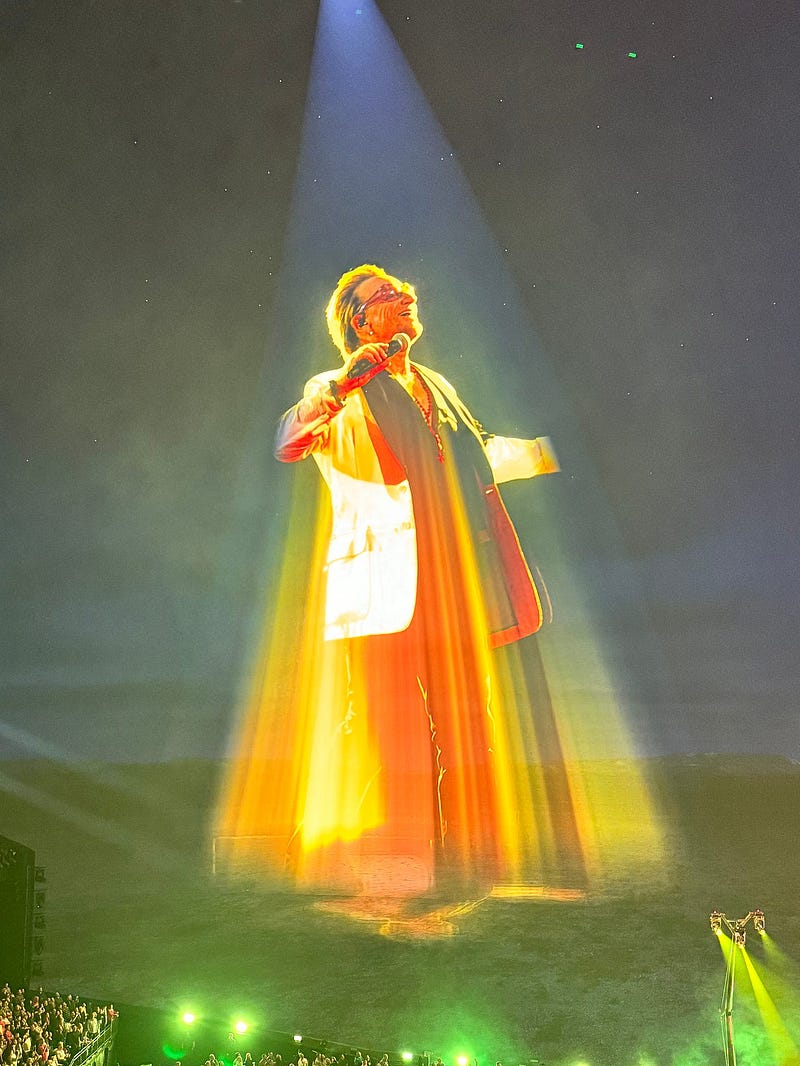
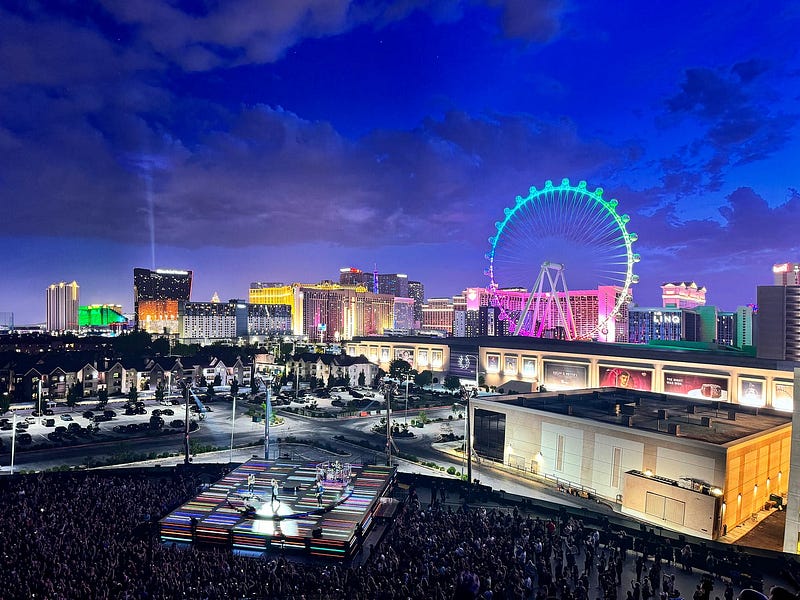
I took that photo on Wednesday night, when I saw U2 play at The Sphere here in Las Vegas, where I am for the Super Bowl this week. Look at that photo. It takes a very specific brand of rock star hubris to have a video of yourself, lit as if you are a deity, broadcast 350 feet high, to 20,000 people. If you hate U2 and Bono — as a shocking number of people do — that picture is Exhibit A as to why. Even if you love U2 — and I love U2 — you have to admit maybe it’s a bit much.
But Bono, and U2, have always been a bit much. That’s what makes them who they are. And as I get older, I find I’m a lot less interested in snarls than I used to be.
The Sphere is a truly breathtaking piece of technology, a massive amphitheater but also a $2.8 billion art project. U2 has always dedicated itself to having ambitious, even pretentious live shows — the last time I saw them before Wednesday was back in 1997, when they played at the Los Angeles Coliseum and Bono came out of a giant mirror-ball lemon — so even as the members of the band enter their 60s, the grandiosity of The Sphere had to have been irresistible. The idea of a band like U2 setting up a residency in Vegas seems awfully strange to anyone who remembers the urgency of the band in ’80s and ’90s and self-seriousness of the band since — and it clearly seems a little strange to the band, considering how many Elvis references there are in the show — but then you see the crazy-ass shit they’ve come up with and it makes sense. Seriously, look at this:
It is difficult to overstate how disorienting it is to experience that in person. It feels like the sky is collapsing in upon you: I actually ducked on multiple occasions. U2 doesn’t do anything small — it’s telling they never did an “MTV Unplugged” back in the day, especially because I’m sure it would have been amazing — but I think it might be impossible to do something bigger than this. I’m curious to see how The Sphere books its shows in the years to come, because you have to be a massive band to even try to fill that space: You have to be the sort of guy who believes a 300-foot projection of yourself is something that’s long, long overdue.
But it works, it all works. Part of it is Bono and U2 have the infinite hubris to perpetually try something so ridiculous. But let’s not overcomplicate: It’s also the songs. U2 has so much inherent pomp — famously satirized in the classic “Ben Stiller Show” sketch which hilariously chronicled their early days playing bar mitzvahs — that the music itself sometimes gets lost in the scuffle; you can almost forget that all this clamor is simply being made by two guys with guitars, one guy drumming and one guy singing. But these songs are great, they’re so great, and as much of a presence as Bono is, the real reason these songs are so great is because of The Edge. The visual festival is hypnotic for the first hour, but then the show just settles into being a big great arena rock show, which is to say it’s all about The Edge.
The Edge has perpetually been underappreciated in rock annals, but it’s also pretty clear that has always meant to be the plan. The Edge is always off to the side, with a headset microphone so small you can barely see it, to the point that it is easy to forget that other voice on all of U2’s songs is his. The Edge is famously spotlight-phobic, which is a problem if you happen to be one of the best rock musicians of all time; the whole thing is about performance, after all. Fortunately, he has Bono to absorb all, all, of the attention. It’s a longtime theory of mine that when Bono, as a young kid named Paul Hewson, met David Evans as teenagers at Mount Temple Comprehensive School in Dublin and was savvy enough to realize, “OK, this guy is a genius but has no desire to be the head of a rock band. I need to be the most over-the-top, messianic, open-satire-of-a-rock-star lead singer so people will look at me instead of him and he can just go about being a genius. Thus: I will create this ‘Bono’ character.” The Edge just makes everything happen in that band. “Bono” almost feels like a performance piece in response. But again: It all works.
And I think it all works because Bono, and U2, truly want to be the biggest rock band in the world, still, even in a world when rock and roll has lost cultural currency, even in a world that can’t do anything collectively anymore. (Even allotting for the fact that I was in Las Vegas, at a very expensive venue, I was flabbergasted by just how old the audience was. I think three-quarters of the audience was older than Bono.) Bono believes. This makes him very easy to mock, as does his and his band’s wholehearted embrace of corporate culture, something that started out feeling like satire (this is a band that once launched a tour from a K-Mart) but ended up becoming central to their identity, including their infamous fiasco with the release of their album “Songs of Innocence” on everybody’s iPhones. (Bono also made sure to shout out The Sphere owner Jim Dolan by name at the show. I wonder if it’s in his contract that he has to do that every show.)
But I’ll confess I also find this spirit cheering. People gotta believe in something, you know? Bono, like Springsteen, believes he can change the world with U2’s music, that the world can be healed, or at least improved, with something as simple as a song. I’m pretty sure he’s wrong. But bless him for believing it. I’m glad Dylan is a “Hell No” person. But we need “all-encompassing yes” people. We need people who will always swing big — who will just go for it. Who believe.
I wouldn’t classify myself as a U2 superfan, though “Achtung Baby” — which they play every song from at The Sphere — is one of my favorite albums of all time. I’m not sure U2 is the sort of band that gets superfans, or at least not as many as obsessive Dylan fans. They have more fans, but a band that wants to be this universal will always have a lower percentage of avid fans as a smaller, aggressively niche figure. People don’t pore over the meaning of Bono’s lyrics, they don’t catalog every setlist of every show, there is no one who considers Bono a transcendent rock poet, other than maybe Bono himself. But they play a fantastic show, for all their postmodern feints they remain intensely earnest, and, yeah, they have some incredible songs. Imagine having written two songs as perfect as “Pride (In the Name of Love)” and “I Still Haven’t Found What I’m Looking For” and not being able to find a place for them in your setlist. That’s a band that has written some great songs.
(Though Bono will never perform them as well as I can, obviously.)
The thing about U2 is that they want everyone, everyone, in the world to hear them, and to love them. They think they can make a difference, and they swing for the fences. Kurt Cobain would have hated that. But then again, he’s dead. U2 is still out there, pouring it out every night, like Springsteen, like Elvis, still believing they have the power to affect every person on the planet. That’s impossible, particularly in the polarized, siloed, microculture we live in. It gets them mocked. It gets them satirized. It even gets some people angry for receiving free music. But to take that big of a leap, to be open to everything, to want everyone to see who you are and what you care about and to believe that it’s something that will might just make the world a little better tomorrow that it was yesterday … I find that I admire this more and more every day. I don’t want to look at the world and say “hell, no” either. I want to say yes. All-encompassingly, yes.
Originally published at https://williamfleitch.substack.com.


