
Bones Of The City
Fiction
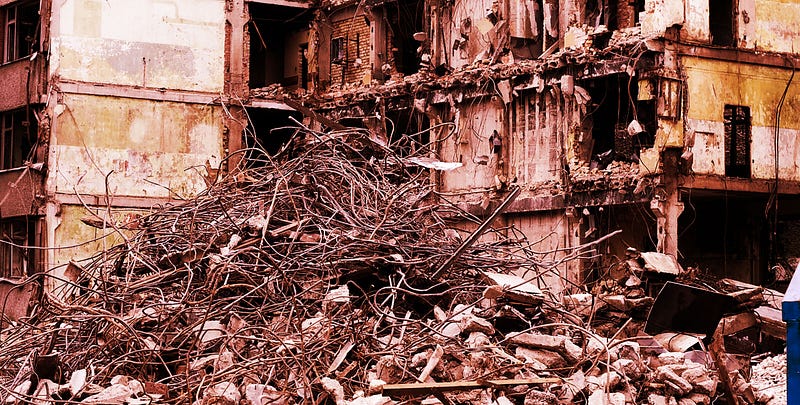
It bleeds.
It cracks and splits and coughs up a pailful of opaque life that can only surrender its fate. Through open windows and shop doors, from factory chimneys and sewer lines — from anything that remains — the city bleeds and cries out in anguish as it is swallowed whole. The cries go unheard by everyone except those who call her home. For us, the sufferers who prop up the bones of the city against the darkness, who count the seconds between bombardments, there is only the hope we can muster, however feeble it may be.
We emerge after days into darkness that has succumbed to fire and ruin. A yellow light, possibly a generator that refuses to quit, peaks through the blackened windows in one of the few remaining buildings not far away. Quickly it is extinguished.
“Perhaps we should go there,” says Elizabeth.
“Or maybe we should run the other direction. Too much of an announcement to be safe.”
“It was brief. It would look like a fire from above.” Fires burn all around. But I know what Elizabeth seeks, that others remain — aside from the two of us.
She is more certain than I am regarding the light. I am immobile, growing roots in the rubble and detritus of Dresden. Behind is the flattened house where we hid. The cellar saved us but not the others who took shelter in its womb. I can’t look back. The effort to leave drained me of my will. Looking back only invites defeat and death.
“Forward it is, then.”
She grabs my hand as we pick our way through and around debris. She displays amazing intent even though her fear, as mine, has to be overriding.
It seems no part of this beautiful city has been spared. I wonder about the Altstadt — the old town — if it is pummeled and flattened completely will Dresden’s culture be reborn? After the madness is it possible to return to anything that was before?
Until a couple of days ago, I worked in one of the factories that supported the German war effort. It wasn’t a choice but an obligation. Age — mine is advanced — becomes irrelevant when the world needs conquering. I did my part, as they say, but my heart wasn’t in it.
There is a droning of engines overhead. I pull Elizabeth toward the old town hall and we cower down at the corner of the building. There is no other cover. She shakes, as do I. We close our eyes and huddle together. In my mind, I look upon her naked body — smooth skin, round breasts — and run a hand up her side. If I’m to die here I want my last thoughts to be filled with joy. Better to depart the world in celebration than in a whimper. I am older, as I said, the thought of death is nothing strange. But she should have many years yet to live. She is far too young for me, as I told her many times in the weeks before the bombing. But times like these create unions that seek their own balance and meaning, even though they defy social mores or logic.
The engines grow louder overhead. A friend, lost now, once told me that the planes were already past by the time you can hear them clearly. I hope he was correct. If not, I’ll badger the old bastard on the other side.
I put my hand on top of Elizabeth’s head and instinctively pull her closer. The smell and feel of her hair fills my senses and rekindles the daydream. For a moment I lose myself to it.
Small bits of the building crumble and fall down on us, breaking my reverie.
“If we weather this storm,” I say, “I want to spend as much time as possible together.”
She presses her hand to my chest. “Not if, when,” she whispers and shakes.
Dust falls, residue from the fires and bombs, and a light layer settles upon us. The war is trying to bury us again, I think. If it can’t put us six feet under at once it will do so slowly. Or perhaps gravity is attempting to shield us.
A man, the first we’ve seen since emerging from the bombed-out house, is coming down the street, illuminated by firelight. He is middle-aged and trots down the center of the road, dodging debris, seemingly oblivious to the aircraft above. He is light, nimble, completely at odds with the world. He laughs hysterically.
Elizabeth raises her head and watches with me. The man almost dances now. I feel his lunacy. He is part of the city bleeding out. He is hope lost. I watch him pass by and try to wrestle reality from the absurdity. But it is a never-ending circle — the reality is absurd and the absurd our reality. Is it any wonder the world has crumbled?
The planes, I notice suddenly, have passed overhead. The sky is getting lighter. We get up and look about. I make an effort to brush the fallen ash and dust from Elizabeth, an absurd act in itself. We walk on in thinning darkness. My legs shake — the weakness of an old man, perhaps, but more, I think, anticipation. The bombs have dropped non-stop for days. My body and mind expect more of them. But the skies are quiet, only bricks tumble asynchronously from the few remaining edifices.
Fires rage. There are screams and somewhere nearby a dog barks.
I stop walking and Elizabeth turns toward me until she notices my gaze and follows it. An old woman runs from the fire that is raging only a few yards away. In her arms is a bundle. She trips and stumbles and the bundle flies toward us. I rush to the woman but she has died on the spot, either asphyxiation or the severe burns she suffered.
Elizabeth pushes her fear aside and picks up the bundle. It is a blanket, burned, singed, and torn in places, but otherwise undamaged. She unwraps it. I swallow my foreboding, uneasy at the prospect. At last, the blanket reveals to us a small baby, a boy, alive and healthy. Elizabeth wraps it up again and pulls it to her bosom as if it is her own, which now it is.
People are everywhere now, glassy-eyed, broken people, emerging from purgatory into hell. We help where we can but mostly we walk in file westward, all of us. Away.
Our city has bled out. I can see there are no bones left to prop up, only rubble. We, the lucky who survived, can only weep. The question of culture and whether it can be rebuilt is irrelevant, absurd. Anything that comes after will be new, different.
Elizabeth holds the baby in one arm and grabs ahold of mine as we walk. She isn’t shaking any longer. She has a purpose. I realize we are three now, a family. One day I will look back at this absurd reality and think, I am the man dancing down the road. But not for a lack of hope, quite the opposite, I think.