
Body-Bashed Boomer Babe Tells All
Or why it took decades to release my fear of the scale
I’m age six. In the girl’s department at Macy’s, the sales clerk, a stiffly dressed lady, suggests my mother steer me toward the racks with the sizes marked Chubette. My mother smiles and nods in a way that lets me know she’s embarrassed.
The Chubette dresses are just a little too big. My mother looks relieved.
I’m age seven. In second grade, it’s Health Day. Two nurses from the county arrive, wearing white uniforms and serious expressions. They roll a beam scale with a height measuring rod to the front of the classroom. Our teacher gives us arithmetic worksheets to complete and tells us to remain quiet and at our desks until our names are called.
One by one, the nurse in the back calls out a student’s name. The teacher sends the student to the nurse in front, who weighs, measures, and then calls out the numbers to the nurse in the back of the room.
The nurse in the back of the room records the numbers on her clipboard.
When it’s my turn, the nurse at the scale calls out numbers that siren to the back of the room on a current of sniggers and snorts. There is only one child in the room who is taller than me, and he’s a boy. And I outweigh even him.
The teacher glares at the gigglers. I am afraid to look at the faces of either nurse, but I can’t help it. When I do, their lips are pressed in tight lines.
I never get in trouble at school, but now it seems I’ve done something wrong.
Or there’s something wrong with me
I’m age eight. My original last name is Teter, which rhymes with Peter. This is a problem because a group of older boys, eleven and twelve, like to hang out in front of the house across the street.
I don’t like to walk past these boys. They call me Ten-Ton Teter. They also call me Fatso and Lardo and chant Chubby; Chubby, two-by-four, can’t get through the kitchen door.
I check the front windows before I leave the house, but sometimes the boys ambush me anyway. My mother tells me to ignore them. “Or,” she suggests, “say, ‘sticks and stones may break my bones, but names will never hurt me.’”
But the names do hurt. So do the rocks the boys throw at me.
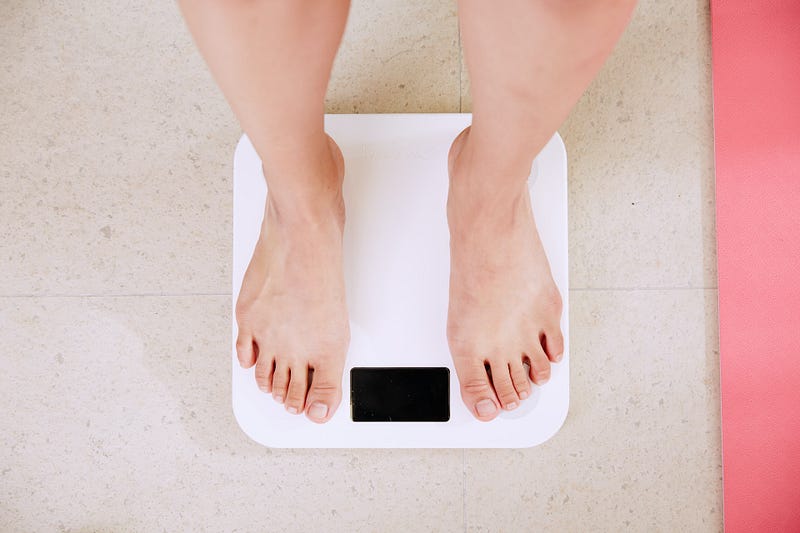
By age nine, I’ve learned to regard our bathroom scale as a small, implacable judge, always waiting there on the tile floor.
My mother takes me to the doctor. The nurse there weighs me again. The doctor pats me on the head and suggests to my mother: no more after-school snacks of peanut butter toast. Instead, a cup of bouillon.
Compliant, I sip my salty broth in the afternoons until one day, I tell my mother I wish I had something to chew.
She makes me peanut butter toast.
In fifth grade, it’s time for Health Day again
This time I ask the nurse to tell me my weight and height so I can tell the other nurse myself. They both look surprised, but they allow it. I am five-foot, two inches tall, and I weigh 110 pounds.
Nobody tells me those are acceptable dimensions. All I know is that none of the other ten-year-old girls weighs even close to one hundred pounds. I’m almost as big as the teacher.
I join the local Girl Scout troop because all the other girls in my class do. On meeting day, we wear our green uniforms to school. Someone calls me the Jolly Green Giant. Everybody laughs.
Even me.
This is the year I start my period, long before the other girls in my class. My mother smiles in her chagrined way when I run to her, crying, frightened by the blood in my underwear.
She explains to me about The Curse. I have a sister in college and another sister in high school, but I’ve never before heard of menstruation.
My father sits me down in a way he has never done before. He tells me I’m going to start behaving differently now. Getting upset. Having strange emotions. I will have to take special things to school with me to “take care of myself,” and my stomach is going to hurt.
All I want to do is get out of the chair and go somewhere else. Somewhere, maybe, where I can forget about my troublesome body. I am sure all this has something to do with my out-of-bounds size.
Most of me is too large, but parts of me are not large enough
I’m twelve, and my mother takes me bra shopping. The sales lady in this department is a sturdy woman with breasts that extend nearly to her waistline.
She measures what she calls my little bosom. “Oh, goodness,” she says with a sorrowful smile. “If only I could give you some of mine.”
Two things are clear to me at this moment: this part of my body is shamefully deficient, and I truly, truly, do not want any of what the sales lady would like to give me.
It is thirty years before I ask for fitting help in a lingerie department again.
When seventh grade starts, I’m still the tallest kid in my classes
Except for Tommy Whats-his-name, who reached six foot three while still in elementary, but he’s a boy, and nobody calls him names.
I take myself in hand. Without announcing it or consulting anyone, I adopt a strict regimen.
Before school, a packet of Carnation Instant Breakfast mixed with nonfat milk. At lunch, one-half of a tuna sandwich. Half a serving of whatever Mom makes for dinner and some iceberg lettuce salad. It’s my job to do the dishes, so nobody nags me about not cleaning my plate anymore.
By eighth grade, I am five-foot, seven inches tall, and I weigh around 128 pounds. I am roughly the same size I will continue to be for most of my adult life, and now most of the girls and even the boys have caught up to me or are surpassing me.
That doesn’t matter. My body is still a problem. Still, I am sure, always a potential target of scorn. It keeps escaping my control.
The way it changes shape and dimension throughout the month, the way it defies my desires to reshape it and, mostly, diminish it. The appetites it’s developing that I don’t understand but that I’m sure are shameful.
My mother sees that boys are showing interest in me. “It’s the girl’s job to say no,” she tells me firmly. This is the only conversation we will have that even touches on sex.
I’m in high school. The most famous model in the world is Twiggy
In my freshman year, all the girls want to look like Twiggy, who we all know, thanks to Seventeen Magazine, weighs 98 pounds. Or sometimes it’s 102 pounds, or as much as 110, depending on which tabloid we read.
Whatever it is, it’s heartbreakingly less than what I weigh, no matter how sparing my tuna sandwich halves become.
Or there’s Jean Shrimpton, who is five-foot-nine, vanishingly slender, and has legs for days.
Those are my only known standards of beauty. It doesn’t matter if my build or heritage or genetics don’t permit them; I do all I can to emulate those impossible (and blindingly white) ideals.
If only I can summon enough willpower. If only I follow the next diet or exercise more. If only my body wouldn’t demand to be fed.
I fail. Over and over
I love food. I love to eat. Time and again, I give in to this unbecoming, unfashionable, unladylike impulse. The shame is recurrent, but so is my abandoning myself to satiation.
Since my Girl Scout days, I’ve learned to pre-empt the harassment I still fear in my bones by making jokes at my own expense. I moan about calories even as I’m consuming them, and promise another diet on Monday.
By all metrics, my weight is well within normal parameters — even, because of my fretful vigilance, on the low side most of the time — but it’s too late. I have absorbed the principle of Thin Is In all the way to my marrow.
Other people tell me I’m thin enough, but I don’t trust it. I’m the obverse of a motto I see in ads for a diet program, “inside every fat person is a thin one trying to get free.” Inside my tenuously slender frame lurks a Chubette, forever threatening to emerge.
Sometimes — usually after a time of particular stress or a period of illness — I sense with elation a gap between my thighs, a concavity in my stomach, a heady lightness of my frame.
I march toward my ancient enemy, the bathroom scale, and step onto it with the bravado of a questing knight. There it is, the number I think I’m supposed to be.
It’s a number below what every metric suggests is appropriate and healthy for my height and frame, but I’m convinced it is my ideal.
If only I could sustain it. Inevitably, though, I recover my health, and life settles down, and my body resumes its stubborn insistence on being fed.
No fat chicks
I am in college, and that sticker sprouts on the chrome bumpers of what seems like every other pickup truck, shouting down the peace sign decals and the Don’t Blame Me, I Voted For McGovern banners slowly fading in the sun.
My scholarship covers my tuition, but I’m anxious about running out of the meager savings that cover my other expenses, so I keep a heavy academic load in addition to the dance and fencing, and yoga classes.
The food in my dorm’s dining hall is grim, so I subsist mostly on yogurt, scrambled eggs, and tahini. The kitchen is closed after breakfast on Sundays, so my boyfriend and I splurge on weekly pizza and Heineken.
By now, even I can recognize that I’m no longer a Chubette. In fact, I’ve grown willowy. As proof of my acceptability, my new boyfriend is dazzling. He’s six-foot-four, blue-eyed, with wavy dark hair and the mustache of a romance novel hero. He plays bluegrass guitar.
He says I’m a fox. Sometimes he points out to his friends in front of me how skinny I am. He means this as a compliment, and I am thrilled.
If I’m careful, if I’m vigilant, I’ll be safe from being a fat chick.
Home for a visit, I go shopping with my mother
I’m three inches taller than she is. In the dressing room, she frets gently about how thin I’ve become. “I was five-foot-two and weighed 140 pounds when your father thought he couldn’t live without me,” she reminds me.
The thought of being desired by a hyper-critical, rage-filled tyrant like my father sits in my stomach like a cold stone. I will never let myself weigh 140 pounds. I step out of the dressing room to find another pair of pants for my mother to try on.
On my way back, I overhear her speaking to a sales clerk who’s stopped by to check if she needs anything. This is still a thing that is done in department stores.
“No, these didn’t fit,” my mother admits to the clerk, as though she’s failed a test. “The tragedy of my life is my heavy legs.”
A few years later, I’m a working actor
I’m in rehearsals for a TV pilot. It’s a variety show, a genre that is swiftly dying out, and this one is already doomed, but I don’t know that yet. Sure, it’s my break at last; I’ve quit my day job.
I’m part of a bevy. A collection of pretty girls who will be permanent fixtures on the show, acting as back-up in the skits, routines, and song-and-dance numbers headed up by the guest stars. In a wan rip off of Saturday Night Live, we’re billed as the Peripheral Players.
One of my fellow Peripherals is a tall, vivacious brunette with a ready laugh. She’s lovely and fun, and I like her, but when she invites me to snort cocaine with her in the dressing room, I decline. “You sure?” she asks, lifting an eyebrow. “Keeps you thin,” she says.
Her agent has told her that her thighs are too thick. One day at lunch, she gleefully pounds down a Big Mac, double fries, and a chocolate shake. “I’ve figured this out,” she tells me. “I can eat anything I want and still lose weight. All I have to do is stick my finger down my throat afterward! You should try it.”
The term “bulimia” hasn’t entered the popular lexicon yet, but I’m pretty sure this isn’t a good idea. Besides, I can’t make myself throw up; I’ve tried.
I have, however, heard about anorexia nervosa. I wonder what it would be like to have such willpower. I have to admit to myself that I don’t.
The show is canceled, and life goes on. I get married and have kids
I am thirty-three, and my husband and I have taken our five-year-old son to San Diego for a last getaway before he becomes a big brother.
I’ve gained 45 pounds with this pregnancy, and I couldn’t care less. I walk along the beach, holding my little boy’s hand, laughing and gasping as we let the cold wavelets rush over our feet.
I feel like I’m five years old too. This far pregnant, I’m released from the obligation to look good in a bathing suit. With my enormous belly and my swishing thighs, my body surrounds me comfortably.
It’s a heady freedom, this sense that my body is my own, an entity capable of marvelous things, not a display casing I carry around to helplessly submit to the assessment of other people.
Maybe I could always feel this way, I think.
But it’s decades more before I regain that freedom
Even after I’ve recognized the damage done by all the body-shaming, I’ve internalized from the culture, from the media, from my well-meaning mother who was teased as a girl (“Helen Dayton weighs a ton!” she recalls her own tormentors saying) — the anxious self-monitoring keeps resurfacing.
Even though I also recognize the damage I’ve done to others, as I’ve fretted aloud about calories and proclaimed my next diet or whined about my thighs or stomach, even in the presence of women larger than me.
I stop doing that crap. I watch with admiration as upcoming generations of girls embrace their prowess in competitive sports that were not considered within the bounds of my cohort growing up.
Maybe young women no longer have to regard their own bodies with fear and distrust, I think. Fitness means strength and function now, not mere thinness.
No longer are all of the models and female media icons rail-thin, long-limbed, and relentlessly Caucasian. Magazines and billboards appear, emblazoned with images of proud, abundant bodies of all colors.
My digital bathroom scale goes on the fritz. I throw it out and don’t replace it. I might be heavier, but I feel lighter.
Body positivity arrives! And is quickly undermined
Almost as soon as the culture has opened a window of acceptance and has begun to admit and even celebrate bodies of all shapes and dimensions, the backlash begins.
Ozempic is trending among celebrities as a weight-loss drug. The fashions of the 90s are rebooting, and with them, the toxic allure of heroin chic. Pre-teen girls are subject to a ceaseless feed of filtered digital images.
It makes Twiggy and Seventeen Magazine seem benign by comparison. And the resurfacing of Thin Is In is far more sinister than a trend. It’s interlaced with misogyny, imbued with classism, and steeped in racism.
I wish I could stop it. I wish I could save girls and young women from taking the poison in through their pores. Alas, I don’t put up billboards in Time Square or edit fashion magazines, and I’m no one’s idea of a social media influencer.
But I can free myself, and maybe that will help someone somehow.
These days, as I reach another decade, I treat my body well. I feed it good things, and I give it plenty of exercise. I celebrate it for its durability, and I appreciate how well it performs and what it can still do for me.
I still catch myself body-checking in the mirror on many mornings. When I become aware of what I’m doing, I tell myself I look damn good. I even believe it.
In preparation for a trip to Africa this summer, I arrive at a doctor’s office to get my travel shots. “Let’s get your weight,” says the nurse, who needs it to determine the correct dosage.
There’s the scale, the physical manifestation of my silent, implacable interior judge. I know you, I think as I step on it.
It says I weigh 140 pounds.
I feel a deep sense of relief. I’ve reached the forbidden number, and nothing inside me nor outside me crashes into ruin.
And I look damn good.


