Blood on the Pavement: White Supremacy Guides our Response to the Shooting of Megan Thee Stallion
At the current height of her career, Megan Thee Stallion has to relive ongoing trauma.
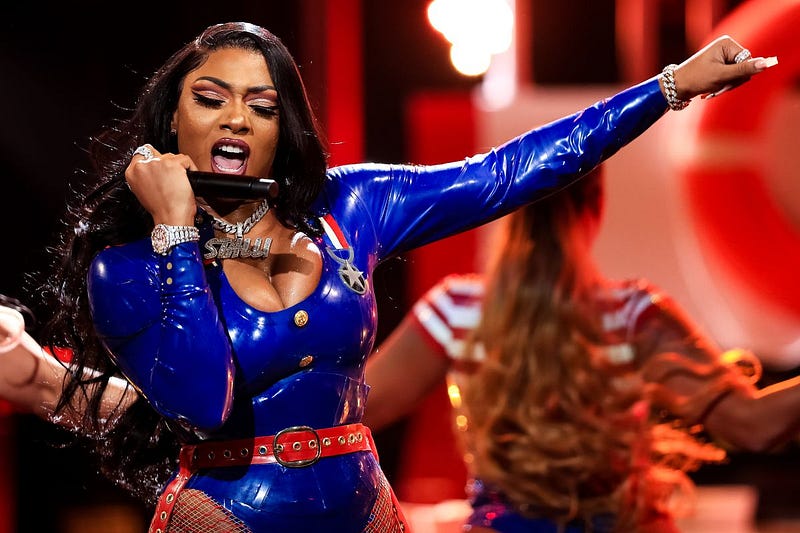
A month ago, rapper Tory Lanz (Daystar Peterson) shot Meg twice, once in each foot, in a blatant attempt to take away her ability to do her trademark twerks. Her fans and the American public were able to see Meg limping from the vehicle they were exiting a Hollywood party from; her leaving a trail of blood on the pavement, police firearms trained on her, ignoring her distress and ready to end her young, promising life.
Since that terrible night, the Internet has provided extensive commentary. I’ve read excellent takes on #blacktwitter on how Meg shows Black women are vulnerable and disrespected, no matter their wealth and status. I’ve read Black men making an utter ass of themselves, asking what an unarmed woman did to have a small, small man attack her with a deadly weapon. I’ve read various permutations of the G-Code and how Meg whether was right or wrong about not pressing charges or, as of today’s writing, going on Instagram live and admitting that Peterson was the one that shot her. We cannot put this incident behind us. Truly, the one in front of the gun lives forever.
Celebrity will make a Black person famous, but not a true citizen of the United States of America. Our state of being is personhood, a status that occurs when a socially dead people attempt to do God’s work of resurrection. As a people who are striving to arise from the condition of property, we cannot count on the state to back us — no matter how much money we generate for ourselves and the organizations in which we are members. Meg, despite her success, understands this American truth.
Meg acknowledged her personhood by refusing to talk to police and pressing charges. “The violence perpetrated against us [Black people] is not a form of discrimination; it is a necessary violence; a health tonic for everyone who is not Black; an ensemble of sadistic rituals and captivity that could only happen to people who are not Black if they broke this or that ‘law,’” Frank Wilderson III wrote in Afropessimism. Black people, to survive a trip to the grocery store, a drive on the highway — any action, which is every action you take in America — have to center this wisdom in their souls as the police can and will be everywhere. For white supremacy, breaking our bodies makes the people who worship this doctrine whole.
I remember a time when I was driving outside of Southhaven, Mississippi. My Honda Fit caught a flat tire on the highway and I had to pull over and change it. A police pulled up behind me. He helped me changed the tire and make sure my wife and I were OK. At the end of the encounter, he gave me a ticket for expired tags — despite the tags being from Arkansas. Who told him to run my license plate? Who told him to violate the prerogative of citizens, the base assumption of innocence? Why did he see potential violence in my distress?
Only an imagination that sees Black folk as objects who don’t know their place could commit such an act. Meg had this in mind when keeping the law out of her tragic evening. As a rapper — a griot of Black personhood, a menace to white supremacy because of the truths she expresses — she knew she already was in a vulnerable position. Why invite more scrutiny? It is the nature of white supremacy to find anything they can to justify their imaginations. Where there is law, there is crime; and in this hegemony, her blood on the pavement would not stop them from killing her dead.
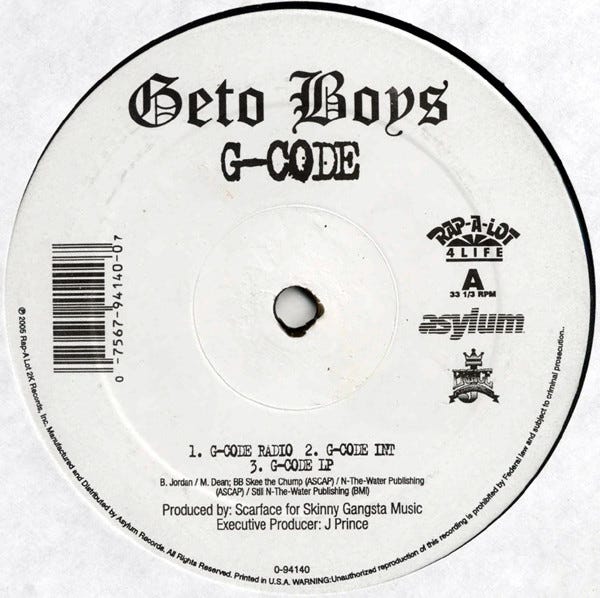
Even the entreats to the G-Code, of what happens in the streets stays in the streets (and as a college student, Meg should be immune from as Drake is due to his previous career as an actor), is a product of white supremacy. The historical logic flows like this; white supremacy is also a doctrine of the ancient hegemony of patriarchy, of political power organized around the penis; white men became able to exert political influence on American politics without owning property as the amount of enslaved property in the United States expanded; slave patrols, that evolved into our police force, maintained return of the escaped enslaved; the suffragist movement broke around the debate as to whether white women or Black personhood ought to get suffrage first; the Jim Crow South and the chain gangs in which the police, evolved to a new political age — but rooted in white supremacy and patriarchy — and provided the labor, while boss politics of the North neutralized our re-rising from social death and corralled us into redlined neighborhoods, in which police made sure we stayed within so we could be brutalized; the movement of the 1950’s and 1960’s that finally gave us the franchise was subverted by having the police force initiate an age of mass incarceration to neutralize the political power we attained by locking us up, sometimes for life, for non-violent offenses. We have inherited this history, transmitted to us via folklore, and substantiated by historical and social scientific research. And in response to this history, a history that places us outside the protection of the state, did the G-Code evolve — a way for Black men to ensure a measure of Solomon’s wisdom within our community. We may not have justice, that thing of laws. But we could have vengeance. We could right the scales. Vengeance is our love language.
Meg Thee Stallion, in what should be her moment of jubilee, is suffering. We cannot, at this time, move beyond her blood on the pavement. As Black personhood moves towards social life — toward a future where a suffering Black woman is treated with medical responses instead of an armada of guns pointed toward her wounds — I can hope for a media climate that interprets these moments better and accurately contextualizes them.
Hal H. Harris is the founder of Established in 1865. He is active on Twitter and hopes you give him a follow at @Established1865.