Now You’ll Know Them Forever!
Blockchain: The Future Of Technology
What are Blockchains? This 5 Minute Read Explains in depth.

By now, you must have heard about a new technology named ‘’blockchain” and are not able to understand the hype behind it. We’re in the same boat. When I started researching this technology, I was left clueless by the mind-boggling information available on the internet.
This article is your one-stop introduction to the topic. I will summarize what it is, how it works, and what characteristics make blockchain so apt to be discussed at every investing, banking, and innovative forum.
In 2009 we had a financial crisis and a lot of people lost trust in the banks. An experiment was launched to see if we could run a decentralized payments network. Bitcoin was seen as a new hope.
What Does This Term “Decentralized” Mean?
To give you an idea of what decentralization is, let me explain with an example:
For our example lets consider, Encyclopedia Britannica vs Wikipedia. The 240 years old Britannica was recently replaced by a decentralized Wikipedia. But how?
Britannica hired 4000 writers who’d write content in a central book. Only the people who bought the Britannica Encyclopedia could have the access to the written book. On the contrary, Wikipedia is decentralized. Wikipedia has 270,000 monthly active editors all editing at once. We just keep track of who edited what. What this brings is speed. And the whole earth can read Wikipedia too!
The next time you’re watching a Football match, see how fast the scores are updated on Wikipedia. Usually its only a few seconds. So by decentralizing information we’ve changed the whole concept of this book. Same is the example of the World Wide Web (WWW) which was also originally developed as a decentralized platform as it is not controlled by a central authority but by decentralized nodes at different locations.
Even though blockchain is a much more complicated concept, the analogy above helps illustrate two of the three main reasons behind its stardom i.e decentralization and transparency. We will discuss them in a while, but before that, let me share what a block chain is.
So What Exactly Is Blockchain?
A blockchain, originally block chain, is a growing list of records, called blocks, that are linked using cryptography. Each block contains a cryptographic hash of the previous block, a timestamp, and transaction data. — Wikipedia
It is “an open, distributed ledger that can record transactions between two parties efficiently and in a verifiable and permanent way” — writes Iansiti, Marco; Lakhani, Karim in their article “The Truth About Blockchain”. At the most basic level, a Blockchain is a special register of records generally defined as a decentralized publicly distributed ledger. Hang on tight and I’ll explain what this means.
To understand blockchains we’ve to first understand ledgers. For the non-bankers here’s what a ledger means:
A ledger can be imagined as money going in, money going out and when you login to your online banking you see a balance. So by definition, it is the book for recording and totaling economic transactions, with debits and credits in separate columns and a beginning monetary balance and ending monetary balance for each account in a bank for example. Everyday the account balance changes.
In a decentralized payments network, there’s 6000 computers around the world all trying to update a single ledger. Whose ledger-edits do we trust? That’s the innovation here, that’s where the block chain comes in. Its really a process to figure out how do we update this one ledger that’s shared by all.
If i tell you a simple story there’s a better chance of you understanding how a Blockchain is functioning internally. So here it is:
The Short Story of Bitcoin Blockchain— How a Blockchain Works:
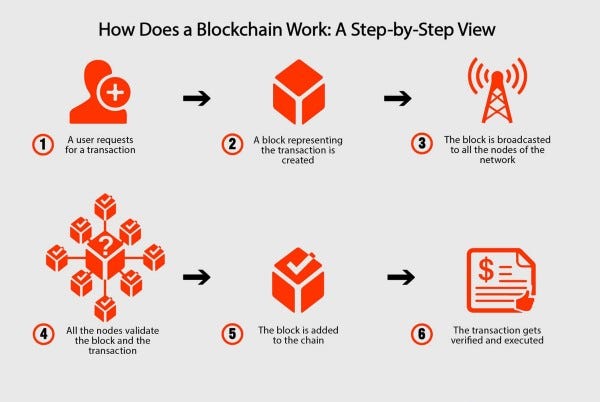
Every ten minutes the Bitcoin blockchain gets updated. It gets updated with a new block of transactions. Because the blockchain is a register of transactions, it is a ledger remember! There are thousands of computers wanting to update the transactions altogether in this ledger. To figure out which computer among the thousands of computers, eventually gets the chance to update the blockchain, we follow a process called Mining. All these computers that are called MINERS are all competing against each other to solve a very energy intensive mathematical problem called Mining (Byzantine generals discussed later in this article explain this phenomena). And the more processing power each computer puts in, the greater that computer has a chance of winning. Similar to a lottery, the more tickets you got the greater chance you have at winning. So all these computers are competing really hard, fighting really hard to solve this mathematical formula. And about 10 minutes later one of these computers comes up and says “Hey i’ve solved this problem. And i am gonna add this block of transactions.” Then all the other other computers in the network check and verify first of all “YES you got the problem right and second all the transactions you included are valid”. If more than 50% of the computers agree, that block of transactions is included. That’s how the block chain works. This is it. This story might not be so clear, but that’s the whole purpose of this article. To understand how the above story executes in real life. That’s what we explain now.
Wait, Why Do We Actually Need the Blockchain?
Can Blockchain Replace Banks?
A block chain is a shared ledger. So multiple parties are allowed to collaborate without having to trust each other. It might be far fetched to say blockchain will replace banks, but what we know is that all major banks are embracing the blockchain technology, since blockchains facilitate auditing; making transparency possible.
But Why Do Banks Need This Blockchain? Still Didn’t Get It.
In the current banking system, the banks work with Correspondent Banking. Basically during fund-transfers you send money from one bank to another. When you send money across countries, the money kind of disappears. But where did your money go? What is happening is your money is skipping from one correspondent bank to another one and then to another one.
This is because we currently don’t have any feasible system where each bank can make partnerships with 10,000 other banks around the world. The individual banks just cannot partner with 10,000 other banks in the world. Each bank has their own ledger. A reconciliation happens at the end of the day. Manual Entry. Its very common for errors to occur. So it ends up being very costly and very slow.
But what if every single bank on earth were all connected with one single shared ledger. Wouldn’t that be cool?
The sending bank would be able to directly connect with the receiving bank. The money will get there much faster and if the sending bank requires liquidity to do the foreign exchange then they got thousands of banks to deal with that they can do a partnership with. Other key areas are syndicated loans, peer-to-peer loans, bonds insurance.
The Australian stock market is actually looking at replacing their entire trading platform with blockchain. These are all trials happening right now.
Is Blockchain Just About Banks? That’s Boring.
You know your shoes you’re wearing how do you know they’re real or fake? Or for example the multi-vitamins you take, how do you know its not counterfeit? Its a serious problem, if you think about it.
According to Interpol in 2013 a million people died from counterfeit medicines. Because we don’t have transparency in this supply chain. IF we put the entire life cycle of this drug from supplier to manufacturer to distributor and seller, all along the way each party authenticates the transaction. Then as a customer we can have full transparency with authentication and real confidence that the life story of this drug is legitimate. Hope you understand why we need blockchains now.
Diving Deep Into: How Blockchain Works?
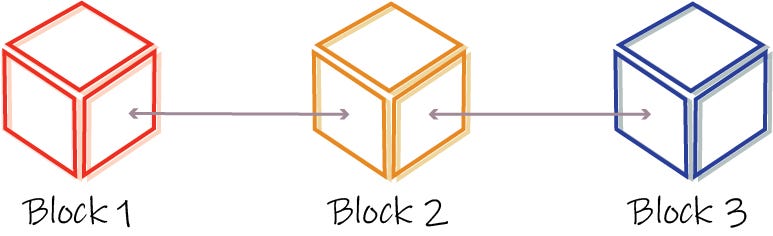
Blockchain stores information in sequenced blocks that are chained together to be distributed among users. Hence, I am talking about digital pieces of information (blocks) connected in a public database. Yes, its public you can see it here it’s visible to everyone.
Let’s Understand the Three Main Components of a Blockchain:
A blockchain comprises of three main components:

1. Blocks:
“Blocks hold batches of valid transactions that are hashed and encoded. Each block includes the cryptographic hash of the prior block in the blockchain, linking the two. The linked blocks form a chain. This iterative process confirms the integrity of the previous block, all the way back to the original block.” — Wikipedia
· The data stored in a block depends on what blockchain is used for. For instance, in an online shopping scenario vs in a digital currency scenario stored information may be different. For example in case of Bitcoins, a block usually contains information about: sender, receiver, date, and time of the transaction. Once recorded, the data in any given block cannot be altered retroactively without alteration of all subsequent blocks, which requires consensus of the network majority.
· At creation, a 32-bit randomly generated number called nounce is generated. This number in-turn generates a hash.
What Is A Hash?
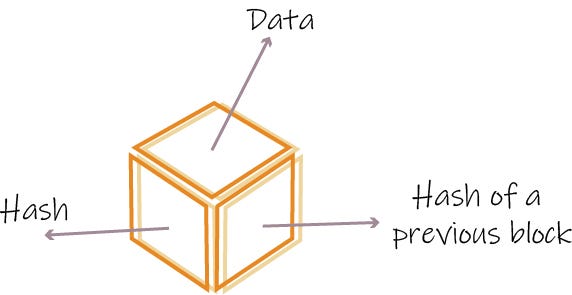
· Well, just like our identity cards distinguish us from one another, the hash is a 256-bit highly complex unique code that identifies each block from every other block in the blockchain. It’s an algorithmically generated cryptographic code that distinguishes a block and its entire content.
· Every block references the hash of its previous block that makes its manipulation highly difficult. Interestingly, a block does not only hold an address of a previous block, but it also holds the hashes of the data stored in the previous block.
Now, this may look simple but remember, for example, in a Bitcoin blockchain a single block can store up-to millions of transactions under one umbrella!
.. back to describing the three main components of a blockchain. The next one is..

2. Nodes (Miners):
The blocks of data, that we studied above are stored on nodes. A node can be a computer, laptop or a server. In a blockchain, Nodes are all connected to each other.
A block chain stores data across its peer-to-peer “network” of connected nodes. Every node in a decentralized system has a copy of the blockchain. No centralized “official” copy exists and no user is “trusted” more than any other.
The Nodes in a Bitcoin Blockchain (also called Miners):
Nodes are called Miners when talking about Bitcoin which is also a blockchain.
Blockchain was invented by a person (or group of people) using the name Satoshi Nakamoto in 2008 to serve as the public transaction ledger of the cryptocurrency called Bitcoin. The identity of Satoshi Nakamoto remains unknown to date.
In a Bitcoin blockchain, Mining is known as the process of adding transaction records (called blocks) to Bitcoin’s public ledger of past transactions. Once a new block is mined, it is verified by millions of users/nodes distributed around the network.
Mining nodes validate transactions. Add them to the block they are building, and then broadcast the completed block to other nodes. Wikipedia
Nodes are like independent owners, each with a copy of a blockchain. These nodes help update and algorithmically verify newly mined blocks. Once a new block is verified each node adds it, to its local blockchain.
The miner is awarded financially as soon as the consensus over the block reaches 51%. Why is the miner awarded? What is a consensus? After the third component’s description below I’ve included a section on Byzantine Generals which explains this with a video.
3. Decentralization:
The most important concept of blockchain technology is decentralization. Bockchain is formed by connected nodes which lack centralized points of vulnerability that computer hackers can exploit. So, it has no central point of failure.
The absence of a central authority and the presence of nodes/devices allow real-time access while keeping the system functioning.
Blockchain security methods include the use of public-key cryptography. Data stored on the blockchain is thus generally considered incorruptible.
By storing data across its network of nodes, the blockchain eliminates a number of risks that come with data being held centrally.
The process summary before we dive deeper:
So we understand Blocks, Hashes, Miners and nodes now. What’s Next? The next step is:
Can Blockchain Be Hacked? Understanding Consensus for Trust Among Blocks
The Byzantine generals for the winner!
You might be thinking what have blockchains got to do with Byzantines haha.
The Byzantine Generals Problem is a famous Computer Science problem. It is a situation where everyone among a group is trying to come up with a strategy. But among the makers of the strategy, some of the team members are corrupt.
In a Byzantine fault, a component such as a server can inconsistently appear both failed and functioning to failure-detection systems, presenting different symptoms to different observers. Because the components are falsifying some information by not being truly honest.
In a blockchain, the blocks must trust other blocks. But how? What if some of them were hacked? Corrupted? How to trust :(
A blockchain solves this problem of Byzantine failure very cleverly. The methods of how a blockchain overcomes the problem are too long to include here in this article. So I've included the above video. But in general, the process of Mining is used where we ask all team members to solve a complex proof of work puzzle (resulting in the creation of a verified hash). Imagine it like this: we are sure we are reaching an honest consensus of the group without being hacked, we ensure this by letting the group of consensus-voters solve a complex problem. That problem is what we call Mining. Yeah, it's complicated. Hope it makes sense. Without consensus mechanisms, we wouldn’t have a Byzantine-Fault-Tolerant decentralized peer-to-peer system. This brings us to our next topic:
So what is a Consensus? A consensus is an agreed decision of a group.
Blockchain has replaced the traditional concept of a central authority and introduced a peer-peer connection that ensures the authenticity and integrity of data through Consensus.
Consensus helps nodes validate the authenticity of the shared block.

The consensus in blockchain, as in the case of banks, requires all your minor to major issues to go through a central entity that adds an extra step (Mining) to resolve any type of dispute honestly.
Summarizing Consensus: A blockchain has no leader. So who makes the decisions if not a leader? Well, that’s where we do the consensus. It's like reaching an acceptable solution during a group meeting that everyone supports even if its not the favorite solution of the any-one individual. This is different from voting where the majority wins. As we try to make an agreement which makes everyone happy.
Great. By now we’ve understood Blocks, Nodes, Miners, Hashes and consensus. Enough for understanding how blockchains work. And thanks for holding up so far. Lets take a look at what makes them so special. The characteristics that define a blockchain help us understand how we can utilize it in the future. To apply any technology it is crucial that we understand not only how it works, but also in what special ways it can help us.
Three Special Features of Blockchain:
The three main characteristics which have helped blockchain achieve worldwide admiration are as follows:

1. Decentralization
2. Transparency
3. Immutability
Let's take a deeper look at these three characteristics of a blockchain.
1. Decentralization

Decentralization has resolved many of the vulnerabilities associated with the centralized system, i.e
- The presence of your data at a single spot won’t make it a target of a hacker.
- The chances of loss of data in a decentralized system are zero to none as everyone will own your information.

2. Transparency
Now you may get confused here and mix the privacy of a user with transparency. Well, users, real identity is secured via cryptographically generated public addresses. Whereas, a private key is used to authenticate their transactions. This public key is always associated with transactions, so for instance, if “Alex” spent “10 $” on Amazon you won’t see “Alex” made a transaction of “10$” instead you will notice “7AWPidB8ZK923uKbsDGylAGUYu9T8 sent 10$”.
Coming back to the transparency, blockchain allows you to view who did what and when? This specialty of blockchain provides a much-needed level of accountability required at various institutions.

3. Immutability
Once a block gets added to a blockchain, it cannot be tampered. This feature of blockchain is provided by a cryptographic hash discussed above. So making any changes in the block requires re-mining not only that particular block but all that comes after it.
Blockchain is an ever-evolving technology that has revolutionized today’s world by providing a way that avoids fraud, theft, and risk. It’s a reliable, peer-peer network technology that brings scalability and legitimacy with the flexibility of implementation at many levels.
The Blockchain <> Bitcoin Connection.
How are the two related? Finally that’s the billion dollar question we all ask.

Bitcoin is based on a distributed ledger — or rather a specific kind of distributed ledger: that is the blockchain.
Sorry if you were expecting something more complicated haha.
Bitcoin’s ledger was the world’s first blockchain, but the technology has begun to spread across the global economy now. The reason for spreading? Blockchains let you keep thousands of strangers honest and consistent.


