
Technology
Is Blockchain Really the Future of Healthcare?
A solution to current healthcare challenges.

I confess. I went to a lecture about Blockchain and I had NO IDEA what it was. Yet all the participants were so engaged and into the subject. I felt… LOST.
As the speaker explained the concept, one feature was clear in my head: security. The presentation focused on the Financial sector, but I began to think: What about other industries? What about healthcare?
I got home and did my research. In this article, I share the definition and my findings about how blockchain will revolutionize the healthcare industry.
1. OVERVIEW
The United States spends nearly 18% of its GDP in Healthcare, reaching $3.6 trillion in 2018, according to CMS.gov.
Before jumping to the transformation of Healthcare, here are some interesting facts about Blockchain:
- Worldwide spending on blockchain technology is expected to increase from U$1.5 billion in 2018 to around U$ 15.9 billion by 2023.
- In 2019, the worldwide spending on blockchain reached U$ 2.7 billion.
- The Financial sector accounts for the biggest Blockchain market value. However, blockchain solutions have spread to multiple industries, including healthcare, aerospace, agriculture, among others.
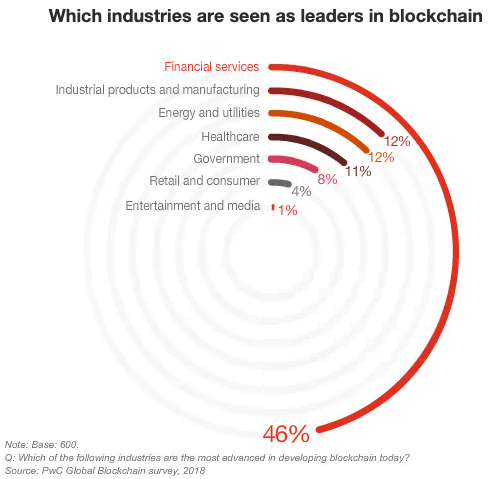
Therefore, considering the economic impact of both topics, blockchain is highly promising for the healthcare industry.
2. DEFINITION
Here’s my favorite explanation of Blockchain, simply because it is simple:
"Blockchain is the foundation for the second era of the internet — an internet of value, where anything of value, including money, our identities, cultural assets like music, and even a vote can be stored, managed, transacted, and moved in a secure, private way. Blockchain is poised to transform every industry and managerial function — redefining the way we make transactions, share ideas, and manage workflow." - Blockchain Research Institute
Telmo Subira Rodriguez describes in depth the blockchain concept. As his article title “Blockchain for Dummies” suggests, he explains the most important aspects in a straightforward way. In his words, blockchain
“works as an immutable record of transactions that do not require to rely on an external authority to validate the authenticity and integrity of the data. Transactions are typically economic, but we can store any kind of information in the blocks.”
To summarize, blockchain is a secure technology because it offers transparency and eliminates the need for intermediaries or third-party administrators.
3. BLOCKCHAIN AND HEALTHCARE

Healthcare is a complex industry that relies on data storage and exchange among multiple stakeholders. A secure and efficient communication is vital to provide high quality care, prevent medical errors, and avoid patient harm.
In this sense, blockchain technology offers a reliable approach to the healthcare environment. Mark A. Engelhardt highlights four main advantages: putting patient at the center, privacy and access, completeness of information, and reduction in healthcare expenditures.
In “Blockchain Technology in Healthcare: A Systematic Review”, the authors describe three important features:
- Decentralization: Blockchain does not rely on a centralized authority. It means that all participants have access to the information stored on the blockchain network, which “creates an atmosphere of transparency and openness, allowing healthcare stakeholders (…) to know how their data is used, by whom, when and how”.
- Security: The information in the blockchain network is reproduced in multiple nodes. In case one node is affected, the information is not entirely compromised. Thus, blockchain is a safe measure against healthcare data corruption, security attacks, or data loss.
- Immutability: An interesting attribute of blockchain is that information, “once created, cannot be retrieved or modified”. Therefore, the technology suits the industry because it protects the integrity and validity of health records.
Blockchain is valuable to healthcare as it offers effective solutions to the field. The technology enhances multiple health segments. Three of them will be explained below: Patients controlling their own data, electronic medical record and supply chain management.
PATIENTS IN CONTROL
As patients, one of the main concerns is that we do not own our health data. We don’t have an easy access to our exams, prescriptions, and medical records. More than that, each piece of information is spread among multiple databases.

Every time we go to a different hospital, a new set of physical checkup is generated. They don’t communicate with our previous healthcare providers. Our health history is not evaluated. Thus, only our immediate needs are tackled. Instead of focusing on preventive care, our system is mostly based on acute care, which compromises quality and safety.
Besides, our privacy is at risk too, since we have no control over who is accessing and utilizing our information.
Blockchain technology provides patients “complete ownership of their medical records, allowing them to grant and revoke provider access to their data”.
Due to blockchain’s decentralization, patients are allowed to manage their own data and to share with different stakeholders according to their needs (healthcare providers, pharmacies, governmental agencies, insurance companies, etc).
Controlling our patient records improves security, privacy, and access. Patients are positioned at the center of care, improving the healthcare system by enabling a preventive care approach.
Imagine having a digital identity that you stored in your digital wallet on a blockchain. Your wallet collects and protects all your biological, financial, and geospatial data throughout the day, and you decide how you want to use it. Your medical records are central to this identity. Your body generates health data. You, not big companies or governments, have a heart rate and a body temperature. When clinicians measure you or take tests of various kinds, they’re providing a service; the results are your asset, deriving from your body. You should control it. - Don Tapscott and Alex Tapscott, Harvard Business Review.
EMR (ELECTRONIC MEDICAL RECORD)
Technology has transformed many industries, including healthcare. Nowadays, complex healthcare environments depend on advanced information systems.

Information system has positively impacted healthcare organizations by offering the opportunity to organize and exchange data efficiently. It has assisted providers to improve quality of treatments.
However, exchanging information between healthcare organizations is still a challenge. Not all caregivers carry compatible systems or coding, reason why information might be lost or mistaken. Privacy and security are also strong concerns.
Blockchain technology is a solution to Electronic Medical Record. The innovation presents a method to secure, share, and store EMR data both within and across institutions.
Michal Scott, in a case study conducted to the Blockchain Research Institute, explains that blockchain
“relies on established cryptographic techniques allowing each stakeholder in a network to interact (e.g., to store, exchange, and view information), without pre-existing trust between the parties. No third-party intermediary such as a hospital, an insurance provider, or a pharmaceutical company owns and manages the ledger. Rather, peers broadcast, validate, and record transactions across a distributed network of participants”.
SUPPLY CHAIN
Due to COVID-19, healthcare supply chain management is a trending topic. Supply chain, in general, has always been a delicate sector due to its scale. In the healthcare industry, problems such as delays, counterfeit products, and thefts, causes tremendous health hazards and can be costly.

According to Ron Shinkman in HealthcareDive, “unnecessary spending on supply chain products and related operations reached $25.7 billion in 2019”.
Blockchain technology is a powerful tool to supply chain management in healthcare. And here is why:
“Since all transactions are recorded onto the ledger, and every node in the blockchain maintains a record of the transaction, it is easy to verify the origin of the drug, the vendor and the distributor instantly. Furthermore, the distributed ledger of the blockchain allows healthcare officials and physician to check and authenticate the credentials of suppliers”.
Supply chain is a vital area for healthcare. Coordinating logistics through blockchain ensures a reliable transportation of medical supplies, prevents thefts, reduces wastes, and protects patients’ safety.
4. CONCLUSION
Blockchain is a disruptive technology and has been transforming different industries. Its unique features — decentralization, immutability, security, and transparency — solve businesses challenges and reduce risk exposure.
On the other hand, the healthcare industry faces many obstacles involving privacy, security, and centralization. Blockchain has the potential to solve current problems, while enhancing patient care, quality, and safety.
Blockchain can be applied in several areas in healthcare: patient data, electronic medical record, and supply chain management, as discussed above. It can certainly improve other areas as well. Therefore, in the long-run, blockchain will reshape the industry by offering secure transactions and putting the patient on the spot.


