
Bliss and Calm or Pain and Injury? Meditating the Wrong Way Can Be Dangerous
How I ended up in agony instead of ecstasy
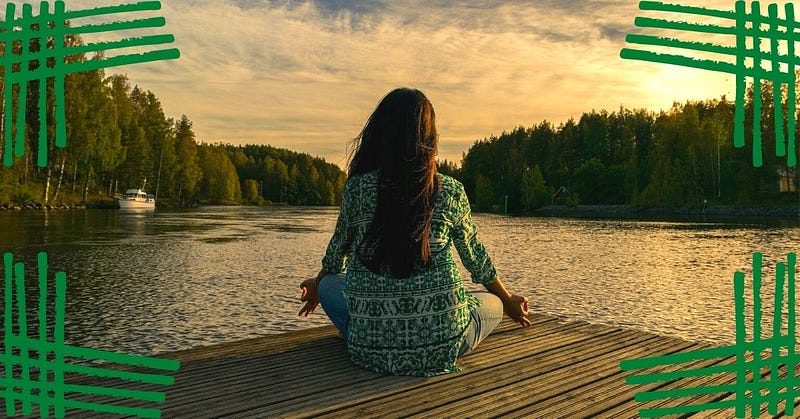
Stressed about isolation and the economy? No problem. Meditation is the answer!
I heard this from many sources. And so I started meditating. At first things went well, and I experienced the bliss and calm predicted. But recently, that changed.
Many people have tried meditation and mindfulness as a way of dealing with the stress of Covid. As with anything popular, it wasn’t long before news stories about the dark side appeared.
Psychologists warned that mindfulness could actually increase people’s depression or anxiety. Putting their attention on the very thing they were trying to avoid could cause a feedback loop. Without professional guidance, people could get trapped in these escalating loops.
Sensational cases of meditation causing psychosis or even mania were quick to follow. But were these people going to snap anyway, with or without the meditation?
A recent study in Psychological Medicine compared mindfulness meditators with control groups. The good news is that meditators did not have higher rates of psychological harm.
The leader of the study also points out that they studied a 6-week mindfulness class. Most news reports of psychological damage come from intensive practice.
Meditation retreats offer no escape
According to an older study cited in The Buddha Pill: Can Meditation Change You? over 60 percent of people at meditation retreats suffer negative effects. Those effects are listed as anxiety, confusion, and disorientation.
Meditation teachers acknowledge that students often experience negative emotions. In mild cases, this may be fear or anxiety. Teachers say these are signs that students are progressing in their meditation studies.
In more severe cases, though, students can suffer traumatic psychological damage. They may experience panic attacks or paranoia.
Even worse, buried memories may be exposed during the retreat. But the student leaves before they are able to come to grips with the trauma. As a result, they may contemplate or even commit suicide to escape the painful memories.
The problem comes from who runs the retreats. Usually these are people experienced with yoga or philosophy. Rarely is there a psychologist or trained mental health professional on hand.
People who have had mental health episodes need a signed waiver to take part. This can come from their general doctor or a psychiatrist. But once at the retreat, there is no one who is monitoring their condition.
One size does not fit all
There are four common styles of meditation.
The first is mindfulness meditation. That simply involves being aware of your thoughts, feelings, and sensations.
The second requires you to concentrate on your breathing. You don’t try to breathe in any special way or do anything different. You just notice the air moving in and out of your lungs.
The third method is transcendental meditation. This involves repeating a phrase over and over. It can be a mantra, which is a nonsense sound chosen for its vibrational frequency. Or it can be a sutra, which is a phrase that has meaning.
The fourth method is guided visualization. You listen to someone describing a beautiful setting, usually in nature. As they describe it, you imagine yourself there.
You can even mix and match the different styles, such as a walking meditation in a labyrinth. With every step, you inhale and visualize or mentally repeat a phrase. Then you exhale, visualizing or mentally repeating another phrase. These phrases are often affirmations, such as “Breath in love, breath out anger.”
The many styles of meditation are helpful for people who experience psychological discomfort. The problem is not with them. The problem is that the style of meditation they have chosen is not the right fit.
Psychological discomfort is not the only risk
I started meditating seriously this past December. I was prepared for some psychological strain. Or for nothing at all to happen.
After all, I’d tried breath awareness and mindfulness meditation a decade ago. They hadn’t worked for me. I didn’t feel any serious negative emotions, just annoyance that I couldn’t do it.
The teachers I’d had in the past were no help. They seemed to think everyone should be able to do meditation the way they taught it.
The meditation teacher I worked with this time was different. He used a practice based on transcendental meditation. And he acknowledged that everyone would have different experiences.
One of the elements he discussed was the mind’s eye. According to him, this frequently appears as a movie screen behind your eyes. For other people, though, it is like a gazing ball that they peer into. Mine was a fully-interactive 3-D experience.
Part of why other meditation experiences hadn’t worked for me was this misunderstanding. I’d been trying to visualize things on this “mind’s eye” movie screen. Which for me meant creating a fully-interactive movie theater, complete with screen. Then showing a film on that screen.
No wonder I thought meditating was hard work!
But psychological pain is not the only danger. Because the meditative state is so deep, and not connected to the physical body, it can cause problems.
At one point, I apparently twisted my leg underneath my chair while I was meditating. When I returned to conscious awareness, I was suddenly aware of excruciating pain in my knee. It would not support my weight, and would not bend correctly for days.
That still wasn’t the worst of it, though. I had taken some time off from meditating while dealing with a burst pipe. The constant sound of the fans — and lack of sleep — made it too difficult to concentrate.
Then, I’d taken some more time off for my Covid vaccine. The lingering pain — and lack of sleep — made it too difficult to concentrate.
So, after three months of regular meditation, I’d gone almost two weeks without it. When I started up again, I was instantly in a deep and profound meditative state. It lasted for over an hour.
At some point during that hour, my head had fallen forward. And stayed forward, straining the muscles in my neck. They went into spasm. And pulled my C1 vertebra out of alignment.
When I moved my head at all — turning side to side, up or down — blinding pain stabbed through my skull. The slight impact of my foot hitting the stair was enough to make my vision fuzz out.
So I’m going to take some more time off from meditation. And when I start up again, I’m going to get a meditation chair that has good head and neck support.
Because meditation can have wonderful health benefits. It can also have serious risks. It pays to be prepared.
Conclusion
Meditation has been shown to have significant health benefits. But it can also cause negative psychological effects in people.
These negative psychological effects are more pronounced with more intense practice.
If you are experiencing negative psychological effects, get help. You may be practicing the wrong type of meditation for you. Or it may be part of the process to deepen your experience. A qualified teacher with mental health training can assist you.
There are also physical risks to meditation. You can dissociate from your physical body in some meditative states. This means that you might miss signals that there is a problem with your body.
Like meditation itself, the key is awareness. Take meditation in small doses, until you find the best style for you. Be aware of any negative mental, emotional, or physical effects. Do not proceed until those effects are addressed. Don’t hesitate to get help from a professional to address those effects.
Ready to have a better tomorrow?
I’ve created a cheat sheet to help you increase your confidence and get control of your life. If you follow this daily, you will level up your life very quickly!