
Blending Agile Approaches (2) Learning
This is the second in a series of posts about why I think it’s good for scrum masters, agile coaches and agile teams to blend agile approaches, and to experiment with how best to deliver software. I’m working towards articulating a semi-formed idea, so it might take a few posts to get there.
Number 1 was about complexity. In this one, it’s time to get meta. We need to learn about learning.
Learning is at the core of an agile mindset. Remember how the agile manifesto described how it is all about uncovering better ways of doing things? It’s very difficult to make that happen without making learning part of the equation.
Software development teams need to avoid making repetitive mistakes, and wasting valuable time when opportunities to learn have been missed.
Therefore, a fundamental part of the role of the scrum master or coach working with agile software development teams, is the facilitation of learning.
Barry Overeem’s ‘8 Stances of the scrum master’ describes valuable behaviours which organisations should encourage in order for their scrum masters to add the most value. It is no coincidence that 3 of these roles directly relate to learning, in subtly different ways: coaching, mentoring and of course teaching.
Scrum Masters are often trainers in everything related to the process. Want to learn more about XP or Kanban? You know who to call! However, in order for a team to really progress, they don’t just need to learn the theory of how to ‘be agile’. They also need to understand how to get better at their own work, to become better designers, developers, architects, testers, managers.
To facilitate professional on-the-job learning, Bob Galen describes how appropriate documentation can help teams build a “collective memory”. This is one way a scrum master can work with a team, to encourage appropriate sharing of expert learning inside the team. So, let’s talk about that a little bit
It is helpful to remind ourselves that everybody learns in different ways. In addition, the way we learn strongly influences our ability to retain what we have learned. Edgar Dale helps us to visualise this with the ‘cone of learning’.
Effectively, Dale neatly illustrates how learning methods influence people’s ability to retain information.
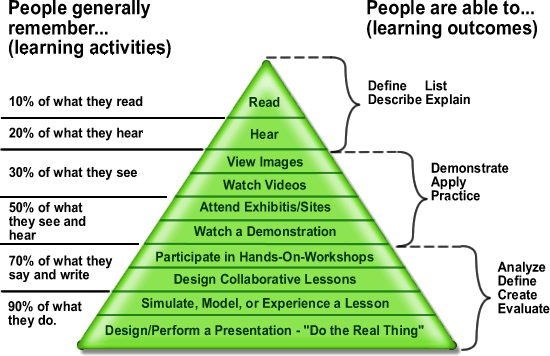
The cone of learning shows that people are only likely to retain up to 20% of what they read or hear. This implies that traditional PowerPoint style training is a very ineffective way to learn. It might be a straight-forward for a scrum master or coach to structure an idea in PowerPoint slides, easy to arrange a meeting, and straight-forward to run a training session by imitating a TED speaker. However, the image illustrates that this is not the best way for learning to happen. In other words, if we want the organisation to retain learning, as scrum masters and coaches we really need to encourage more active ways for learning to happen.
To develop this idea further, Jay Cross believes that most learning happens informally inside an organisation. That is, we learn more about how to do our job through experience, making mistakes and talking to colleagues than we ever will on a training course. In fact, Cross believes that up to 80% of learning happens this way, and that, while most organisations tend to invest resources in formal training, informal learning does not usually get the same level of investment.
However, scrum masters have a solid role to play here. First up, scrum masters sit in the same space as their team in order to help them optimise the work they do. Much of that effort involves facilitation of informal conversations, the kind that build relationships and help fuel that informal learning. Second, a coaching role of the scrum master implies that members of a team can learn for themselves, rather than being told what to do or how to do it. A good scrum master will engage in servant leadership by helping to create an environment where this type of learning is frequent and helpful to the team. Third, the scrum master can help encourage informal learning through organising activities that encourage active participation from team members. These activities are at the lower levels of Edgar Dale’s cone of learning, and will give a better chance for the learning to ‘stick’.
Sharon Bowman’s ‘Training From the Back of the Room’ describes a set of techniques that can help achieve these goals. They encourage us to think of ‘learning outcomes’ rather than ‘training objectives’.
There is a genuinely excellent primer on these techniques linked below, and I encourage you to watch it if you aren’t aware of them.
Also, if you have ever been involved in Pair Programming activities, you will understand the powerful moments of learning that can come from collaboratively solving a problem with a colleague.
To recap, learning is at the core of developing an agile organisation. People learn in a range of ways, and the way people learn has a strong influence over how much they retain that learning. Scrum masters and coaches have a role at the core of how teams and the organisation learns. This implies that scrum masters and coaches must be literate in a range of training methods and techniques, in order to be better able to create an environment where learning can happen.
Next up: Part 3! How biases can impede learning, and what scrum masters can do about it.
References:
- Agile Manifesto
- 8 Stances of the Scrum Master — Barry Overeem
- Collective Memory of the Team — Bob Galen
- Dale’s Cone of Learning — HLWiki
- (Video) What is Informal Learning — Jay Cross
- (Video) Training from the back of the Room — ICAgile