
BIBLICAL REFLECTIONS
Blame Is Pervasive in Human History
Day 2 Genesis 3: 8–13: The woman made me do it. The snake made me do it.
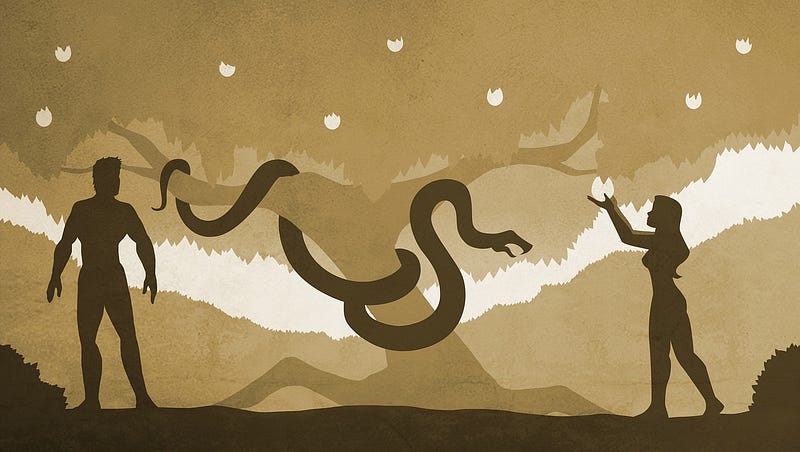
The apple got a bad rap
FYI: Nowhere is an apple mentioned as the fruit of the tree Adam and Eve were to avoid. It’s safe to eat apples and not worry about snakes.
My focus today is not on the fruit or the snake. My focus is how blaming others appears in the first written interactions between man, woman, and the Creator.
First, a true story I’ve wanted to write about but never found the occasion
Now is the time as this is about the creation of Adam and Eve.
We astute 4th graders laughed raucously when Sister Teresa Ann told us what happened.
The 1st grade had come in from recess. After a few minutes, one of the boys raised his hand. He was in obvious pain and almost crying. With great sincerity he declared, “Sister, my side hurts. I think I’m having a wife.”
Now that I have that need fulfilled…
The reluctance to accept responsibility
Genesis gives us the beginning of human history. Well, not actual history, but a mythological or poetic version.
Placing blame and rejecting responsibility is found in the male-female interaction when confronted by an all-knowing G-d who asks, “Did you…? And Why?”
If you ever took a parenting class you learned, when you know a child committed an offense, to acknowledge the deed as fact and move on to discussion and consequences.
And, avoid the, “Why did you do it?”
The answer is “I dunno,” “Cuz I wanted to,” peer pressure, or lack of impulse control. In the case of Adam and Eve, the why was peer pressure for Adam and a snake for Eve.
As I re-read the passage (Jerusalem Bible, Genesis 3:12), I note a subtle, “your fault Creator of us all,” in Adam’s reply. “It was the woman you put with me; she gave me the fruit and I ate it.”
At least Eve didn’t blame G-d. (verse 13) “The serpent tempted me and I ate.”
I wonder what would have happened if the two said, “Yes, I did it. I couldn’t resist having that knowledge. I’m sorry. I can see it was a bad idea.”
Perhaps humanity coulda, woulda taken an easier path if the first two had just acknowledge their wrong, asked forgiveness, and moved on.
That actually works in some relationships.
Responsibility and personal growth
We get ourselves into more trouble by not accepting responsibility for our actions.
Relationships grow and develop when we say, “Yep, I’m so sorry. I’ll change that.”
Of course, the key is to keep your word and change your behavior. If you don’t, you simply affirm you have no integrity.
You won’t grow spiritually or emotionally if you lie to yourself.
If you blame others for your lack of personal discipline, you won’t quit sabotaging yourself. You have to be willing to accept responsibility and engage in self-reflection. It’s the only way to discover how you managed to “snatch victory from the jaws of defeat,” as my step-father would say.
Without self-reflection, you won’t connect lack of sleep with the inability to function your best at work, with friends or family.
I know a guy who refuses to believe his drinking has anything to do with his anger and getting fired from his job… for being drunk. Soon, his fiancé is going to leave him. She’s “this close.” (thumb and forefinger barely apart)
When you blame others, you have no control over what happens. If it’s always someone else’s fault, you won’t look within and discover what you can do to change the situation.
In families, it isn’t unusual for the wrong person or wrong situation to be blamed.
A therapist wrote a story of misplaced blame. The family was complaining about the 11-year old daughter always being late to school. The parents wanted the therapist to “fix” their daughter. They considered her obstinate because she wouldn’t show up before the open bell at school.
After failing to help the family find the solution, the therapist pointed out the obvious. The favored son, the younger child’s ride to school, wasn’t leaving in time to get his sister there on time. Had the favored son left 10 minutes earlier, the less favored daughter would have been there at the opening bell.
One of my housemates has ADHD much worse than my ADD. She has discovered that setting the timer on the stove helps her stay focused, or to refocus.
We do have a problem when I use the timer to notify me when the chicken is ready. She can’t remember why she set the timer (because she didn’t), turns it off, and the chicken dries out.
I could continue to blame the dried out chicken on her, but it’s easier to set the timer on my phone. After all, she does have a short-term memory problem. Neither she nor I can change what the stroke did to her.
It’s my responsibility to find the solution. Cell phone timers work great as long as I carry the phone with me.
Self-check
When something goes wrong ask yourself what could you have changed to produce a different outcome.
Example: Yesterday, I had an appointment with my primary care person. I had been focused on my writing and just walked out when it was time to leave.
After my 30 minute drive, I discovered the nurse practitioner wasn’t in due to being exposed to Covid. (Yeah, blame the f-n virus.) “Didn’t you get the message? We called.”
I hadn’t even looked at the phone and didn’t have the phone with me to check.
When I finally picked up my phone there was no message.
Puzzled I checked my texts. Nothing. Back to the phone. Checked my calls. Yep, there was one, but no message.
Technology and the problem we sometimes have being surrounded by mountains is frustrating.
Next week, I’m calling an hour ahead of time and double-checking on my appointment. Hopefully, she didn’t contract Covid.
What can you do to fix a situation you blame on others?


