
BlackRock’s Bitcoin ETF: Here’s What You Need To Know
The First Spot-ETF For Bitcoin Is Possible
For years funds like Grayscale and Fidelity pursued a Bitcoin (spot) ETF approval in the US market, only to meet a categorical denial by the SEC, which insists it will not accept one “until it has regulatory oversight of crypto exchanges”.
The SEC has given the green light to various Bitcoin Futures ETFs (exchange-traded funds) since 2017, and perhaps, what seemed impossible this time will be different.
BlackRock, a nine trillion dollar financial behemoth, is ready to launch a spot Bitcoin ETF, a move that will massively alter the cryptocurrency landscape if it doesn’t get rejected by the SEC.
Previously we analyzed that Bitcoin (BTC) required a groundbreaking milestone to annul the negative macro sequence and present a better price range for the 2024–2025 cycle after the fourth halving.
This milestone is BlackRock’s spot ETF, a product that adds prestige to the shrinking popularity of Bitcoin (BTC).
We examine some details of BlackRock’s preliminary registration statement (link: sec.gov).
Subscribe (for free) to get email notifications whenever I publish:
BlackRock (iShares) Bitcoin Trust, Important Details
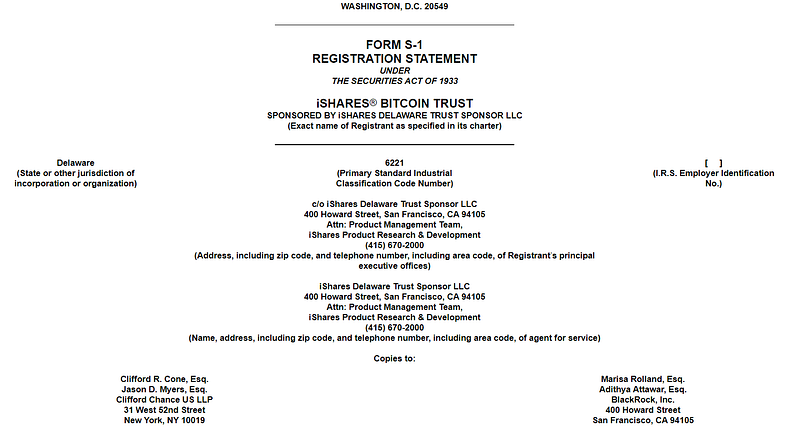
A lot has changed since 2017 when BlackRock CEO Larry Fink called Bitcoin an “index of money laundering”.
A spot ETF suggests participants will own rights to Bitcoin BTC, in the form of Trust shares. However, investors will not maintain access to the private keys, hence the proposal includes the risk of custodian services.
Important details emerge while studying BlackRock’s preliminary draft.
Coinbase Custody
BlackRock will cooperate with Coinbase as the fund’s custodian service that will maintain all the Bitcoin of the fund and its customers, with Coinbase storing most of the private keys in cold storage.
Hard Forks
The BlackRock ETF expands into hard forks, devoting a large segment of the draft proposal on this matter.
Apparently, Ordinals and the scalability issues of BTC, which also affect the Lightning Network, divided the Bitcoin (BTC) community enough for BlackRock to describe its perspective.
On the hard fork issue, BlackRock (depending on the size the fund reaches) becomes a decisive part of the decision process:
Furthermore, while the Sponsor will, as permitted by the terms of the Trust Agreement, determine which network is generally accepted as the Bitcoin network and should therefore be considered the appropriate network for the Trust’s purposes, there is no guarantee that the Sponsor will choose the network and the associated digital asset that is ultimately the most valuable fork. Either of these events could therefore adversely impact the value of the Shares.
Source: sec.gov
As finance joins Bitcoin (BTC), it will not be an observer but a consensus participant (a stakeholder), which the rest of the Bitcoin community can not ignore.
Finally, concerning possible hard forks or airdrops, the Trust will have the right to claim any such benefit as an “Incidental Right”, and not distribute the profit to the ETF participants.
Shareholders may not receive the benefits of any forks or “airdrops.”
SEC’s Stance
Due to the unregulated nature and lack of transparency surrounding the operations of digital asset exchanges, they may experience fraud, security failures or operational problems, which may adversely affect the value of bitcoin and, consequently, the value of the Shares.
Source: sec.gov
The risk of unregulated centralized exchanges increases due to the several fraud and mismanagement examples the industry has suffered for more than a decade.
The SEC so far has used this argument in its rejections of previous spot ETF proposals.
We could assume that the SEC will bring no opposition to anything Blackrock presents. However, also important to note that the SEC has already rejected one of Blackrock ETFs in 2014 (Reuters).
Furthermore, the SEC has lately exhibited a negative sentiment against the crypto industry with several lawsuits against cryptocurrency projects (XRP, TRX) and their founders (Justin Sun), and also against cryptocurrency exchanges Coinbase and Binance citing their securities offerings and staking programs.
However, with these lawsuits, we should also mention that the sentiment is not negative for PoW blockchains (Bitcoin, Bitcoin Cash, Litecoin), which SECs chairman Gary Gensler specifically cited as not being securities in 2018.
On the other hand, Ethereum’s place after the consensus switch from proof-of-work to proof-of-stake creates increased speculation regarding the future treatment by regulators.
Redemption Service
BlackRock’s ETF will allow redemptions in contrast to Grayscale’s Trust, where “redemptions have been completely suspended since 2016” (source: Yahoo).
BlackRock’s ETF will service redemption requests of Trust shares in exchange for the underlying Bitcoin (BTC).
Price Impact On The News
Bitcoin $BTC is up 5% since the announcement.
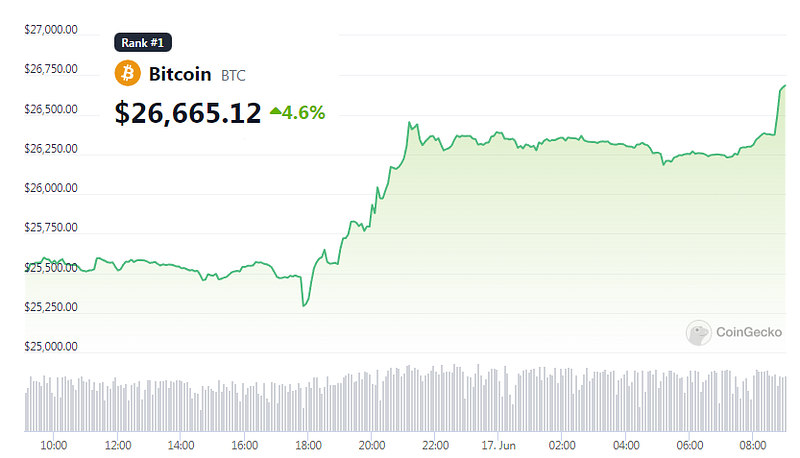
Following the news, the price of Bitcoin (BTC) and other cryptocurrencies saw a positive reaction, with speculation and volumes on the rise.
In Conclusion
If the BlackRock ETF is approved, Bitcoin (BTC) will become an asset integrated into finance. Undoubtedly, the approval of a BlackRock Bitcoin (BTC) ETF will have a long-lasting impact on the cryptocurrency industry.
A Blackrock Bitcoin spot-ETF will be one of the most decisive milestones in Bitcoin’s history. That would be a victory for those embracing the idea of finance adopting Bitcoin, like Microstrategy’s CEO Michael Saylor, who transformed his company into a stock pegged to Bitcoin’s volatility.
However, it remains to be seen if Bitcoin (BTC) will find a use case in finance, beyond the speculative aspect.
BlackRock’s ETF proposal (draft):

- Cover picture on Pixabay (modified)
Images, and material in this article are used for research, and educational purposes and fall under the guidelines of fair use. No copyright infringement intended. If you are, or represent, the copyright owner of images used in this article, and have an issue with the use of said material, please notify me.
Also Read:
Platforms:
● read.cash ● noise.cash ● noise.app ● Medium ● Hive ● Steemit ●Vocal ● Publish0x ● Twitter ● CashRain ● Me.dm ● YouTube
Don’t forget to Subscribe and Like if you enjoyed this story!


