
Black Mirror Season 6 Is Based On True Stories?!
The premise of each episode comes from events closer to home than anyone realized
Welcome to TRANSlating Everything, a publication of articles, podcasts, documentaries, and video essays by Stephenie Magister ✨ and occasional guests.
Note: I need your support! But if you can’t afford a membership, read the article for free on Substack or watch it as a video below
Two big things happened over the pandemic that can’t be ignored
First is that Charlie Brooker, the creator of Black Mirror, consumed almost every available resource for true crime content (Wired). If you made a podcast, a documentary, a TV show, or a movie, chances are he consumed it.
They say if you can only reach one person. Guess who?
The second is that Netflix, now the home of Black Mirror and Charlie’s digital soul (per page 56, paragraph 13), decided to crack down on subscription sharing among friends and family who don’t live in the same house.
The party is over. Netflix now enforces location-specific usage of their platform. Will their subscriber base dwindle? It’s hard to say, but with the newest season of Black Mirror dropping as of June 15, 2023, they’ve got me for at least one more month.
But no sooner do I log in to Netflix than I’m faced with the kind of questions I hoped Black Mirror would throw at me like a sucker punch. If you haven’t seen it yet…
SPOILERS!!!! SPOILERS!!!! SPOILERS!!!! SPOILERS!!!! SPOILERS!!!!
Season 6 Episode 1: “Joan is Awful”

“[The episode] follows an ordinary, only moderately awful woman who finds that her real life is being turned into a slick television show starring Salma Hayek offered on “Streamberry”’ — a very thinly veiled Netflix analogue.”
How would you react if you opened Netflix and saw a new docuseries based on your life?
What if you never consented to them making it?
It’s all based on publicly available footage and comments you made throughout your life.
None of it is illegal.
All of it is based on fact.
But does that mean any of it is true?
What if the person seeing this was named Elizabeth Holmes — infamous subject of The Dropout — watching her life become dramatized over and over and over?
You don’t need to be the potential star of an Orange is the New Black reboot to be the subject or victim of the next AI-generated content.
Instead of a life, think of a piece of art.
Artists don’t consent to AI scraping the furthest reaches of the internet, then making slight changes to that art the same way ChatGPT tweaks mirrored iterations of real-world text.
If you saw the text or the art next to the original, you’d see exactly what happened. There’s no other word for it. ChatGPT and AI art generators are committing outright theft.
That’s why it’s so easy for instructors to catch students using ChatGPT to fill out their written responses.
That’s why it’s so easy for artists to look at articles populated or reprinted with AI art and recognize where the art actually came from — and why those authors are committing outright theft along with the AI that generated that art for them.
Is it a coincidence those same people are the most likely to have once added copyright tags to the end of their Facebook posts?
(It was me)
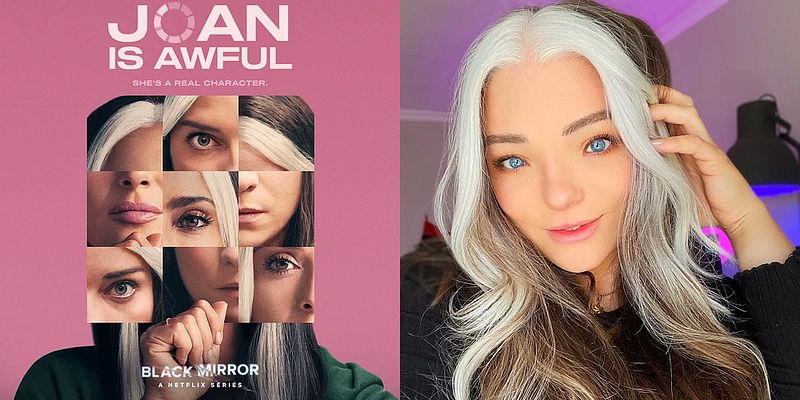
That’s why it’s so easy for Joan, the subject of the first episode of Black Mirror season 6, to recognize what has happened when she streams the newest series and sees her own life and likeness embellished for the sake of fresh content.
Writing for Wired, editor and content creator Amit Katwala said:
Katwala: “JOAN IS AWFUL,” the first episode of the new season of Black Mirror, was inspired by The Dropout. Specifically, as creator Charlie Brooker told WIRED this week, it was sparked by seeing the deluge of content surrounding Elizabeth Holmes and the Theranos scandal — a book, a TV show, a movie, around 800 podcasts — and thinking about how weird it must have been for people to see themselves portrayed by Hollywood actors in events that “feel like they happened about 10 minutes ago.”
“Brooker was struck, watching Amanda Seyfried’s portrayal of Holmes, how recent the events being depicted seemed and how weird it must have been for the real people involved. “You had all these celebrities playing people who must be sitting at home watching this,” he says.
Katwala teased out further insights in an interview with Charlie Brooker published just a day earlier than his analysis (fresh content demands daily supply). Amit asked:
Amit: A few episodes in this season seem to turn the show’s lens back on itself. “Joan Is Awful,” in particular, has a lot to say about turning your life into content. Was that inspired by something happening in your own life?
And Charlie Brooker answered:
Charlie: This is not something I consciously sit down and think about; it’s just that the stories that appeal to me seem to often be about … inauthenticity of experience would be one way of describing it.
The fictive levels only get deeper. The character Salma Hayek plays, like the “real” person she’s based on, is also facing her life being adapted into a new streaming series. In that version, Salma Hayek is played by Cate Blanchett.
This episode calls back to classic films like The Thirteenth Floor and, depending on your interpretation, The Matrix. What we think is reality is merely one level of reality on top of a deeper one.
The main character discovers she is a fictive character based on a real person who exists on a level of reality above her. Presumably, it’s turtles all the way down, and even that person may have another layer of reality to challenge the authenticity of their own identity and existence.
You can see why I started off wondering if the main character was actually played by Stef Sanjati, then found out it wasn’t, then decided there’s absolutely a fictive level where the main character is played by Stef.
Season 6 Episode 2: “Loch Henry”
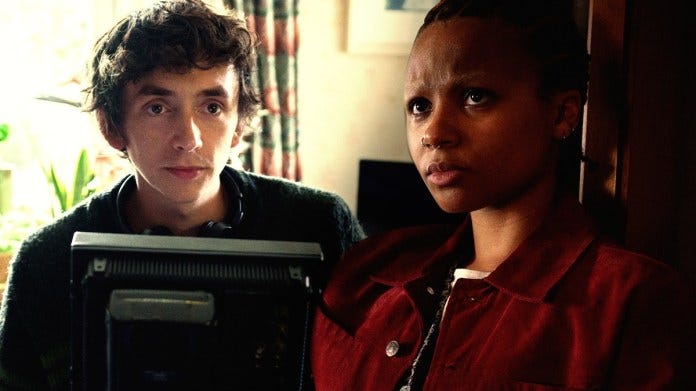
Writing for Netflix Life, Natalie Zamora described the episode by saying:
True crime fans will feel seen with the second episode of Black Mirror season 6, “Loch Henry.” This one follows a couple who visit the man’s childhood home on a trip to Scotland to film a documentary. But as he revisits a traumatic event in the town’s history, they change course on what their movie will be about. For better or for worse.
In his interview for Wired, Brooker confessed what true-life incidents inspired the episode.
Inspired by Brooker’s true-crime binge, it’s about the uncomfortable nature of turning atrocities into entertainment. “While you’re watching it, you think, ‘I’m watching some real art here,’” he says. “But you are still there to rubberneck at the scene of a crime.”
Season 6 Episode 3: “Beyond the Sea”
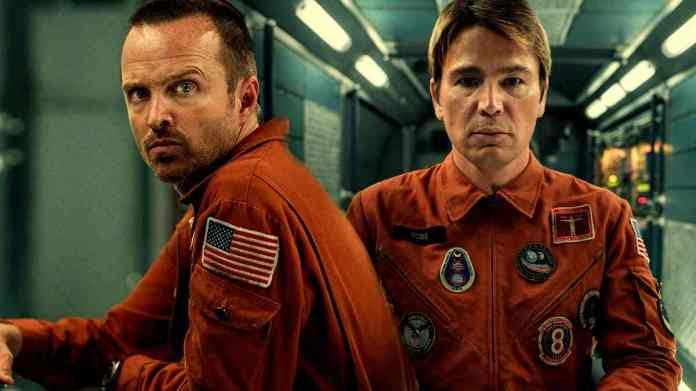
In “Beyond the Sea,” starring Aaron Paul and Josh Hartnett, a distant astronaut pays the ultimate price for public acclaim.
In a breakdown for Mashable that’s as devastating as the episode, Shannon Connellan gave this description for the episode — and it’s chilling connection to real-world events.
Shannon Connellan: In the episode “Beyond the Sea”, Black Mirror recurring player Aaron Paul and Josh Hartnett star as astronauts Cliff and David, who each have “Earth replicas” that stay with their respective families. These robot doppelgängers work with connected pods, so the pair can enjoy their life back home while completing a six-year mission in space together.
One fateful night, David’s life is obliterated as he’s forced to watch his family murdered in front of him (well, his replica) by anti-replica cultists, claiming “to restore the natural order.” The 1969 Manson Family comparison is semi-subtle.
Cast as David’s wife, Auden Thornton slightly resembles the late Sharon Tate. And the Chitty Chitty Bang Bang cinema outing places this episode in 1968, one year before the notorious Manson Family murders.
Black Mirror has left us reeling with many a twisted ending over the years, but Season 6 wields one of the most chilling to date.
I haven’t felt like life was this empty and pointless since the ending of Se7en.
Insanely good performances from Aaron Paul, Josh Hartnett, Kate Mara, and Rory Culkin.
I loved when David told Cliff’s wife Lana, “I see how you look at me.”
And Lana tells him, “At YOU?”
Reminding David whose body he is inhabiting. Reminding him how much of what he takes as an authentic reaction to “him” is actually her reaction to the body of her husband.
There’s a lot more to it than that, such as when she explains why the potential affair offered her clarity on the emotional absence in her marriage.
The episode made me think back to an old 90s movie that premiered the trailer for Star Wars: the Phantom Menace. It was Meet Joe Black, a three-hour movie that some said was three hours too long (but that I said was three hours too short).
The joke among critics and I guess weirdo teenagers was that the movie made back its budget due to most people buying a ticket just to see the Star Wars trailer, then leaving without watching Meet joe Black.
Meet Joe Black is a remake of an even older movie called Death Takes a Holiday, wherein well, you know what happens.
In Meet Joe Black, the Claire Forlani character first falls for Brad Pitt in a diner, then falls even harder for him over the course of the movie, but it’s while she still thinks Death–who is merely using the body as a shell–is the man she met at the start of the movie.
How can she begin to disentangle the assumption of who he was with how she felt about him once she knows who it was after that first meeting?
The movie doesn’t really offer an answer to that conflict except to resurrect Brad Pitt, who Claire Forlani instantly falls back in love with. Black Mirror is more like what would really happen.
In Black Mirror, David tries to recreate with Lana the same shot-for-shot intimacy we saw him have with his wife at the beginning of the episode. And it is not a happy love story ending.
David is not acting rationally. He has no earthly (heh) way to process the trauma. Even the body he shares with his fellow astronaut is not his own body. It is not even a “real” body. It is a replicant, and that of another person. It can only do so much to process the pain local to his own mind. Brings a whole new depth to the phrase (and book) “the body keeps the score.”
Remember too that David’s greatest strength and yet his limitation is his memory.
He draws from memory. He feels from memory. He experiences from memory.
When he draws Cliff’s wife naked, he is most likely drawing the wife’s head/identity on a replicant of his wife’s body–a neat thematic parallel.
And when he reaches for embodied intimacy while sharing the body of Cliff’s replicant, David is once again constrained by his greatest strength. The strongest way he has to reconnect with the love he never found a way to grieve is to pick up where he left off, to literally replicate the physical elements essential to his memories, experiences, and identity.
This is my favorite kind of Black Mirror episode. No idea where it was going. Lots of moments where it seemed predictable and then swerved left for an even bigger payoff.
This episode is the best of what Black Mirror can do when it wants to break your heart.
Don’t watch this one if you want to smile. But please watch it.
Season 6 Episode 4: “Mazey Day”
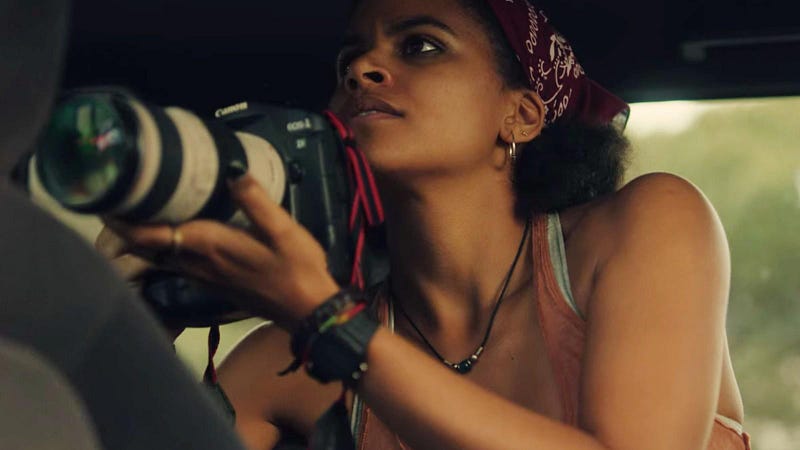
In “Mazey Day,” we meet a young celebrity hounded by the paparazzi in early 2000s Los Angeles (inspired by a documentary Brooker watched about Britney Spears).
As riveting and otherworldly as this one becomes, the revelation that the girl has been turned into a werewolf brings a deeper fictive level to an already disturbing episode.
What does it mean for the paparazzi to take photos of her at any cost and for any cost? When they finally track her down, she’s chained to the floor, and yet the cameras continue to flash.
When she turns into a werewolf, the photographers won’t stop. One of them keeps flashing until Mazey completes her transformation and rips his throat out.
Even the photographer who is our main character doesn’t miss a once-in-a-lifetime opportunity. At the end, with Mazey finally finding release from a prison no one knew she’d become trapped within, the photographer raises the camera for one final shot.
Why waste the opportunity?
Season 6 Episode 5: “Demon 79”
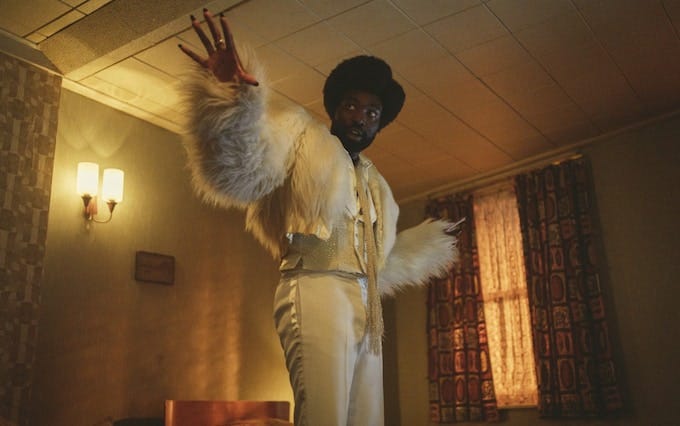
From Kristy Puchko’s excellent breakdown at Mashable:
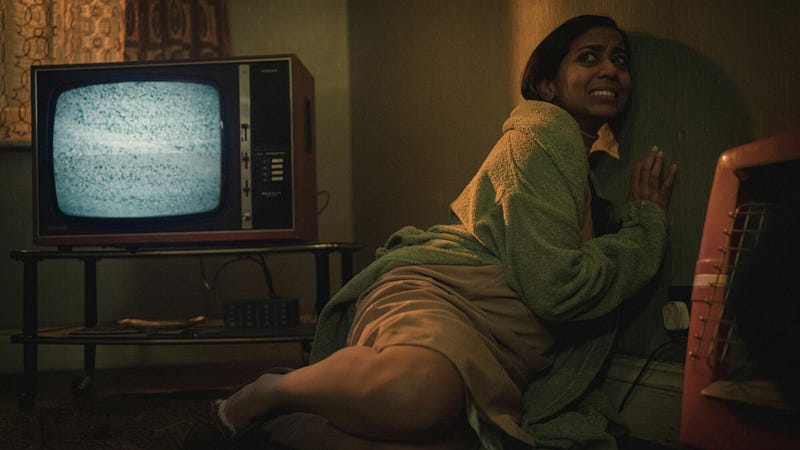
Written by Bisha K. Ali and Charlie Brooker, “Demon 79” centers on a mild-mannered sales clerk in 1979 London. As an Indian woman in a predominantly white neighborhood, Nida stands out, whether she wants to or not. Racist neighbors shoot her side-eye. A skinhead marks her door with menacing “NF” graffiti, indicating the far-right political party favored by her snarling co-worker.
Lunch in the basement leads to Nida finding a small wooden talisman, etched with a symbol in red. (The Red Mirror, perhaps?) Accidentally anointing it with her blood, she summons Gaap (Men’s Paapa Essiedu), who informs her that she must kill one person a day for three days or else the world will end on May Day. But is this real — meaning real within the world of Black Mirror’s movie’s reality? Or is this all in Nida’s head?
How far would you go to prevent the world from ending?
Though this episode delves into the commands of a demon and the reasonable suspicion that you might not realize what you’ve agreed to until it’s too late, the twist is that the episode doesn’t betray the audience’s trust like that.
The world really is going to end. Nuclear war really is on the verge of wiping out everyone on the planet.
Skynet will win…but does that mean we will have lost?
Charlie: What if it goes all Skynet and decides to wipe us out? I remember reading an article that said that will happen in an afternoon, if it’s gonna happen. We’ll wake up one morning and stretch and yawn, and by the time the sun goes down we’ll be sharing the planet with an intelligence that’s 50 billion times as intelligent as us, and then all bets are off as to what it could do. We can’t possibly predict it.
Amit: But maybe if these things are built in our own image they’ll just be crippled with anxiety and self-loathing?
Charlie: That would make them more interesting. But the problem is they’re sort of not. I’ve seen stories about robots that suddenly develop human emotions, and I’ve always avoided that in Black Mirror because I find them hard to relate to.
Maybe I’m a robot, or maybe I’ve got too many emotions, I don’t know. But I always found it not that interesting as a storyline — maybe because I’m selfish and I think, “I don’t care about the fucking robot.”
At the end of the episode, the main character walks hand in hand with a demon as the world burns behind her. It’s the perfect way to close out the season, especially once you find out where the episode fits into the Black Mirror cinematic universe.
In the same breakdown for Mashable, Kristy Puchko broke down the connective tissue at the core of “Demon 79.”
Kristy: In “Demon 79,” Nida (We Are Lady Parts’ Anjana Vasan) is given a glimpse of a dystopian future that includes the vicious robotic dogs from “Metalhead.” That could suggest her story happens in the same world as “Joan Is Awful,” “Loch Henry,” and the rest. And it does, just not on in the same way as the others.
At the start of “Demon 79,” an ominous orchestral score plays over opening titles cards with a bold red font; they have the flare of ’70s horror movies, calling to mind Let’s Scare Jessica to Death or Last House on the Left. Among these titles cards is one that reads “A Red Mirror film.”
It was a clue teased in the season’s trailer too. “Demon 79” isn’t a story in the same timeline as the bulk of the series, which is perhaps no surprise considering it’s set in the ’70s and ends with a pretty seismic conclusion. Instead, this is a movie that exists within the world of Black Mirror.
In conclusion…is Black Mirror a warning?
Amit: But they’re warnings, right? You make these shows as a warning about not making the thing, and then they go ahead and make the thing.
Charlie: I don’t know if it’s necessarily about not making the thing. Usually there’s a weak and flawed human in the story to fuck things up rather than it being the technology specifically.
Go here to listen to (or read) Amit’s extensive discussion with Charlie Brooker (Wired), then read their incredible breakdown of “Joan Is Awful.”
Did you watch Black Mirror season 6 yet? What did you think?
If you like my work and want to support it, send me a tip or become a paid subscriber for Translating Everything on Patreon, Medium, or Substack


