avatarChicago Education Advocacy Cooperative

Free AI web copilot to create summaries, insights and extended knowledge, download it at here

2934

Abstract

m/news/articles/2022-09-14/chicago-s-biggest-challenges-stem-from-its-history-of-segregation">Chicago’s Decades of Segregation Feed South and West Side Hardships</a> By <a href="https://www.bloomberg.com/authors/AOazxMUSBUg/shruti-singh">Shruti Singh</a> and <a href="https://www.bloomberg.com/authors/AQUS59a2qxc/isis-almeida">Isis Almeida</a></figcaption></figure><p id="ad1f">Disciplinary practices in CPS seemingly target Black students for higher punitive outcomes resulting in Chicago Police Department than their white peers. For example, it is more common to see a Black student be suspended or expelled for rule violations involving violence as opposed to their white peers. By imposing sanctions with different levels of frequency, intensity, and duration for students of different races, CPS can be said to be actively contributing to the over-policing and criminalization of Black youth in the city. What happens next is the <a href="https://www.reuters.com/legal/government/criminalizing-illinois-students-flouts-law-reduce-school-to-prison-pipeline-2022-05-09/">school-to-prison pipeline</a> where students are taught that they are criminals by their teachers and administrators through the imposition of sanctions that basically tell the student that school is not meant for them. All of this contributes to further limited educational opportunities for Black students in Chicago.</p><figure id="d913"><img src="https://cdn-images-1.readmedium.com/v2/resize:fit:800/1*98cNKVpk5zixhicPIp1U9g.png"><figcaption><a href="https://consortium.uchicago.edu/publications/suspending-chicagos-students-differences-discipline-practices-across-schools">Suspending Chicago’s Students</a></figcaption></figure><p id="c302">A glaring lack of diversity exists in the CPS workforce with most teachers identifying racially and ethnically as white or Caucasian. On the other hand, nearly all students enrolled in Chicago Public Schools are non-white. It is not to say that white teachers are unable to educate Black students. What we are saying is that <a href="https://chicago.chalkbeat.org/2018/11/5/21106168/beyond-hiring-the-struggle-to-diversify-chicago-s-teaching-ranks">cultural incongruency in the classroom between teacher and student</a> is a known contributing factor to the disparities in educational outcomes for Black children in Chicago. Research has shown that students of color perform better academically when they have teachers who share their racial or ethnic background. However, the teaching workforce in Chicago is predominantly white, which can lead to diminished learning expectations, lack of awareness cultural parity, and a diminished capacity for cultural responsiveness in the classroom.</p><figure id="af2f"><img src="https://cdn-images-1.readmedium.com/v2/resize:fit:800/1*9z7d-XaWWEbG3ZyseiEsEQ.jpeg"><figcaption><a href="https://chicago.chalkbeat.org/2018/11/5/21106168/beyond-hiring-the-struggle-to-diver

Options

sify-chicago-s-teaching-ranks">Beyond hiring: The struggle to diversify Chicago’s teaching ranks</a> By <a href="https://www.chalkbeat.org/authors/adeshina-emmanuel">Adeshina Emmanuel</a></figcaption></figure><p id="127d">Standardized testing has been shown to disadvantage Black students, as these tests are often culturally biased and fail to account for the unique experiences and backgrounds of Black students. The emphasis on standardized testing in the CPS system can exacerbate the achievement gap between Black students and their white peers. Of course, there are signs that CPS intends to <a href="https://chicago.suntimes.com/education/2023/1/25/23571935/cps-consider-science-social-studies-marks-instead-of-standardized-tests-advancing-next-grade">move away from using standardized testing</a> as the primary means of documenting academic growth. Using any quantitative or qualitative measure of academic growth independently opens the door for misunderstanding of academic progress and possible interventions that could increase academic motivation and performance.</p><figure id="0911"><img src="https://cdn-images-1.readmedium.com/v2/resize:fit:800/1*R664bfzsqg7GxcOv_XdSrw.jpeg"><figcaption><a href="https://www.wbez.org/stories/faltering-scores-for-poor-black-students-in-chicago-and-statewide/6813505e-bbc2-4901-be05-7e965d28bf93">Faltering Scores For Poor Black Students In Chicago And Statewide</a> By <a href="https://www.wbez.org/staff/294/linda-lutton">Linda Lutton</a></figcaption></figure><p id="b1d0">What does it all mean? Where do we go from here? Race continues to play a significant role in determining educational outcomes for Black children living in Chicago. Addressing systemic racism and discriminatory practices in the city’s education system, promoting diversity in the teaching workforce, and implementing culturally responsive teaching practices can help to improve educational outcomes and close the achievement gap for Black students in Chicago. With the election of a new mayor, their incoming administration has their hands full with a historically racist system. That said, there is hope for the future as the incoming mayor, Brandon Johnson, is <a href="https://chicago.chalkbeat.org/2023/4/6/23672993/chicago-mayor-brandon-johnson-q-and-a-public-education-schools">a parent of a child in CPS</a> and a member of a historically racialized and minoritized group of people living in Chicago. There exists still much work to be done to achieve full equity in terms of educational opportunities and advantages through education in the City of Chicago. Knowing that we, Chicago citizens and parents with children in CPS, can expect that the incoming mayor has at least endured the <a href="https://chicago.chalkbeat.org/2022/11/21/23471410/chicago-public-schools-applications-magnet-selective-enrollment-high-school-kindergarten">CPS School Lottery</a> process is comforting.</p></article></body>

Black Children and Education in Chicago: Legacy of Discrimination, Divestment, and Exclusion
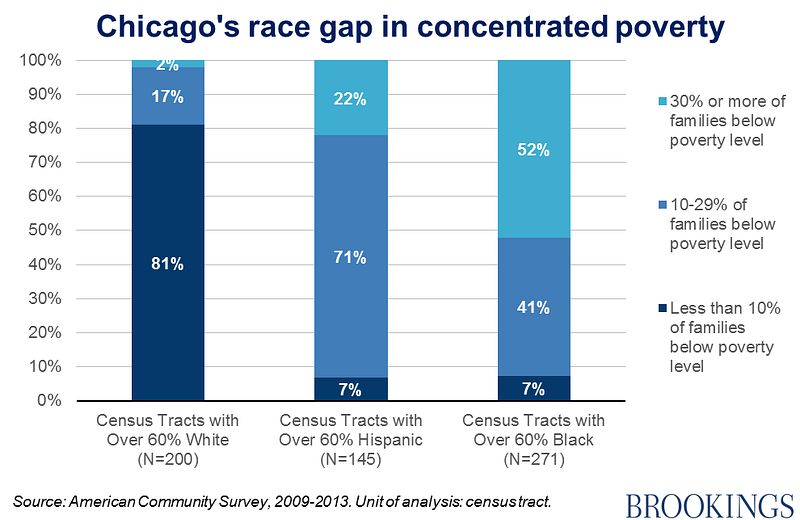
The most American city: Chicago, race, and inequality by Jonathan Grabinsky and Richard V. Reeves

Racial and ethnic identity is thought to be causal in determining a host of socially relevant outcomes. Scientists have attempted to empirically document how health, employment, relationships, and education are driven by the social construction of race and ethnicity in the United States. Chicago Public Schools (CPS) is one of the largest and oldest educational districts in America. It is no secret that race has long been a determining factor in educational outcomes for Black children living in Chicago. Historically, Black families in Chicago have faced systemic racism and discriminatory practices in the form of neighborhood redlining, neighborhood divestment, and disproportionately higher exposure to toxic chemicals and other environmental hazards. All combined, Black Chicago children have endured disproportionately higher rates of negative life outcomes related to limited access to quality education ever since all schools were legally obligated to accept them. What does the future hold for Black children in Chicago? Where are the practical pathways to upward social mobility through education? How have historical events contributed to our current situation? Great questions! Let’s start unpacking…

Housing insecurity is at the top of the list of factors contributing to the continued disparity in educational outcomes for Black children in Chicago. Governmentally imposed racial and economic segregation of the city led by Mayor Richard J. Daley continues to have lingering effects of higher concentrations of poverty and disinvestment in predominantly Black neighborhoods. One of the most harmful effects of neighborhood divestment is the underfunding of schools. Schools with fewer resources and less qualified teachers are known to be prone to disorganization, diminished student performance, and broken relationships with the community the school is intended to serve.
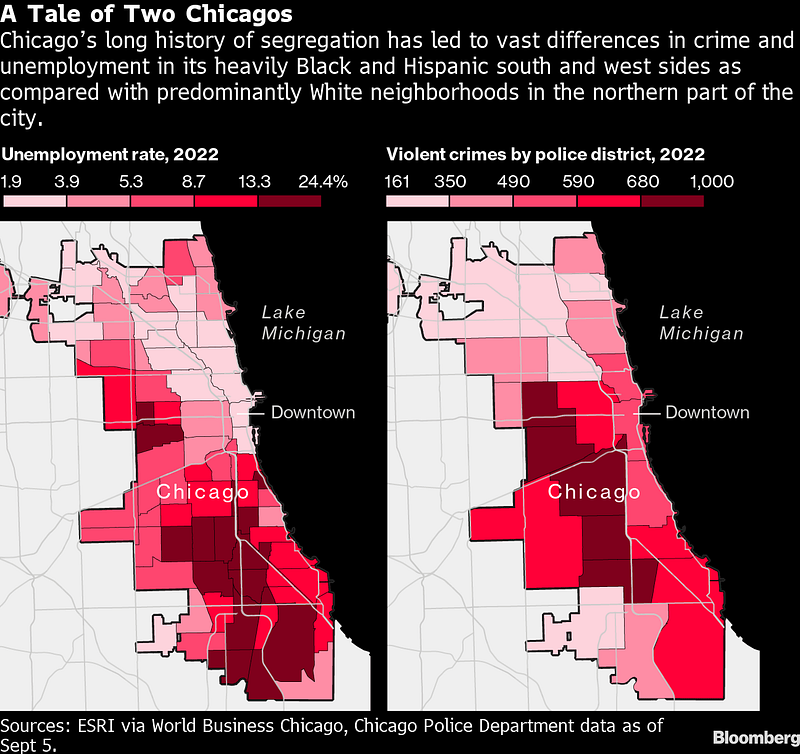
Chicago’s Decades of Segregation Feed South and West Side Hardships By Shruti Singh and Isis Almeida

Disciplinary practices in CPS seemingly target Black students for higher punitive outcomes resulting in Chicago Police Department than their white peers. For example, it is more common to see a Black student be suspended or expelled for rule violations involving violence as opposed to their white peers. By imposing sanctions with different levels of frequency, intensity, and duration for students of different races, CPS can be said to be actively contributing to the over-policing and criminalization of Black youth in the city. What happens next is the school-to-prison pipeline where students are taught that they are criminals by their teachers and administrators through the imposition of sanctions that basically tell the student that school is not meant for them. All of this contributes to further limited educational opportunities for Black students in Chicago.
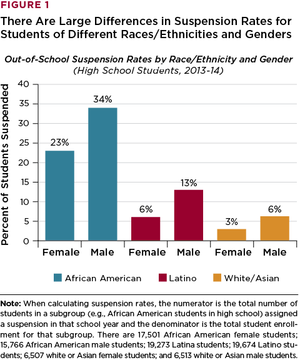
Suspending Chicago’s Students

A glaring lack of diversity exists in the CPS workforce with most teachers identifying racially and ethnically as white or Caucasian. On the other hand, nearly all students enrolled in Chicago Public Schools are non-white. It is not to say that white teachers are unable to educate Black students. What we are saying is that cultural incongruency in the classroom between teacher and student is a known contributing factor to the disparities in educational outcomes for Black children in Chicago. Research has shown that students of color perform better academically when they have teachers who share their racial or ethnic background. However, the teaching workforce in Chicago is predominantly white, which can lead to diminished learning expectations, lack of awareness cultural parity, and a diminished capacity for cultural responsiveness in the classroom.
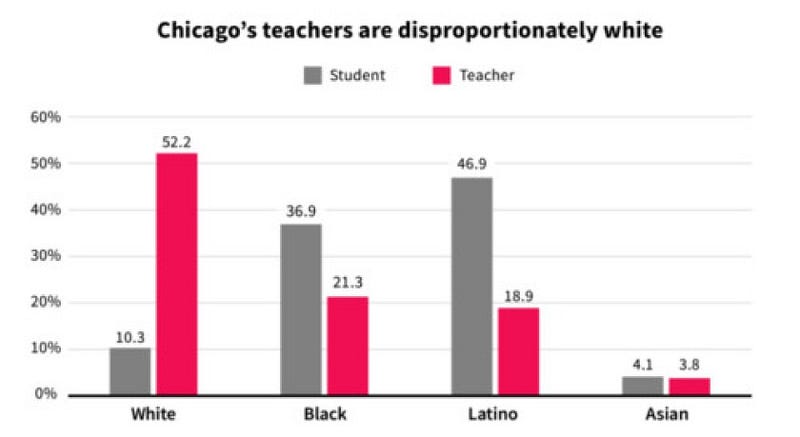
Beyond hiring: The struggle to diversify Chicago’s teaching ranks By Adeshina Emmanuel

Standardized testing has been shown to disadvantage Black students, as these tests are often culturally biased and fail to account for the unique experiences and backgrounds of Black students. The emphasis on standardized testing in the CPS system can exacerbate the achievement gap between Black students and their white peers. Of course, there are signs that CPS intends to move away from using standardized testing as the primary means of documenting academic growth. Using any quantitative or qualitative measure of academic growth independently opens the door for misunderstanding of academic progress and possible interventions that could increase academic motivation and performance.
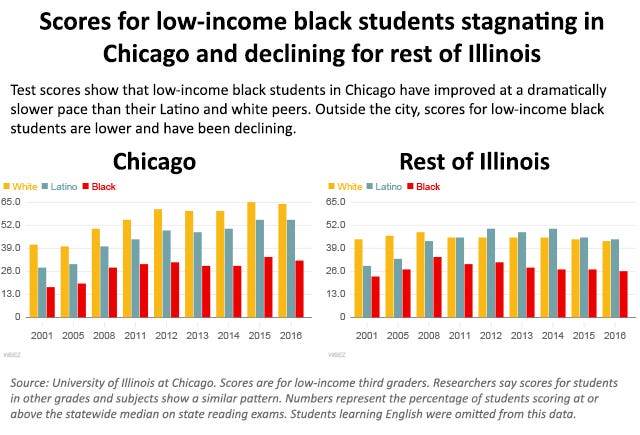
Faltering Scores For Poor Black Students In Chicago And Statewide By Linda Lutton

What does it all mean? Where do we go from here? Race continues to play a significant role in determining educational outcomes for Black children living in Chicago. Addressing systemic racism and discriminatory practices in the city’s education system, promoting diversity in the teaching workforce, and implementing culturally responsive teaching practices can help to improve educational outcomes and close the achievement gap for Black students in Chicago. With the election of a new mayor, their incoming administration has their hands full with a historically racist system. That said, there is hope for the future as the incoming mayor, Brandon Johnson, is a parent of a child in CPS and a member of a historically racialized and minoritized group of people living in Chicago. There exists still much work to be done to achieve full equity in terms of educational opportunities and advantages through education in the City of Chicago. Knowing that we, Chicago citizens and parents with children in CPS, can expect that the incoming mayor has at least endured the CPS School Lottery process is comforting.

Education
Chicago
Racism
Housing
Poverty
Recommended from ReadMedium