
Bitcoin is Not a Currency of Criminals
“Bad news travels fast” — this age-old saying applies perfectly to Bitcoin, the pioneering digital currency that has been in the eye of the media storm for a decade.
Despite its disruptive potential to revolutionize finance, Bitcoin is often painted with a broad, unflattering brush as the “currency of criminals”.
This article intends to debunk this widespread myth, shedding light on the true nature of Bitcoin and how it functions as a part of our global financial ecosystem.
Buckle up and let’s dive into the intriguing universe of Bitcoin, but remember — it’s not as spooky as some might have led you to believe!
What is Bitcoin, really?
Let’s start at square one.
Bitcoin is a digital currency, yes, but it’s much more than that. Bitcoin is essentially a decentralized peer-to-peer payment network.
It’s like a global ledger that records transactions transparently, without the need for a middleman like a bank.
To use a simple analogy, imagine if every dollar bill you’ve ever held could tell you its complete transaction history. That’s what Bitcoin does with its underlying technology, blockchain.
The misconception: Bitcoin = criminal’s currency
The perception of Bitcoin as a criminal currency comes from its feature of relative anonymity.
While Bitcoin transactions are transparent and can be traced, the identities of the people behind the transactions aren’t readily known unless revealed.
This has made Bitcoin appealing for some illegal activities, the most famous of which was perhaps the now-defunct dark web marketplace, Silk Road.
However, it’s important to remember that any tool, currency, or technology can be used for both good and bad. The fact that a small percentage of users engage in illegal activities doesn’t make Bitcoin inherently criminal, just as the existence of crime doesn’t make cash inherently illegal.
Bitcoin in comparison to traditional banking
Let’s draw a parallel to understand this better.
According to a UN report, up to $2 trillion is laundered globally each year, much of it through traditional banking systems. That’s about 2–5% of global GDP!
Yet, we don’t consider banks or fiat currencies (like the dollar or euro) to be criminal. Why?
Because we recognize that the misuse by some does not define the whole system.
The same understanding should apply to Bitcoin.
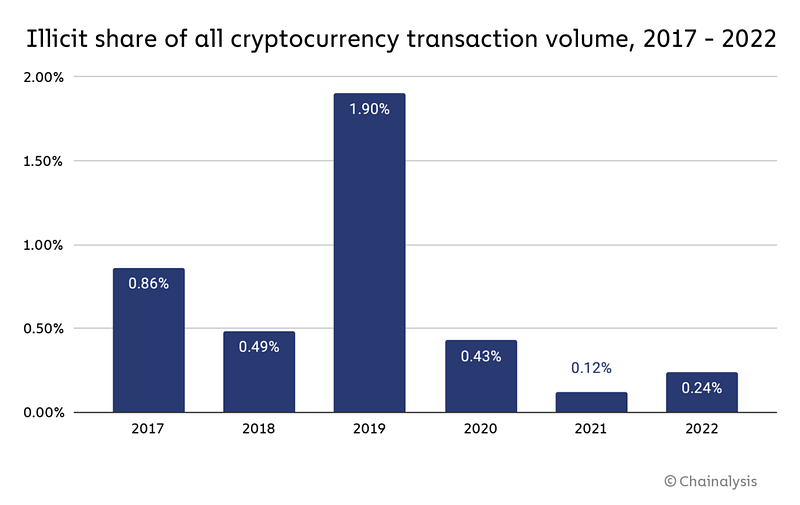
In fact, Bitcoin might be less attractive for illegal activity than you might think. According to the 2023 Crypto Crime Report by Chainalysis, illicit activity represented only about 0.24% of all cryptocurrency transaction volume.
Yes, you read that right — less than 0.5%.
The brighter side of Bitcoin
Focusing solely on the negative aspects overshadows the numerous positive applications of Bitcoin.
Bitcoin provides financial inclusion for unbanked populations, offers a hedge against hyperinflation in countries with unstable economies, and fosters innovation in finance, to name a few benefits.
It’s like a tool — it can build houses or, in the wrong hands, cause harm. The tool itself is not inherently good or bad.
Institutions, Bitcoin, and the Fear of the Unknown
Another layer in this intriguing tapestry is the role of institutions. Now, this is not to claim that there’s a grand conspiracy against Bitcoin, but it’s important to consider how established powers respond to disruptive change.
Traditionally, governments and financial institutions have held exclusive control over currencies. They dictate the rules of the game: they can print money, set interest rates, and control capital flows.
This system, with all its advantages and flaws, has been the status quo for centuries.
Enter Bitcoin.
Bitcoin, a decentralized, peer-to-peer currency, presents a paradigm shift that could potentially render the traditional financial system obsolete. It could democratize finance, putting power back into the hands of the people. It challenges the very notion of a centralized authority.
And this can be… unnerving, to say the least, for those who’ve held the reins until now.
In light of this, it’s not entirely surprising that institutions might take a defensive stance, consciously or unconsciously. Branding Bitcoin as a “criminal currency” serves as a potent deterrent for mainstream adoption.
It taps into the fear of the unknown, associating Bitcoin with the seedy underbelly of the financial world.
The media, often echoing these sentiments, can amplify this negative narrative, leading to a widespread misconception about Bitcoin’s true nature.
However, it’s important to distinguish between narrative and reality.
As we’ve discussed, the reality is that illegal activities make up a minute fraction of Bitcoin transactions.
Just like the internet was initially demonized as a hub for illicit activities, so too is Bitcoin facing its trial by fire. As with the internet, the narrative will likely shift as understanding grows and the technology matures.
This isn’t to say that Bitcoin or blockchain technology is without its flaws or risks. Like any powerful tool, it needs to be handled responsibly, with robust systems in place to prevent misuse. And while Bitcoin challenges the current system, it’s not necessarily about overthrowing it.
It’s about providing an alternative, a choice, fostering a spirit of financial autonomy and inclusion.
Understanding this, we can see that the narrative of Bitcoin as a “criminal currency” is an oversimplified perspective that overlooks the technology’s transformative potential. It’s an echo of the apprehension that often meets ground-breaking innovation — an apprehension we must overcome to fully embrace the potential of the financial revolution at our doorstep.
Conclusion: Bitcoin and the bigger picture
In conclusion, labeling Bitcoin as a “criminal currency” is both simplistic and misleading.
It oversimplifies the multi-dimensional nature of Bitcoin and other cryptocurrencies while misleading the public about their true potential and purpose.
Bitcoin, like any currency or technology, is a tool that can be used for a variety of purposes, both good and bad. But as we’ve seen, the bad represents a minuscule fraction of the whole.
We need to focus more on understanding this novel technology, its potentials, and its pitfalls, rather than jumping to conclusions based on sensationalized headlines.
We’re standing at the precipice of a financial revolution, with Bitcoin leading the charge. Instead of fearing what we don’t understand, let’s embrace the opportunity to learn, grow, and perhaps even profit from this exciting development in human history. Remember, the future is here — it’s just unevenly distributed. And Bitcoin is a big part of redistributing that future.
Enjoyed the read? For more on Web Development, JavaScript, Next.js, Cybersecurity, and Blockchain, check out my other articles here:
If you have questions or feedback, don’t hesitate to reach out at [email protected] or in the comments section.
[Disclosure: Every article I pen is a fusion of my ideas and the supportive capabilities of artificial intelligence. While AI assists in refining and elaborating, the core thoughts and concepts stem from my perspective and knowledge. To know more about my creative process, read this article.]