
Bitcoin is Coal Currency
Proof of Stake will take over as the green choice
The Bitcoin cryptocurrency ecosystem is estimated to be consuming 130 terawatt-hours, as much electricity as all of New Zealand. Twenty-six times as much as all of FaceBook’s data centers. Printing US currency consumes 0.1 terawatts, of course there are other environmental factors to consider with physical currency such as the consumption of cotton and flax, production of ink, and incineration of de-circulated bills but the total consumption does not come close to Bitcoin.
Under the Hood
Let’s start with a quick look into the design of the currency without getting too technical. The core of the technology is the hash which is a string of letters and numbers generated mathematically from some content input e.g. “Inkbear” hashes to “ca77ab560b4d46508697611d4af17d094c9523647f0b91c88143ac5e035d0d95” and the entire opening paragraph of this article hashes to “752cb3ea2f7bcb6da485192ff87214e0be5a743a4daf863b26246336d250941d”. If even a single character is changed, the hash will be different.
Creating the blockchain goes something like this:
- A ledger of the ownership is created and hashed. This starts a new chain.
- When a new entry is made on the ledger (a block). The block is hashed with the hash of the previous block.
e3b0c44298fc1c149afbf4c8996fb92427ae41e4649b934ca495991b7852b855 + “Inkbear” = b2790a940fddf6567b6f30dfa4260f7fc9d026e068f7698e4a75ac6cf73132c4- A numeric value called a nonce is searched for by a worldwide network of computers (Remember SETI@home?). When the correct nonce number is added onto the data input and rehashed the resulting hash will start with four zeros e.g. “Inkbear” + nonce = final hash with leading zeros.
e3b0c44298fc1c149afbf4c8996fb92427ae41e4649b934ca495991b7852b855 + “Inkbear” + 291038478 = 0000632560109d927d834388711f06efe0b74eb8c0f2b5aced28897419af4597- The first computer solving what the nonce number is “wins” and sends all of the above to the network for validation.
- If 51% or more can use the nonce with the block contents to get the same hash output (with the four leading zeros) the hash is considered valid.
- The validated block is then added to the chain and the process starts over again when the next transaction occurs.
For a more detailed explanation read this article by Jake Howering.
Why Bitcoin Takes So Much Power
Remember the winning computer? That is a “miner” and the owner was rewarded with some of the fees collected by the use of Bitcoin. The validators also get a small amount but it is that competition to find the nonce first driving the ever-expanding arms race of computing power.
The Bitcoin “Proof of Work” (PW) algorithm changes over time so that an average mining time of 10 minutes is maintained. Whoever has the fastest computer gains an edge over the other competitors and the more computers running the higher the odds are of winning. The computers are designed to be as fast as possible and As the computing power increases so does the amount of electricity used. Additionally, to increase odds of being first, huge farms of servers are used to mine. Thus the network is ever increasing in the amount of power and the number of servers.
One Bitcoin mining node is like three toasters.
The search for the nonce is sent to the whole network of computers (called miners) and the first to solve it is rewarded. Validation also receives a small compensation. The combination of racing for a nonce and ever-increasing complexity in finding the nonce has led to an arms race of computational power. The Antminer S9 consumes 1323 watts, but that is 220v so double that for a typical household 110v circuit. 2646 watts would fully consume your kitchen outlets — more than 3 two-slice toasters. Russia has one data center running 3000 of these computers, China has one even bigger.
Where the Power Comes From
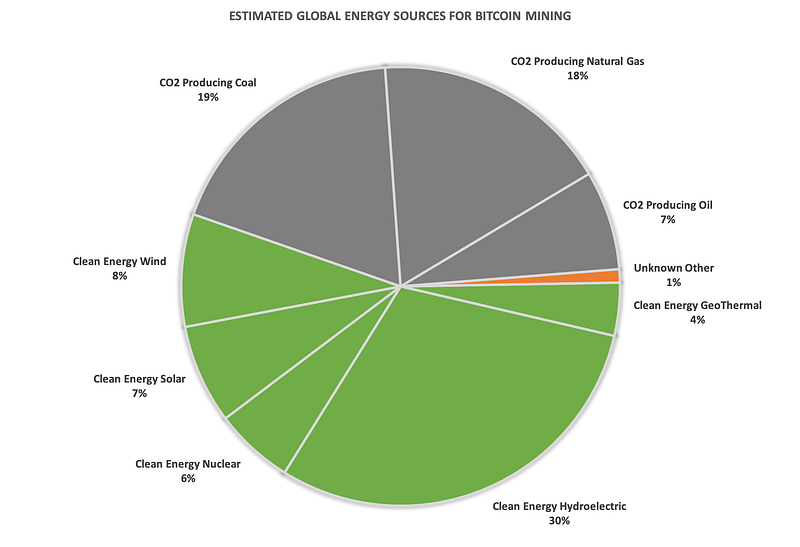
Bitcoin miners are run mostly where energy is cheap and thus a large percentage is from renewable energy sources. In China, this means hydropower and mining moves geographically to take advantage of the rainy season in Sichuan before returning to the North. Other countries like Iceland have hydropower and ambient temperatures that make data center cooling easier.
One argument in favor of high energy consumption is that since data centers do not need to be near a metropolitan area, mining can provide the consumption needed to warrant building green infrastructure.
This is the sunny side, now for the burnt around the edges flip side. China is mining 65% of Bitcoin and that migration North after the rainy season is a return to coal country. I will generously split the Chinese mining evenly between hydro and coal and that pencils out to 42 TWh running on coal. According to a Cambridge University study, the share of clean energy in crypto mining is around 56% (exact figures are difficult to come by).
Where Is This Going?
The inflationary model of BitCoin coupled with its massive energy consumption has Bitcoin going full steam toward disaster. A survey by Bank of America showed 74% of institutional investors believe Bitcoin is in a bubble.
Fortunately, Power of Work is not the only crypto algorithm in play. Cardano, the third most held asset on Coinbase, and some other digital coins rely on a “Proof of Stake” (PS) mechanism where hashers buy tokens that allow them to participate. The hashing requests are distributed to a handful of miners who are rewarded (or fined) for accuracy and performance much the way a general contractor is bonded. Validators also receive a portion of the fees. As a side feature, the 10-minute requirement is removed as well making the network more responsive to fulfilling transactions. For more on transaction speed and the inner workings of Bitcoin check out this article by Jesse Zhou.
Cardano (ADA) is a blockchain platform built on a proof-of-stake consensus protocol that validates transactions without high energy costs. The blockchain’s native token, ADA, is named after the 19th-century mathematician, Ada Lovelace.
There are lots of other cryptocurrencies to buy/hold/sell/use that do not use Proof of Work. Etherium (ETH)is in the process of converting from work to stake, while lesser-known coins are finding efficient models and niche uses e.g. healthcare records.
If you are truly looking to the future, divest of coal currency and buy into some greener cash.


