
Birds of a Feather: How the Audubon Society and Vegetarians Shaped the History of Millinery
.jpg)
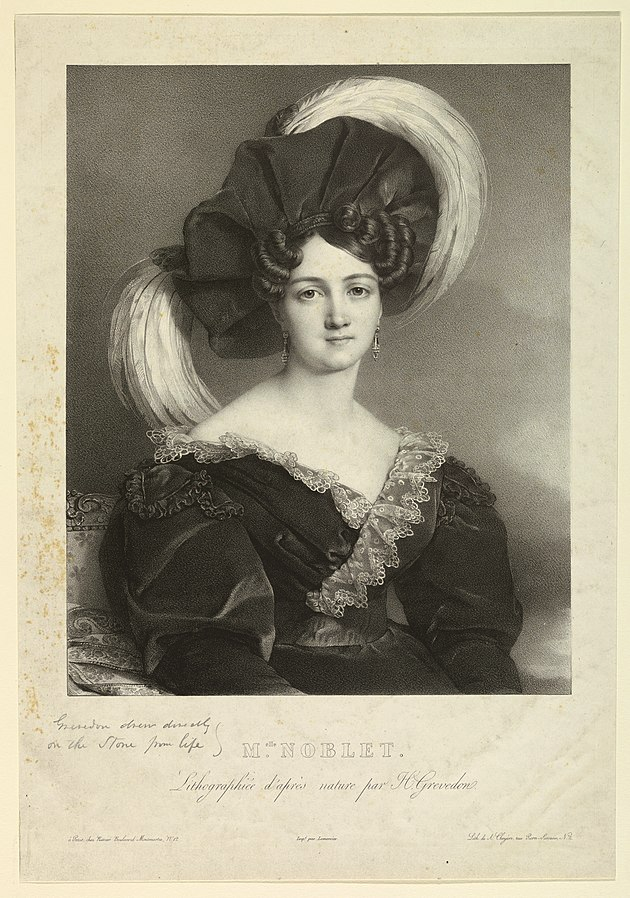
Hats were an essential accessory for women in the 19th and early 20th century. While hats were used as sun protection, they were also an important part of social etiquette. A woman going outside with an uncovered head in 19th and early 20th century Western culture was considered scandalous. Feathers were a highly desirable element in women’s fashions for hats in the 19th and early 20th century. Wild birds were the most sought after source of plumage for trimming stylish hats.
The indispensability of hats posed a problem for vegetarians and vegans in this era. Vegetarians were opposed to decorating hats with feathers on the grounds of animal cruelty. Vegetarian advocate, writer and philosopher Henry Stephens Salt condemned the practice of using bird feathers for millinery in Animals’ Rights Considered in Relation to Social Progress, originally published in 1892:
But if the fur trade gives cause for serious reflection, what are we to say of the still more abominable trade in feathers? Murderous indeed, is the millinery which finds its most fashionable ornament in the dead bodies of birds–birds, the loveliest and most blithesome beings in Nature! There is a pregnant remark made by a writer in the “Encyclopedia Britannica,” that “to enumerate all the feathers used in ornamental purposes would be practically to give a complete list of all known and obtainable birds.” The figures and details published by those humane writers who have raised an unavailing protest against this last and worst crime of Fashion are simply appalling in their stern and naked record of unremitting cruelty. (p. 67–68)
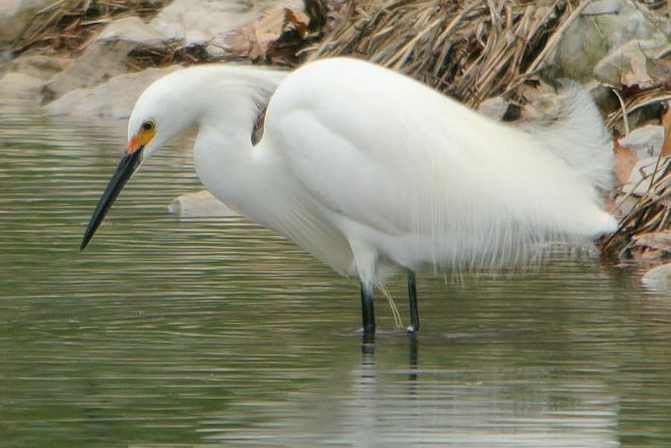
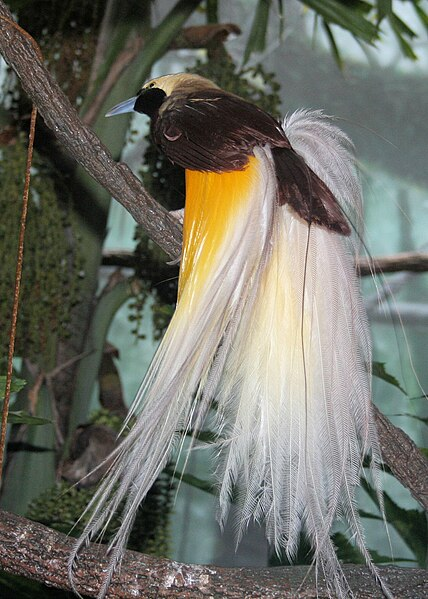
Snowy egrets, birds of paradise, herons, owls and countless other species of birds were hunted for their feathers and plumage. Ornithologist Frank Chapman conducted a “census” of birds seen on women’s hats, spotting over forty species of wild birds decorating their hats during two walks he took on Manhattan streets in 1886. Outrage at his findings sparked a desire for change and the beginning of other organizations that would also oppose the use of exotic feathers in millinery. Anti-vivisectionists and humanitarians also counted themselves among those seeking the end of plume-hunting.

.jpg)
Wealthy socialites with an interest in conservation also lent their financial and organizational support to the cause, forming the first bird protection societies. Bird protection societies, humanitarians and anti-vivisectionists shared a common goal with the vegetarians about the cruelty involved in the use of feathers in the hat-making industry. While these organizations did not require vegetarianism for their members, many members were also vegetarians.
The call to action for consumer behaviors to change was the primary goal of most bird-protection activists. An early form of the Audubon Society was created in Massachusetts in 1896 with the purpose of discouraging the purchase and sale of wild bird feathers. The founders of the society, Boston environmentalists, Harriet Hemenway and Minna B. Hall, hosted tea parties, distributed leaflets and organized lectures to further the cause of protecting wild birds. Hall and Hemenway’s efforts would inspire the creation of similar organizations across the United States.
The Royal Society for the Protection of Birds was the British counterpart to U.S. bird protection societies, founded in 1889 by Emma Williamson. Membership in RSPB grew to over 20,000 by 1898. The organization’s collective protests against wild bird feathers led to laws preventing their importation into Britain by 1921. Using similar tactics to their American Audubon society contemporaries, the RSPB used leaflets as well as their own publication Bird Notes and News to inform the public about the underlying harm in feathered hats.
Vegetarian societies also held lectures to raise awareness about plume hunting to encourage change in hat-buying habits. Humanitarian publications, like the Humane Advocate wrote against the use of the feathers in millinery, including these lines of poetry.
THE WINGED HAT
Angelina has a hat
With wings on every side;
Slaughter o’ the innocents
Those pretty wings supplied.
Sign of barbarity,
Sign of vulgarity –
That winged hat.
The little bird of beauty born,
With joy in every motion,
By cruel hands is slain and torn,
For vulgar whim and notion,
Oh, the barbarity,
Oh the vulgarity –
That winged hat. (p. 223)
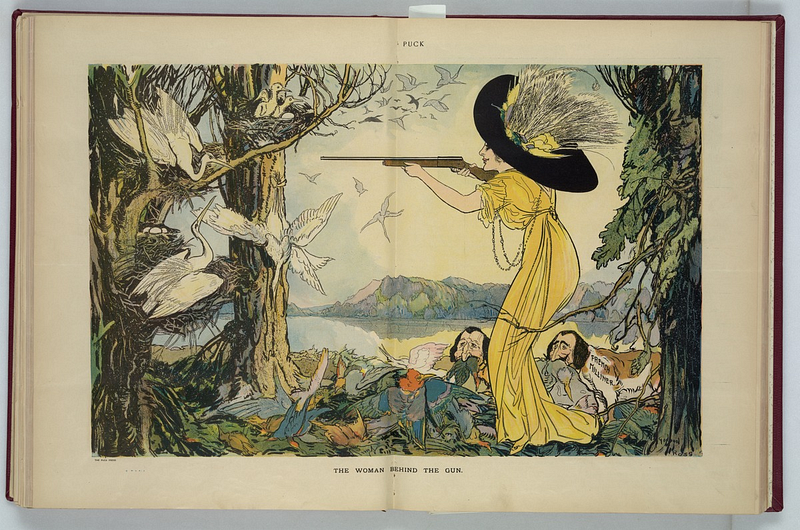
Contentions over feathered hats also reached mainstream publications. The Ladies Home Journal, likely reflecting the divided opinions and desires of their readers, featured feathered hats in their pages, while also publishing articles on behalf of the birds. An article in the form of a letter from the songbirds pleaded with the readers of the magazine to make laws to prevent the death of birds for the millinery trade.
“You have always made a law that no one shall kill a harmless song-bird or destroy our nests or our eggs. Will you make another one that no one shall wear our feathers, so that no one will kill us to get them? We want them ourselves. Your pretty girls are pretty enough without them.” (p. 14)
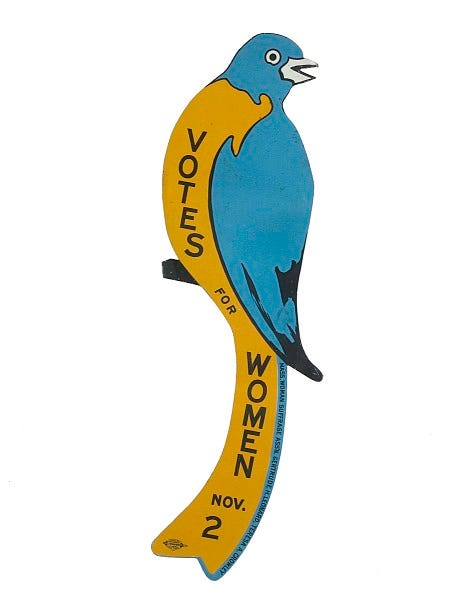
The blame for the deaths of countless wild birds was placed squarely on women, and their “murderous millinery”. While many birds died in the name of fashion, and the majority of milliners were women, men also killed thousands of birds for the sake of scientific inquiry. The sexism of 19th century bird protection efforts created an unusual catalyst for women’s further involvement in politics. The majority of bird protection organizations were founded and maintained by women. It was women’s participation in consumer boycotts of feathers that helped to make the first waves of change to eventual bird protection laws. Birds entered into not only symbolism of conservation and animal welfare activism, but appeared in suffrage support emblems, including bluebird pins issued by the Massachusetts Woman Suffrage Association.
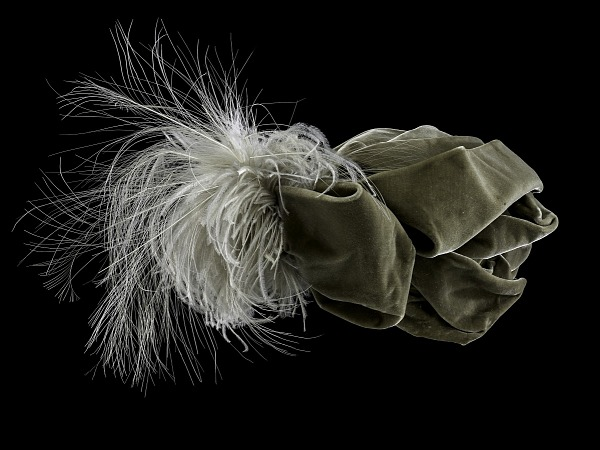
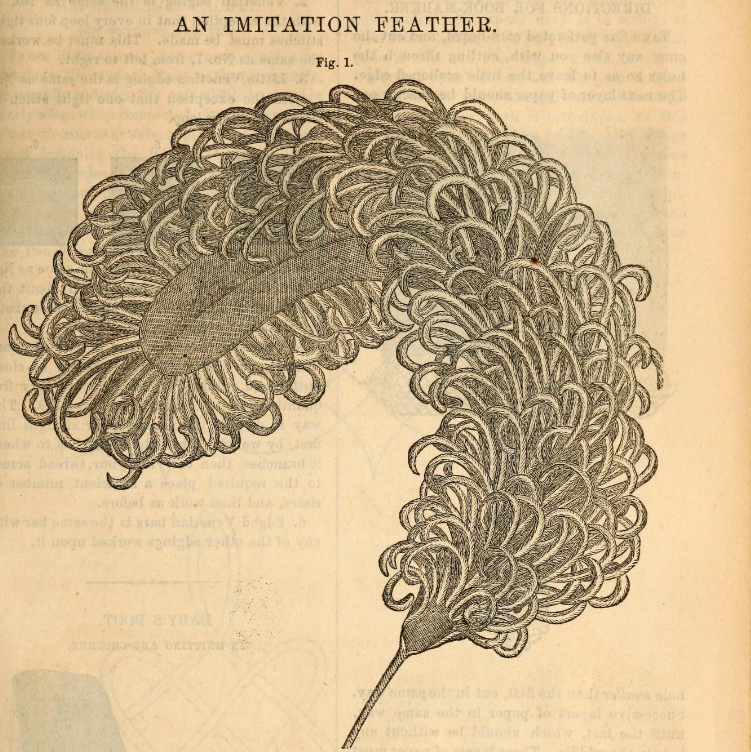
Alongside the protests and prose of the bird-protectors, experimentation with creating artificial feathers for millinery purposes can be seen throughout the 19th century. An early example of an imitation feather can be found in Godey’s Lady’s Book, a popular women’s magazine in the Victorian era. Likely developed for economy instead of animal rights, the suggested use for this “feather” created by precise fabric cutting was for trimming children’s hats. Vegetarians and others opposed to genuine feathers could have used a pattern like this to create false feathers at home to decorate their hats.
A patent was filed in 1859 to manufacture artificial feathers from palm leaves. The inventor described the potential uses of these imitation feathers in millinery:
I propose substituting in lieu of the natural feathers or plumes now used for ornamenting bonnets, and for other purposes, a feather or rather bunch of plumes made from palm leaves, making such plume or plumes either of one piece or several, and of a white or any color or shade of color, also giving them in the manufacture arched or curvilinear forms in order that the shadows or light and shade obtained by the separation of the leaves may render the whole a light and elegant ornament suitable for all articles or purposes for which natural feathers are now used. (p. 10)
Later in the 19th century, it seemed another inventor had also developed artificial feathers, the imitation plumes were described in a Pocket Dictionary of Dry-Goods originally published in 1896.
ARTIFICIAL FEATHERS: Artificial ostrich feathers are made of celluloid, rattan and silk, and are a comparatively good imitation of the original. Patented machines make the silk, the flue¹, the quill, and combine the flue and silk. The quilling machine takes an ordinary piece of rattan or celluloid and produces the quill in 15 seconds; the material is drawn between two grooved rolls. In the manufacture of the flues, the silk is stretched between two machines 75 feet apart, which wind, twist, cut and spin it into a flue. (p. 31)
The existence of these commercially produced imitations would end up further complicating the decisions of consumers seeking to avoid wild bird feathers. The intentional mislabeling of artificial feathers is an unusual quirk in fashion history, where the genuine article was passed off as an imitation. Sellers of feathers or feathered hats would sometimes market their millinery as artificial to persuade hesitant customers into making a purchase.
To avoid the intentionally mislabeled feathers and unknowingly fund the industry that hunted exotic birds for plumes, featherless millinery for bird protectors became the order of the day. The Vegetarian Magazine wrote favorably of English millinery styles being created without feathers.
English coat-makers and milliners are showing most artistic effects in garments and hats made without fur or feathers. The imitation furs which are offered by the English coat-makers are marvels of warmth and elegance. The millinery shown, without feathers, are works of delicate art and skill. (p. 22)
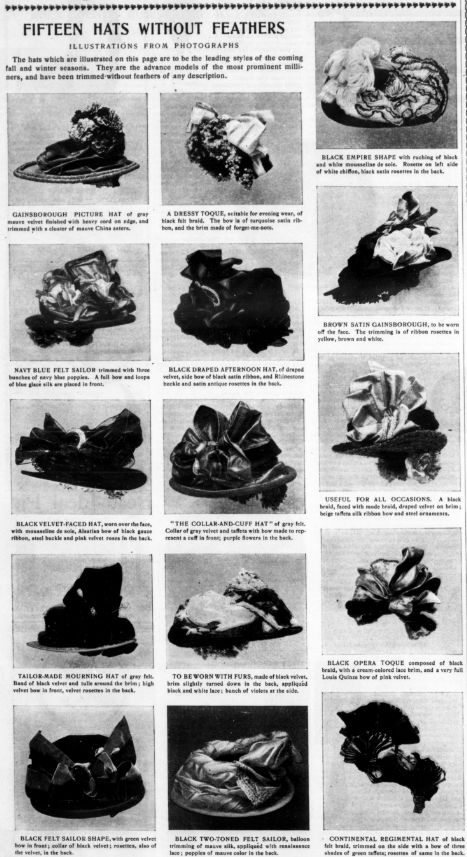
In addition to sometimes conceding to bird protection activists by publishing sympathetic articles to their cause, the Ladies Home Journal also featured featherless hat designs in 1898. Detailed illustrations of varied hat designs demonstrated options for the Victorian lady who was style conscious but cruelty-averse.
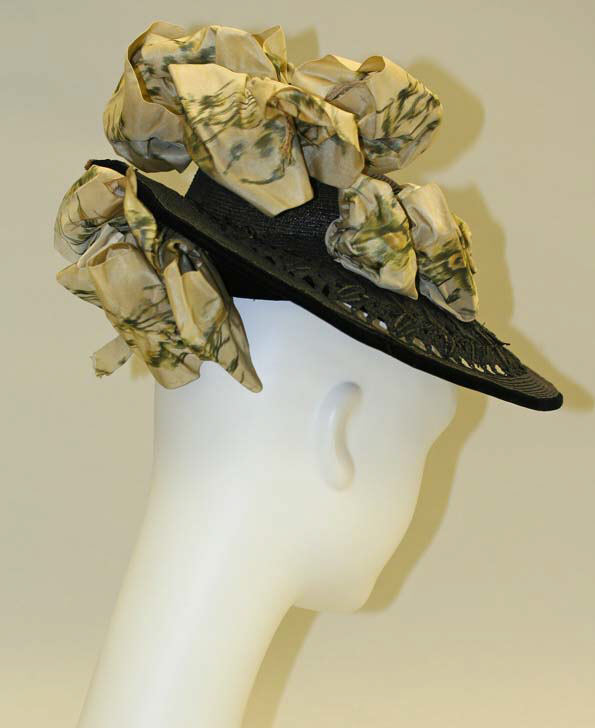
This museum piece dated to 1892 is an earlier example of featherless millinery, the straw hat is decorated only with ribbons.

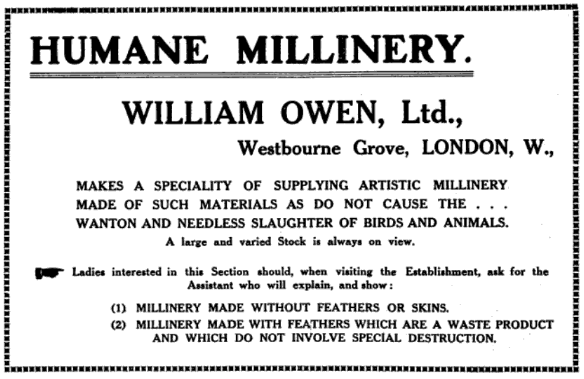
Exhibitions and humane fashion parades attempted to portray featherless millinery as stylish and appealing. Hats that did not use feathers derived from plume-hunting were sometimes dubbed “Audubonnets.” The Gardener’s Chronicle made suggestions of completely plant-derived millinery decor in the form of dried plants such as seeds and grasses, paired with artificial fruits and flowers in an article titled “Vegetarian Millinery”. Vegetarians could also find sources of humane millinery advertised in their periodicals, like this 1909 advertisement in Herald of the Golden Age.
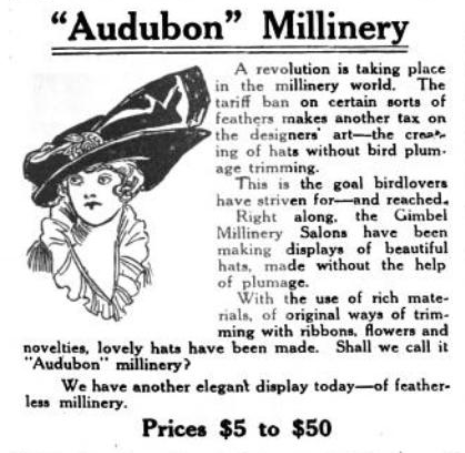
Featherless millinery extended beyond the pages of vegetarian periodicals, as evidenced by this advertisement for “Audubon Millinery” in the trade journal Merchant’s Record and Show Window.
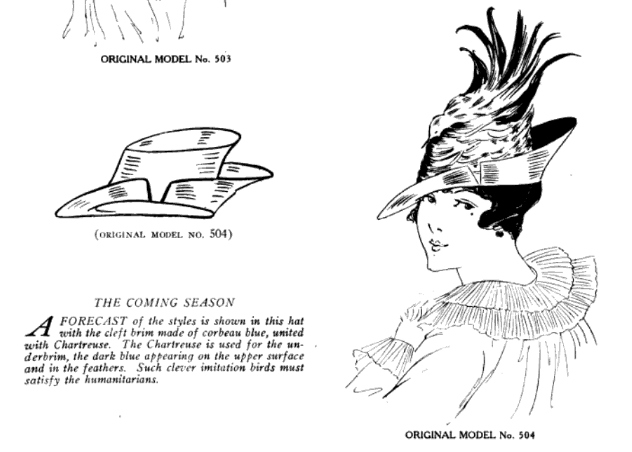
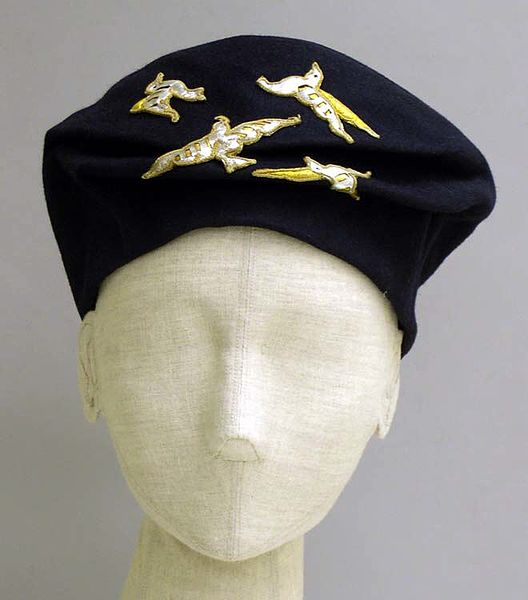
Fabrics sculpted into an imitation bird in this 1916 hat design from the Millinery Trade Review was intended to satisfy humanitarian customers.
The efforts of bird-protecting societies and vegetarians to agitate for changes in the use of feathers coincided with WWI’s demands for more practical head-wear, resulting in simpler hat designs with fewer feather decorations. High fashion design began to take notice of these societal shifts. In a 1913 interview with Paul Poiret indicated that fashion designer’s preference for simple lines extended to featherless hats. Forest and Stream magazine opined that Poiret’s feather-free designs would be the final blow to the feather industry. The author of the article claimed other designers would imitate Poiret’s work, claiming:
“As the great are followed by the lesser, so will the American milliner, with the French name, let this year’s hats go unfeathered, and so the rosette and doodad will destroy the feather trusts’ profits.” (p. 432)

The boycotts, along with other activism culminated in 1913, with the passage of the Weeks-McLean Law, also known as the Migratory Bird Act. This act banned the hunting and interstate transport of many species of wild birds once used in millinery. Emblematic of the changes of the Weeks-McLean law, this milliner’s guidebook from 1925 lists types of bird feathers, and notes that several exotic bird species are now off-limits for commercial sale. Additional laws to protect wild birds would follow later in the 20th century. The collective work of 19th and early 20th century vegetarians, anti-vivisectionists, humanitarians, and bird-protection societies led to the protection of endangered wild bird species. These different organizations with overlapping goals share a legacy of attempting to make animal cruelty go out of style.
Note:
- Flue refers to the branching part of an ostrich plume that makes up the full volume of the feather.
Thank you for reading!
If you love history, plants or the history of plants, consider supporting Plant Based Past by buying me a coffee!
For more vegan, vegetarian, and botanical histories, follow Plant Based Past on Medium.
You can sign up for email alerts to receive the next story when it becomes available, just by clicking the envelope icon.
Next Week: Sweet as Honey: A History of Honey Substitutes