avatarDan Pfeifer

Summary

The undefined website features the Hairy Woodpecker, detailing its appearance, diet, habitat, and interesting facts, as part of a series on bird species.

Abstract

The Hairy Woodpecker is the focus of Volume 4 in a bird spotlight series, characterized by its frequent visits to feeders, particularly for suet cakes. It closely resembles the Downy Woodpecker but is larger with a longer beak, and only the male has a red spot on the back of its head. These birds are widespread across the United States and Canada, often nesting in dead or dying trees, which they excavate for their nests. The article also shares intriguing facts, such as the Hairy Woodpecker's tendency to explore large cavities left by Pileated Woodpeckers for missed insects, and the record of a Hairy Woodpecker's longevity at nearly 16 years old. Additionally, the author invites contributions to their publication, "Gardening, Birding, and Outdoor Adventure."

Opinions

  • The author expresses a fascination with the Hairy Woodpecker, highlighting its regular presence at bird feeders and its unique behaviors.
  • The author seems to appreciate the natural behaviors of the Hairy Woodpecker, such as its resourcefulness in utilizing cavities created by other birds and its preference for nesting in dead trees.
  • The author values the importance of observing and understanding bird habits, as indicated by the invitation to contribute to their publication focused on gardening, birding, and outdoor adventures.

Bird Spotlight-Hairy Woodpecker

Volume 4 In a Series
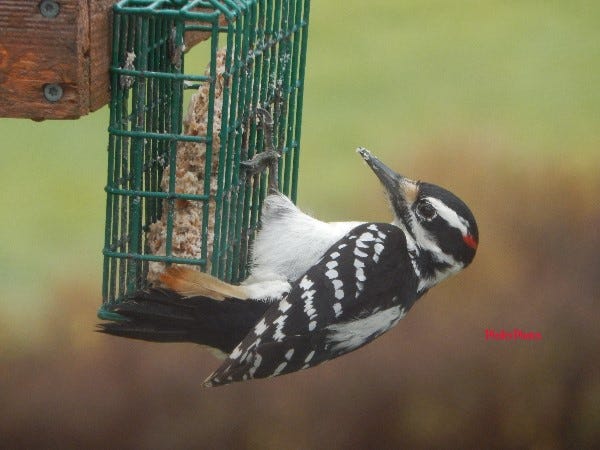
Hairy Woodpecker/Pfeifer Photo

These interesting birds are frequent visitors to my feeders. They normally can be found eating suet cakes. Sometimes they will sneak sunflower seeds. Most likely you will see them on your suet feeder or maneuvering around your backyard trees. In the wild, most of their diet consists of insects.

The Hairy Woodpecker is almost identical in appearance to the Downy Woodpecker. The main differences are the size of the bird and the size of the beak. They are larger and have a longer beak as compared to the Downy Woodpecker. The male has a red spot on the back of his head, and the female does not.

These birds can be found throughout the United States and Canada year-round. If you have a dead or dying tree in your yard, you may get them to nest there. They excavate their nests in a dead tree, and the nest is empty except for a few wood chips on the bottom to protect the eggs.
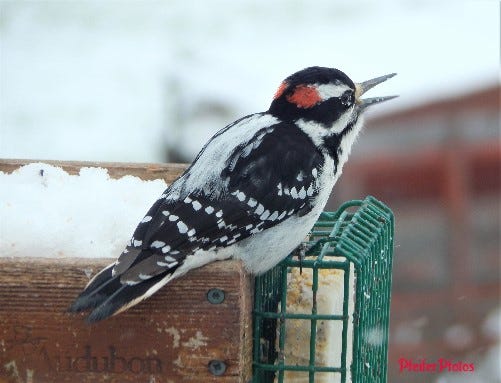
Hairy Woodpecker/Pfeifer Photo

Interesting Facts

These birds will sometimes investigate huge cavities created by Pileated Woodpeckers once they have moved on, finding insects that the larger woodpeckers missed.

The oldest recorded Hairy Woodpecker was almost 16 years old when re-captured and re-released in New York.

I have started a publication, let me know if you want to contribute:

Birds
Photography
Nature Writing
Outdoors
Homesteading
Recommended from ReadMedium