
Bird of Prey
Crystal Killer Eyes
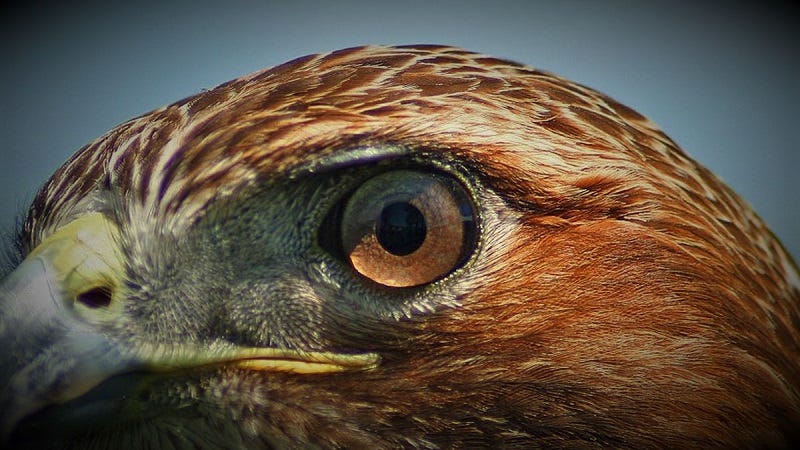
Hawk wings absolutely still Eyes of purest greed
Gliding, circling, up-wind, hunting, looking, meadow, hunger, gusts, clouds, two wing beats, banking, feathered hunger, airborne greed, survival of the keenest eyesight and shortest reaction time.
My own eyesight is not the best these days — although this year is 2020 it feels more like 1919 was the last time my eyes were 20/20 — but slow age-dimming notwithstanding, I did catch this large, majestic hunter up there, way up there, riding what winds move at that altitude, gliding and gazing down.
A hawk? An eagle? Actually, too high up for me to tell. Predator, that I could tell; which kind, not.
How well do these airborne hunters see? I asked Mr. Google. Who said:
All birds of prey have excellent long-distance vision, but eagles stand out. They can see with clear precision about eight times farther than humans can, allowing them to spot and focus in on a rabbit or other small animal at a distance of about two miles (spotting a rabbit from two miles up, or two miles away, I’m trying to get my head around this). While we, with 20/20 vision, can see a candle flame at that distance, a small animal camouflaged in its surroundings would be hidden from us.
Eagles can also quickly shift focus, allowing them to essentially “zoom” in on their prey. They also can see a wider range of colors than we can, allowing them to differentiate small changes in coloration on the ground and so, again, zoom in on their prey; they also see UV light.
As far as daytime vision goes, eagles, hawks, and falcons reign supreme. However, they don’t do as well during the night.
Owls do, though. These nighttime predators take the torch from eagles as soon as the sun goes down. Unlike many birds with eyes that sit at an angle, owl eyes face directly forward, giving them incredible binocular vision. Although their large eyes can’t move or roll like human eyes can, owls can move their heads nearly all the way around, allowing them to have a 270-degree range of vision (in both directions, mind you) without moving their bodies.
Their large, tube-shaped eyes contain significantly more rods than human eyes, which allow them to be far more sensitive to light, and depending on the surrounding light, their irises widen to allow more light to reach their retina as the light dims. Because the iris adjusts, owls can also see during the day (unlike other nocturnal animals that can only see well at night), but their day vision is slightly blurry and they cannot see colors well.
Also, and this is key, owls and other animals with good night vision sport a reflective layer of the choroid (the pigmented vascular layer of the eyeball between the retina and the sclera) known as the tapetum lucidum. This thin reflective layer allows light to bounce back into the animal’s eye (through the retina) after it’s already passed through once, giving the animal two chances to collect an adequate amount of light to see with clarity even in the near dark.
Eyes like telescopes with well-polished mirrors catching even the faintest star.
This layer, adds Mr. Google, is also what sometimes make their eyes (like a cat’s) shine in the dark, especially if you shine a light on them.
How high up was this bird I saw? Perhaps a quarter of a mile, a little higher perhaps; meaning, if it was an eagle, it could probably spot a field mouse on the ground, no problem. This is hard even to imagine.
Am I really right (in my wolfku) in calling its eyes, “the eyes of purest greed”? True, they scan for edibles, killable edibles, but greed, when I reflect on it now, seems to be a distinctly human condition. Animals kill to eat, well, in the main; the wolverine often kills for pleasure, as does the hyena.
As an aside, the laps in northern Sweden have problems with both wolves and wolverines. They hate but understand the wolf, who kills to eat, and if a pack of wolves attack a reindeer flock, they will only kill one animal, the one they will then eat. If, on the other hand, a wolverine (who normally hunts alone) attacks a flock or reindeers, it will kill as many animals as it can, just for the sheer wolverine joy of killing, even though it can hardly eat more than a slice or two of one.
Is that greed though? I guess it’s an animal manifestation of greed, but I don’t think the wolverine has a say in the matter, it’s all instinct. Not so with human greed, it’s consumerism run amok, and it’s voluntary. Humans can cease to greed; I don’t think the wolverine can.
Nor the hawk or the eagle, gliding, circling, up-wind, hunting, looking, meadow, hunger, gusts, clouds, two wing beats, banking, feathered hunger, airborne greed, survival of the keenest eyesight and shortest reaction time.
© Wolfstuff


