

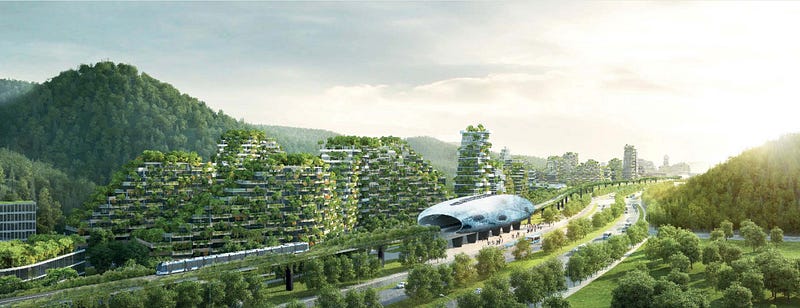
Biomimetic architecture
Through its infinite complexity, nature is an instructive and inspirational influence that can expand the aesthetic horizons of the building arts and confirm the inalienable right of humanity to try to salvage a place on this planet before it’s too late. The mission now in architecture, as in all human endeavour, is to recover those fragile threads of connectedness with nature that have been lost for most of this century. The key to a truly sustainable art of architecture for the new millennium will depend on the creation of bridges that unite conservation technology with an earth-centric philosophy and the capacity of designers to transform these integrated forces into a new visual language.
— James Wines (2000: 237)
There are countless examples of architects taking inspiration from biology. The Uluru- Kata Tjuta Cultural Centre in Australia, designed by Gregory Burgess Architects, mimics the interwoven bodies of two battling snakes. Foster & Partner’s Swiss Re Headquarters in London, known as the ‘Gherkin’, is a 40-storey tower inspired by marine organisms called ‘glass sponges’. These suck in water at the bottom and expel it at the top to filter nutrients; the building’s ventilation system mimics this flow.
Many other internationally recognized architects often rely on zoomorphic inspiration for the designs, processes and concepts that shape their buildings. Other internationally recognized architects who frequently rely on zoomorphic inspiration for the designs, processes and concepts that shape their buildings are Santiago Calatrava, Michael Sorkin, Frank Gehry, Renzo Piano, and Nicholas Grimshaw (Martin, 2004; Aldersey-Williams, 2003).
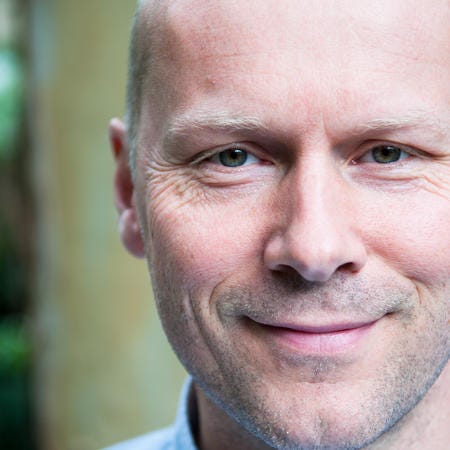
While many of them are inspired by natural and biological forms, Michael Pawlyn’s approach to biomimicry in architecture is to focus on what he can learn from biological processes to make buildings more efficient by modelling nature’s closed-loop, renewable energy, no-waste systems in the design of buildings (2011).
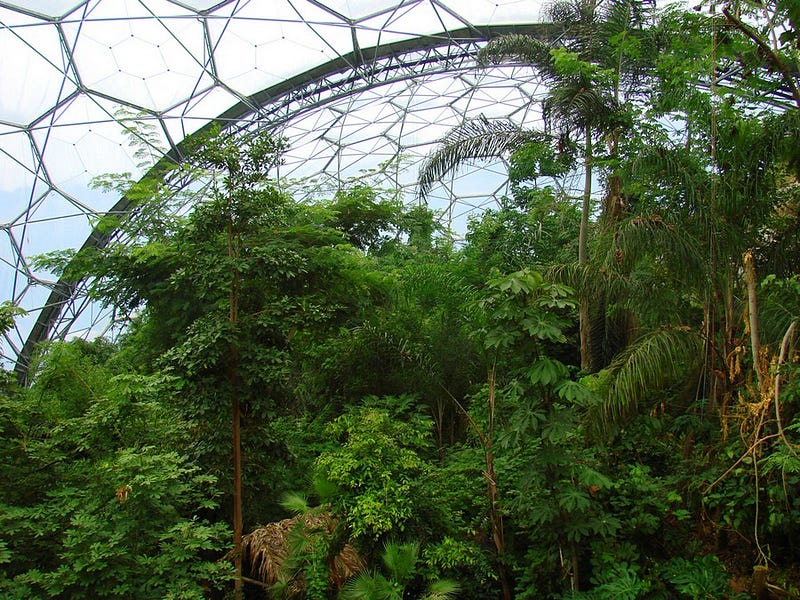
In helping to design the indoor environments for the Rainforest and Mediterranean biome exhibitions at the famous Eden Project, Pawlyn learned a lot about how water and energy cycle through natural ecosystems and how processes and functions in ecosystems are integrated and interlocking to create synergies. His design for the ‘Sahara Forest Project’ (Figure 16) makes use of such biomimicry thinking.
The bold proposal aims not only to generate large amounts of renewable energy based on concentrated solar power and to desalinate large amounts of seawater. It integrates these functions through the use of seawater-cooled greenhouses for the horticultural cultivation of food and biomass, creating a long-term strategy to reverse desertification and regenerate productive ecosystems where the Sahara Desert borders the sea.
The project is on its way to implementation. A pilot test and demonstration centre has been built in Qatar in collaboration with two giant fertilizer companies, the Norwegian Yara ASA and its Qatari joint-venture partner Qafco. It would be good to keep in mind that in the long term the fertilizers used in such a facility will also have to be produced from renewable sources and with renewable energy. Nevertheless, this experiment at scale will give us many opportunities to learn. It will teach us how to ask the right questions in an attempt to re-green the world’s deserts.
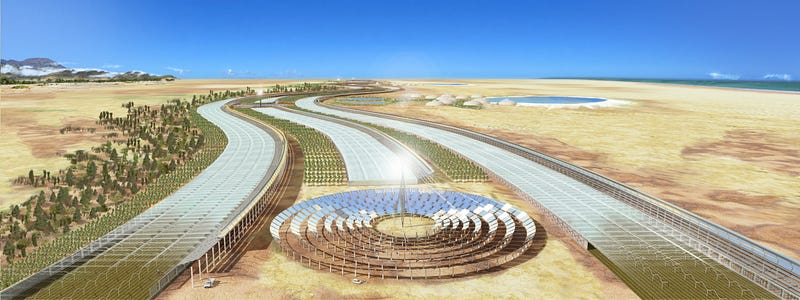
Growing vegetables and biomass in the desert with external fertilizer inputs, but also using renewable energy and innovative desalination and horticulture approaches, can be considered a Horizon 2 stepping-stone technology, offering us important opportunities to innovate even more closed-loop systems that are based, as much as possible, on organic fertilizers and on-site nutrient cycling.
Conventionally, human-made systems tend to be fossil-fuel dependent, linear and wasteful, mono-functional and engineered towards maximising one goal. Here the aim is to pursue a different paradigm — that is demonstrated by mature ecosystems which run on current solar income, operate as zero waste systems, are complex and interdependent, and have evolved toward an optimised overall system. The Pilot Project will demonstrate concentrated solar power, seawater-cooled greenhouses, evaporator hedges creating conditions for restorative agriculture, halophyte cultivation and algae production in an interdependent cluster that achieves significant increases in productivity for all elements of the system.
— Michael Pawlyn (2014)
Human beings, as expressions of life-generating-conditions-conducive-to-life, are capable of creating designs that are both restorative and regenerative. We can go beyond simply not doing any harm and start to regenerate health, resilience and thriving communities everywhere. This is the promise of biologically and ecologically inspired design and architecture.
The Eastgate Centre is a multi-storey office building in the Zimbabwean capital Harare. It uses a passive cooling system inspired by the way termites (Macrotermes michaelseni) cool their mounds. Mick Pearce and engineers at Arup designed the building to use only a tenth of the energy normally needed to cool a building of this size in the hot African climate (Biomimicry 3.8, 2014b). The Swedish architect Anders Nyquist of EcoCycleDesign applied a similar termite ventilation to the Laggarberg School in Timrå, Sweden.
The visionary architect and writer Jason McLennan, a Buckminster Fuller prize winner and Ashoka Fellow, created the Living Building Challenge in 2006 as a new kind of building certification system that goes beyond international or national standards like LEED or BREAM and sets a standard for regenerative architecture based on biologically inspired and ecologically informed design. There are currently 192 projects on four continents spanning a range of building types. The ‘Living Building Challenge 3.0’ challenges us to ask some fundamental questions about architecture and design:
What if every single act of design and construction made the world a better place?
What if every intervention resulted in greater biodiversity; increased soil health; additional outlets for beauty and personal expression; a deeper understanding of climate, culture and place; a realignment of our food and transportations systems; and a more profound sense of what it means to be a citizen of a planet where resources and opportunities are provided fairly and equitably?
— International Living Future Institute (2014: 7)
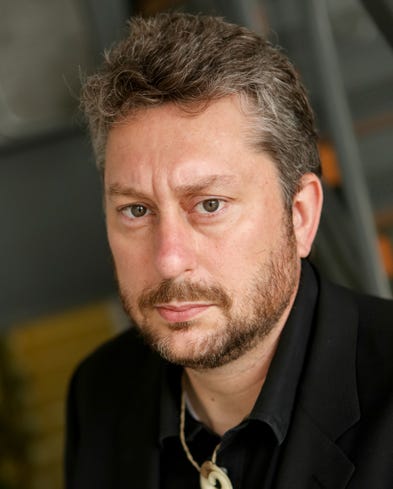
McLennan’s vision is to take what has already been learned through previous versions of the Living Building Challenge and incorporate these insights and new questions within the framework of the Living Future Challenge. McLennan regards the Living Future Challenge as “an opportunity to rethink and redesign all our systems and provide a vision for a truly regenerative society” (Living Future Institute Australia, 2014). He is a driving force in the transition towards a regenerative culture who has inspired architects around the world to take up his challenge to create buildings conducive to life.
…
[This is an excerpt of a subchapter from Designing Regenerative Cultures, published by Triarchy Press, 2016.]
—
If you like the post, please clap AND remember that you can clap up to 50 times if you like it a lot ;-)!
Daniel Christian Wahl — Catalyzing transformative innovation in the face of converging crises, advising on regenerative whole systems design, regenerative leadership, and education for regenerative development and bioregional regeneration.
Author of the internationally acclaimed book Designing Regenerative Cultures