avatarMelissa Soderston

Free AI web copilot to create summaries, insights and extended knowledge, download it at here

12865

Abstract

upposed pillars of the environmental establishment, have both discussed mobile biomass facilities and biomass chargers with what amounted to glee.</p><p id="22d8">Generally, I receive some version of “Well, this is just one small project” or “surely this is better than the alternative” when discussing either logging or biomass with local agencies, such as these quotes regarding biomass from a local sustainability department:</p><p id="342f"><b>“It’s a worthy offset in my opinion because biogenic carbon is not causing climate change in the big picture.”</b></p><p id="b33d">And</p><p id="7381"><b>“You are commenting on a wider issue than we engage in. For our little part, we are just talking about green waste that comes off of residential properties that gets trucked away in the current model. To your point, I think anyone would agree that any given application of biomass energy technology is not a blanket solution everywhere. It’s all nuanced and site specific. In fairness, we are not the right jurisdiction/agency/entity to engage if you want to talk about those other issues.”</b></p><p id="6b9b">Most of the statements agencies have been making regarding biomass are misguided — failing to address social, equity and proliferation issues, like the quotes above. Others are outright factually misleading or incorrect.</p><p id="7e13">Consider this: Were all these projects across local jurisdictions to be approved, how many separate biomass operations would exist within the Tahoe Basin? It seems rather irresponsible to approach these as singular projects, “just one small part”, in such an important, connected ecosystem. Each of these “small parts” will affect the whole basin. Once extracted from the ecosystem, how would this “material” be transported to these plants? Will this really reduce our VMT’s (Vehicle Miles Traveled) and emissions, or are more small loads traveling on basin roads actually a larger impact than large loads trucked out of the basin? Why not the somewhat planet-friendlier option of chipping and returning the material to replenish the soil and retain moisture? Biomass as carbon neutral has been widely debunked, and the <a href="https://www.theguardian.com/environment/2021/oct/04/biomass-plants-us-south-carbon-neutral">social justice harms</a> are immense, with plants built virtually on top of already marginalized communities across the Southern US, spreading ash and sawdust and pollution across neighborhoods. How will emissions and pollution from these “small-scale” plants be measured, tracked, reported and cross-referenced for accumulative effects across the basin if they are considered separate from one another? We also have two airports in the Tahoe Basin, one in Truckee and one in South Lake Tahoe, facilitating sometimes 100’s of private jet trips a <i>day</i> during the <a href="https://americancenturychampionship.com/">American Century Celebrity Golf Championship Tournament</a>, hosted yearly on the South Shore of Lake Tahoe. Both were proposed biomass site options. Why not just cut emissions by disallowing private jet travel into the Basin? I’ve also noticed the conspicuous lack of rooftop solar at these airports.</p><p id="88ba">That is not even to address two of the most significant concerns. First, we must consider how approving these projects in an area so “environmentally conscious” as the Tahoe Basin is imagined to be will affect overall market confidence, contributing to acceptance and complacency surrounding biomass in much less protected areas, and also regarding GSNR’s industrial-scale plants. And what of removing all this “woody biomass” from the environment in general? What is being called “overgrowth” or “hazardous” or “ladder fuels” is actually serving many essential roles. Birds nest in shrubs, beneath downed branches and trees, and among leaf litter as well as in burned and snag trees, which are of particular importance to nesting woodpeckers which require hundreds of wood-boring beetles <i>daily</i> to support their nest. Coyotes often create their dens beneath dense Arroyo Willow along riverbanks. Ground debris and small vegetation help retain immense amounts of groundwater and moisture, actually often slowing fire, and serving a vital purpose during drought. Fungal colonies cannot thrive, or even survive without ground debris and decay. Erosion protection, lower ambient temperatures, etc. And of course their most essential role — the replenishment of nutrients to the soil as they break down upon death.</p><figure id="20fe"><img src="https://cdn-images-1.readmedium.com/v2/resize:fit:800/0*NgK35TP2inRbKOva"><figcaption></figcaption></figure><p id="3a5e">Another major point is that forests are meant to experience fire, and that grasslands are actually <i>just as likely</i> to experience fires with catastrophic loss of life and property, and grass fires can <a href="https://www.yahoo.com/news/plant-everywhere-fueling-growing-risk-080029246.html">spread <i>much</i> more rapidly</a> than forest fire. No amount of “thinning” or even outright clearcutting will slow or prevent wind and climate-driven fire. You cannot stop embers which travel miles, jumping every contingency line, and alighting spot-fires ahead and behind the fire lines, alighting on wood-shingle roofing and in leaf-filled gutters, flattening entire towns in mere minutes. Both <a href="https://www.hawaiinewsnow.com/2024/03/20/lahaina-disaster-highlights-lack-safety-equipment-fire-training-maui-officers/">Lahaina</a> and just last month the <a href="https://en.wikipedia.org/wiki/Smokehouse_Creek_Fire">Smokehouse Creek Fire</a>, the largest in Texas history and<i> </i>it started in <i>FEBRUARY</i>, burned through grassland. Why would we want to turn our forests <i>into</i> grasslands?</p><p id="f4dc">Logging, fire suppression, overdevelopment, overconsumption, and all other forms of just plain old bad management and industry have brought us to this critical moment. The hubris involved in believing that we can continue to cut, suppress, “thin”, build and destroy our way out of current situations is frightening and driven by intense lobbying. Many in our communities have already experienced this intense lobby; have seen the abuse and harm with which these industries come. I grew up in Amador County, CA, former long-term home of a large Sierra-Pacific Industries facility, storing acre upon acre of once beautiful mature, healthy trees. When they finally closed the doors on that site, it decimated the local economy and unemployment skyrocketed for years. We cannot afford — financially, emotionally or sustainably — another round of industry boom and bust.</p><p id="61e7">Until we begin to allow natural processes, fire regimes and ecosystems to recover from our abuse, we cannot expect any improvement to either ecosystem health or climate and fire conditions. Instead, we need to act in a completely different way. Nearly everyone will agree that our national infrastructure is in dire shape with little hope of withstanding the growing effects of a changing climate. Far beyond fire country, where I reside, these deficiencies must be addressed. Fire, flood, sea level rise, hurricane strength, tornado frequency, heat waves, drought, crop failure — ALL of these and more are issues of equal and growing concern. Yet billions of dollars were allocated<i> just in California</i> in 2023 for “forest management” and “fire suppression and prevention” alone. Coupled with the over $2 billion tax-payers are funding for one single lithium mine, how much infrastructure could have been improved with that amount? How many public transportation systems funded?</p><p id="3d22">The discrepancy in funding between industry and infrastructure is astounding; it would be laughable if it wasn’t so important to our very survival. There are many who still want to debate the efficacy of “thinning” and “forest health”, grazing and biomass, EV’s and industrial solar and wind as “fixes” for the problems we face. Many of these debaters are from those agencies and industries which are likely imagining significant hits to their budgets. While I could talk about the science all day (and firmly believe that evolved ecosystems are far better off without human intervention) I really don’t even find that debate necessary.</p><p id="5600">With the information we already have regarding our failed infrastructure and the risks of climate change, combined with the knowledge that these ARE fire-adapted ecosystems, plus the clear statements by Cal-Fire, USFS and our insurance companies that we cannot fight extreme fire and that home and infrastructure hardening is the ONLY way to protect life and property, we know what we need to do. Bob Horton, Senior Director of Research and Policy at the Western Fire Chiefs Association said recently:</p><p id="ed99"><a href="https://oregoncapitalchronicle.com/2024/02/26/oregon-homeowners-face-soaring-premiums-few-property-insurance-options-over-wildfires/"><b>“Investing in home and community hardening is the best option state leaders have to lessen the pain of a chaotic insurance market and increasing wildfire risks with climate change.”</b></a></p><p id="2e76">Why continue to funnel TRILLIONS into industrialized ecosystem and cultural site destruction, or “new” technologies that just involve paving over more habitat or burning new things as energy, rather than public transportation, infrastructure hardening and rooftop solar?</p><p id="145c">When one looks at the biggest picture — these thousands upon thousands of projects, millions upon millions of acres — it becomes clear that what we are doing is causing great harm while providing only short-term “solutions” that will never add up to long-term results in safety, sustainability or planet health. There is no chance of hardening our infrastructure or creating truly Firewise communities without a significant shift of funding into these programs, which requires the end of extractive industry handouts. While many still fear a loss of jobs and funding along with this shift, that is in no way the case. Current workforces can and should be redirected towards infrastructure hardening and our local economies would be stimulated in numerous ways — everything from trade schools to hemp production — offering much safer, higher-paying jobs closer to home. The long-term security (job security, life, fire, climate…) as well as cost savings and other benefits cannot be quantified.</p><p id="bcbc">On the other end, it cannot be overstated how little we understand the ways in which current policies will affect these ecosystems for the long-term, or how the (now certain) 2 degrees of warming is going to change them, no matter how they are “managed”. We are very confident now in saying that former logging, industrial mines, coal powered plants and other forms of land abuse were ill-advised, greed-driven mistakes. Why should we accept now that current approaches will somehow magically work if we simply label them “lithium batteries” or “forest health” or “solar farm” or “biomass”? Biomass is actually <a href="https://www.biologicaldiversity.org/campaigns/debunking_the_biomass_myth/pdfs/Forest-Bioenergy-Briefing-Book-March-2021.pdf">more polluting</a> per unit of energy produced than <b><i>coal</i></b>. Perhaps that is because they are essentially the same thing — biogenic carbon. They both store carbon and release that carbon when burned. The difference being that “woody biomass” is <i>much</i> less energy dense than both coal and LNG, meaning that it requires much more combustion to produce the same amount of energy. To say that somehow because trees will “grow back” that biomass is “carbon neutral” is simply false. It takes a very long time for trees to “grow back”, if they ever do, meaning that while we are burning they aren’t storing as much, leaving us with an incredible carbon debt. Much like coal when left in the ground, if left to decay naturally, “biomass” would provide long-term carbon storage, only slowly releasing that carbon. Logging releases massive carbon and water stores into our atmosphere <i>instantly</i>, and then again when wood is burned. We would be laughing hysterically were someone to propose we begin opening coal powered plants again. Why would we think burning <i>anything</i> for power was the path to a “green future”?</p><p id="861a">Likewise for paving or bulldozing or digging up our deserts. Desert flora stores enormous amounts of carbon, within vast underground root systems, and in many cases these plants actually live far <i>longer</i> than our carbon-storing trees. We need to allow natural processes to govern these spaces as our planet continues to warm, whatever that new normal will be; at the very very minimum until we can determine how they are being affected already, and what “nat

Options

ural processes” will even be at 2 or 3 or even 5 degrees of warming. What does a “healthy” forest look like at 4 degrees Celsius above pre-industrial temperatures? How can we say what a “sustainable” timber harvest quota is today without knowing what our forests will look like in just a few decades? How will composition and dispersion naturally progress? How much natural die-off will occur?</p><p id="b12d">Anything we do to our wild spaces today cannot be reversed without decades or centuries of time, if ever. In this rapidly changing climate we really have no clue what we can truly expect to happen completely outside of our control. We cannot compete with physics. Generations of our potential or real grandchildren could live without ever knowing what an untouched, unmarred landscape spreading to the horizon looks like, if they are even able to exist for that long. Never hear the chirp of frogs in the thousands, or watch the sky be darkened by endless flocks of migrating birds. Hear wind roaring high through massive, swaying redwoods. Stand in awe as unnamed colors explode across the desert to warm the cool morning earth beneath their bare toes. Feel the spray of an ocean where they can swim amongst neon coral, rather than towel off the stinky slick of oil or make room amongst trash for a spot to lie on the shore.</p><p id="a359">When has an industrial focus ever served our communities, the greater good, or the environment? They no longer even attempt to hide their “profit margins or bust” attitude or the feeling that they bear no responsibility for finding solutions that work. We can do better, and we must start yesterday. Tell those in power wherever you live that it is time to end the destruction, and to focus all of our efforts and resources on our most effective solutions. Infrastructure hardening against natural disasters of all types. Ensuring crop security and water supplies. Rooftop solar and wind. Mass public transportation. And what is likely the very most impactful thing we can do, yet also the most simple — <b><i>the preservation as wilderness of ALL of our remaining undeveloped land and standing mature trees, already both far too uncommon and disappearing before our very eyes.</i></b></p><h2 id="eb4d">Links/References:</h2><p id="88de"><a href="https://www.homelandsecuritynewswire.com/dr20240307-climate-change-poses-serious-national-security-threat"><b>https://www.homelandsecuritynewswire.com/dr20240307-climate-change-poses-serious-national-security-threat</b></a></p><p id="23b7"><a href="https://apnews.com/united-states-government-c119aa0ef87446108abd2aa637e91b7f"><b>https://apnews.com/united-states-government-c119aa0ef87446108abd2aa637e91b7f</b></a></p><p id="4819"><a href="https://nevadacurrent.com/2024/03/21/solar-power-project-threatens-prime-desert-tortoise-habitat-conservationists-warn/"><b>https://nevadacurrent.com/2024/03/21/solar-power-project-threatens-prime-desert-tortoise-habitat-conservationists-warn/</b></a></p><p id="25c5"><a href="https://www.theguardian.com/us-news/2023/may/21/solar-farms-energy-power-california-mojave-desert"><b>https://www.theguardian.com/us-news/2023/may/21/solar-farms-energy-power-california-mojave-desert</b></a></p><p id="65a4"><a href="https://www.doi.gov/pressreleases/interior-department-proposes-second-offshore-wind-sale-gulf-mexico"><b>https://www.doi.gov/pressreleases/interior-department-proposes-second-offshore-wind-sale-gulf-mexico</b></a></p><p id="2a11"><a href="https://www.nrdc.org/bio/amy-mall/5-key-reasons-stop-mountain-valley-pipeline"><b>https://www.nrdc.org/bio/amy-mall/5-key-reasons-stop-mountain-valley-pipeline</b></a></p><p id="ca6d"><a href="https://www.npr.org/2023/05/31/1179201992/mountain-valley-pipeline-west-virginia-debt-ceiling-deal"><b>https://www.npr.org/2023/05/31/1179201992/mountain-valley-pipeline-west-virginia-debt-ceiling-deal</b></a></p><p id="380a"><a href="https://www.theguardian.com/us-news/2023/oct/13/native-americans-1865-massacre-lithium-mine-thacker-pass"><b>https://www.theguardian.com/us-news/2023/oct/13/native-americans-1865-massacre-lithium-mine-thacker-pass</b></a></p><p id="07b3"><a href="https://www.protectthackerpass.org/the-history-of-thacker-pass/"><b>https://www.protectthackerpass.org/the-history-of-thacker-pass/</b></a></p><p id="1a37"><a href="https://www.thenation.com/article/activism/thacker-pass-mine-protest/"><b>https://www.thenation.com/article/activism/thacker-pass-mine-protest/</b></a></p><p id="a5a7"><a href="https://www.reuters.com/markets/commodities/lithium-americas-get-226-bln-us-doe-loan-nevada-mine-2024-03-14/"><b>https://www.reuters.com/markets/commodities/lithium-americas-get-226-bln-us-doe-loan-nevada-mine-2024-03-14/</b></a></p><p id="820d"><a href="https://www.fs.usda.gov/news/releases/usda-announces-43-million-investment-advance-innovation-in-wood-products"><b>https://www.fs.usda.gov/news/releases/usda-announces-43-million-investment-advance-innovation-in-wood-products</b></a></p><p id="745f"><a href="https://www.usda.gov/media/press-releases/2024/03/14/usda-outlines-vision-strengthen-american-bioeconomy-through-more"><b>https://www.usda.gov/media/press-releases/2024/03/14/usda-outlines-vision-strengthen-american-bioeconomy-through-more</b></a></p><p id="21fc"><a href="https://www.reuters.com/world/us/us-unveils-solar-energy-plan-western-public-lands-2024-01-17/"><b>https://www.reuters.com/world/us/us-unveils-solar-energy-plan-western-public-lands-2024-01-17/</b></a></p><p id="a347"><a href="https://www.doi.gov/pressreleases/fact-sheet-president-biden-take-action-uphold-commitment-restore-balance-public-lands"><b>https://www.doi.gov/pressreleases/fact-sheet-president-biden-take-action-uphold-commitment-restore-balance-public-lands</b></a></p><p id="0556"><a href="https://www.scientificamerican.com/article/grand-canyon-gains-new-million-acre-monument/"><b>https://www.scientificamerican.com/article/grand-canyon-gains-new-million-acre-monument/</b></a></p><p id="177a"><a href="https://www.grandcanyontrust.org/blog/uranium-mine-starts-new-grand-canyon-monument"><b>https://www.grandcanyontrust.org/blog/uranium-mine-starts-new-grand-canyon-monument</b></a></p><p id="9ea8"><a href="https://www.hcn.org/articles/south-politics-a-reality-check-on-bidens-30-by-30-conservation-plan/"><b>https://www.hcn.org/articles/south-politics-a-reality-check-on-bidens-30-by-30-conservation-plan/</b></a></p><p id="a84d"><a href="https://www.savetheredwoods.org/"><b>https://www.savetheredwoods.org/</b></a></p><p id="4fb9"><a href="https://www.msn.com/en-us/news/us/the-shadowy-history-behind-the-fight-to-save-the-redwoods/ar-AA1ffFEM"><b>https://www.msn.com/en-us/news/us/the-shadowy-history-behind-the-fight-to-save-the-redwoods/ar-AA1ffFEM</b></a></p><p id="b962"><a href="https://grist.org/energy/logging-biomass-nature-conservancy/"><b>https://grist.org/energy/logging-biomass-nature-conservancy/</b></a></p><p id="999f"><a href="https://www.thewildlifenews.com/2024/03/14/now-or-never-logging-video-timber-industry-propaganda/"><b>https://www.thewildlifenews.com/2024/03/14/now-or-never-logging-video-timber-industry-propaganda/</b></a></p><p id="4dec"><a href="https://wildfiretaskforce.org/"><b>https://wildfiretaskforce.org/</b></a></p><p id="d3f2"><a href="https://goldenstatenaturalresources.com/"><b>https://goldenstatenaturalresources.com/</b></a></p><p id="234e"><a href="https://www.rcrcnet.org/"><b>https://www.rcrcnet.org/</b></a></p><p id="3107"><a href="https://www.visittuolumne.com/"><b>https://www.visittuolumne.com/</b></a></p><p id="d7ca"><a href="https://www.lassencounty.org/visiting"><b>https://www.lassencounty.org/visiting</b></a></p><p id="c70d"><a href="https://www.desmog.com/2024/03/04/wood-pellet-giant-drax-targets-california-forests/"><b>https://www.desmog.com/2024/03/04/wood-pellet-giant-drax-targets-california-forests/</b></a></p><p id="4a01"><a href="https://www.biofuelwatch.org.uk/2024/drax-pinewells-investigation/"><b>https://www.biofuelwatch.org.uk/2024/drax-pinewells-investigation/</b></a></p><p id="c846"><a href="https://dogwoodalliance.org/2022/01/fires-at-wood-pellet-facilities-what-you-need-to-know/"><b>https://dogwoodalliance.org/2022/01/fires-at-wood-pellet-facilities-what-you-need-to-know/</b></a></p><p id="bd95"><a href="https://www.kcra.com/article/crews-battle-fire-at-a-lumber-mill-in-amador-county/40711097"><b>https://www.kcra.com/article/crews-battle-fire-at-a-lumber-mill-in-amador-county/40711097</b></a></p><p id="4f58"><a href="https://nevadacurrent.com/2024/03/19/lake-tahoe-remains-murky-after-25-years-and-a-2-9-billion-investment/"><b>https://nevadacurrent.com/2024/03/19/lake-tahoe-remains-murky-after-25-years-and-a-2-9-billion-investment/</b></a></p><p id="97b3"><a href="https://www.rgj.com/story/news/2022/09/06/tahoe-forest-products-carson-city-nevada-lumber-sawmill-process-timber-salvaged-wildfires-new-jobs/7964646001/"><b>https://www.rgj.com/story/news/2022/09/06/tahoe-forest-products-carson-city-nevada-lumber-sawmill-process-timber-salvaged-wildfires-new-jobs/7964646001/</b></a></p><p id="2947"><a href="https://carsonnow.org/story/08/23/2022/we-support-initiative-its-location-thats-challenge-sawmill-developers-host-forum-in"><b>https://carsonnow.org/story/08/23/2022/we-support-initiative-its-location-thats-challenge-sawmill-developers-host-forum-in</b></a></p><p id="ca32"><a href="https://www.mtdemocrat.com/news/portable-biomass-facility-coming-to-county/article_040229ac-87f6-535c-b7b9-5962f974946e.html"><b>https://www.mtdemocrat.com/news/portable-biomass-facility-coming-to-county/article_040229ac-87f6-535c-b7b9-5962f974946e.html</b></a></p><p id="8653"><a href="https://southtahoerefuse.com/renewableenergy/"><b>https://southtahoerefuse.com/renewableenergy/</b></a></p><p id="b54a"><a href="https://www.sierrasun.com/news/wildephor-consulting-unveils-biomass-bioenergy-study-findings-to-truckee-fire-protection-district/"><b>https://www.sierrasun.com/news/wildephor-consulting-unveils-biomass-bioenergy-study-findings-to-truckee-fire-protection-district/</b></a></p><p id="9489"><a href="https://www.theguardian.com/environment/2021/oct/04/biomass-plants-us-south-carbon-neutral"><b>https://www.theguardian.com/environment/2021/oct/04/biomass-plants-us-south-carbon-neutral</b></a></p><p id="3164"><a href="https://americancenturychampionship.com/"><b>https://americancenturychampionship.com/</b></a></p><p id="ff93"><a href="https://www.yahoo.com/news/plant-everywhere-fueling-growing-risk-080029246.html"><b>https://www.yahoo.com/news/plant-everywhere-fueling-growing-risk-080029246.html</b></a></p><p id="f1cc"><a href="https://www.hawaiinewsnow.com/2024/03/20/lahaina-disaster-highlights-lack-safety-equipment-fire-training-maui-officers/"><b>https://www.hawaiinewsnow.com/2024/03/20/lahaina-disaster-highlights-lack-safety-equipment-fire-training-maui-officers/</b></a></p><p id="b162"><a href="https://en.wikipedia.org/wiki/Smokehouse_Creek_Fire"><b>https://en.wikipedia.org/wiki/Smokehouse_Creek_Fire</b></a></p><p id="9ccc"><a href="https://oregoncapitalchronicle.com/2024/02/26/oregon-homeowners-face-soaring-premiums-few-property-insurance-options-over-wildfires/"><b>https://oregoncapitalchronicle.com/2024/02/26/oregon-homeowners-face-soaring-premiums-few-property-insurance-options-over-wildfires/</b></a></p><p id="7f92"><a href="https://www.biologicaldiversity.org/campaigns/debunking_the_biomass_myth/pdfs/Forest-Bioenergy-Briefing-Book-March-2021.pdf"><b>https://www.biologicaldiversity.org/campaigns/debunking_the_biomass_myth/pdfs/Forest-Bioenergy-Briefing-Book-March-2021.pdf</b></a></p><p id="eb3e"><a href="https://www.ecowatch.com/chatham-house-biomass-study-2288764699.html"><b>https://www.ecowatch.com/chatham-house-biomass-study-2288764699.html</b></a></p><p id="8c1b"><a href="https://www.bbc.com/news/business-59546278"><b>https://www.bbc.com/news/business-59546278</b></a></p><p id="f92f"><a href="https://www.hsph.harvard.edu/c-change/news/gas-biomass/"><b>https://www.hsph.harvard.edu/c-change/news/gas-biomass/</b></a></p><p id="f556"><a href="https://www.hsph.harvard.edu/news/hsph-in-the-news/natural-gas-biomass-surpassing-coal-as-biggest-pollutants-study-finds/"><b>https://www.hsph.harvard.edu/news/hsph-in-the-news/natural-gas-biomass-surpassing-coal-as-biggest-pollutants-study-finds/</b></a></p><p id="5b69"><a href="https://www.nrdc.org/bio/rita-frost/golden-state-natural-resources-biomass-boondoggle"><b>https://www.nrdc.org/bio/rita-frost/golden-state-natural-resources-biomass-boondoggle</b></a></p><p id="95b2"><a href="https://www.sierrasun.com/news/golden-state-natural-resources-wood-pellet-project-and-the-debate-over-californias-forests/"><b>https://www.sierrasun.com/news/golden-state-natural-resources-wood-pellet-project-and-the-debate-over-californias-forests/</b></a></p></article></body>

Biomass, Bulldozers and Greenwashing- Our Renewed Obsession With Industry
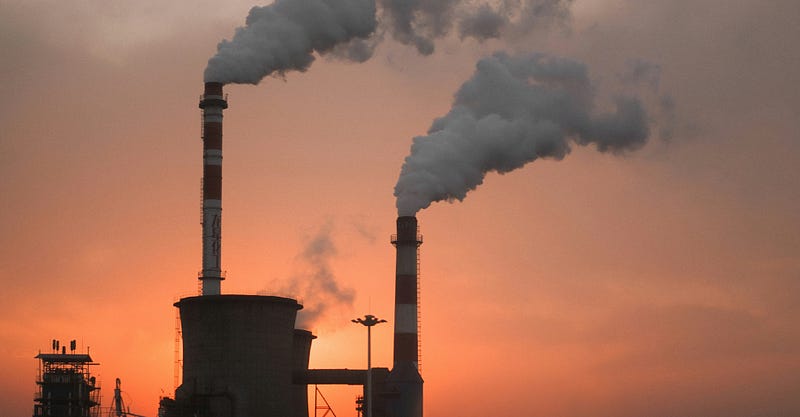
Photo by Alexander Tsang on Unsplash

The densest woods and forests of Northern California have always been my refuge, sheltering and isolating me comfortably away from a world I did not understand. When I was too afraid, or felt unable to speak, the trees were always there to listen to my stories. Now that my beloved trees have themselves become isolated from their own vital connections and networks, which sheltered them from harm for centuries, it is my turn to protect them from a world that cannot hear.

This small planet which shelters and protects all of “us” is in big trouble. There really isn’t much debate on this matter anymore, with outright denial becoming much less common. Even many of our most staunchly conservative members of Congress are regularly mentioning the climate as a growing concern, and the Department of Defense recently called the effects of climate change a “National Security Threat”.

Unfortunately, the “solutions” currently being offered are likely to prove far worse for Earth than anything we’ve managed yet. Rather than denial, we have arrived at the point of “we can help the environment AND grow our economy”. The industrial-scale push we have seen recently is frightening — pumping billions into unproven or unscientific methods, all of which are causing irreparable harm to sensitive ecosystems, while ignoring the most very basic — yet highly effective — options. Massive solar-sprawl covering our most diverse desert habitat. Wind turbines creating a slalom course through oceans and prairie alike. LNG, pipelines and fracking. Lithium mines and EV’s. Landscape scale “thinning” (logging), new sawmills and biomass.

Never before have we witnessed so much being destroyed and extracted so quickly from the Earth. Not during the “hydrolicking” days of the California Gold Rush, nor the building of the Transcontinental Railroad. Not during Western expansion, which decimated both the land and her original stewards. Not to build the vast sprawl of metropolitan-urban-suburban development, nor the bombs and factories that supported that growth. Crucial tipping points are growing more near by the day, or have already been breached. The Amazon region is near to becoming a carbon-source, rather than the great “lungs of the Earth” as we have always known it to be. Geological exploration is bulldozing priceless cultural heritage and reaching into the very depths of the oceans; oceans filled with trash and pollution and temperatures which are alarmingly anomalous. The Biden administration recently opened 22 million acres of public land for potential solar energy development.

In contrast we are offered 30x30, President Biden’s plan to conserve 30% of US land and water by 2030. We certainly have seen some very positive land preservation already as a result, such as the designation of Baaj Nwaavjo I’tah Kukveni National Monument at the Grand Canyon, containing numerous sacred ancestral cultural sites. Just don’t mind the uranium mine; we couldn’t possibly give National Monuments a “categorical exemption” from those 1850’s mining laws, now could we? While 30x30 is a good start, it has a very broad view of what “conservation” actually is, meaning that logging and grazing are still very much involved. And it is nowhere near enough compensation for the amount of open, wild space currently being consumed by backhoes and feller-bunchers. When we are done building all these solar panels, wind turbines, lithium batteries, transmission lines, etc.; when we are finally satisfied with our “thinning” and “forest health”, what of “nature” will even be left for conservation?

There have been very, very few major national public transportation infrastructure projects supported by our government since the construction of the Transcontinental Railroad, and that was never truly intended for human transportation, but rather for the benefit of industry and the economy to transport goods and workforce. Those same folks building trains and factories and universities are of the same circles which formed the Save Our Redwoods League, which for many years was nothing more than an industry scheme to “conserve” the remaining mature redwood stands not for preservation, but for their valuable lumber and timber interests. Sadly, nothing much seems a whole lot different today. Both the Nature Conservancy, and the Wilderness Society have become increasingly intertwined with logging and biomass interests. Even more concerning, a board member of California’s Wildfire Task Force — created by Governor Gavin Newsom to “prevent catastrophic wildfires by creating healthy, sustainable natural environments” — is concurrently a board member of Golden State Natural Resources (GSNR), a 501(c)3 supposed public benefit non-profit biomass corporation formed by leadership in several rural California counties, mostly members of RCRC. Able to thus directly influence policies from which they will profit (and there will be lots of profit, tax status aside) this biomass company recently released this map of their proposed “working zone”, showing an extraction area that encompasses almost all of the Sierra Nevada and foothills, extending into the Southern Cascades of Oregon:
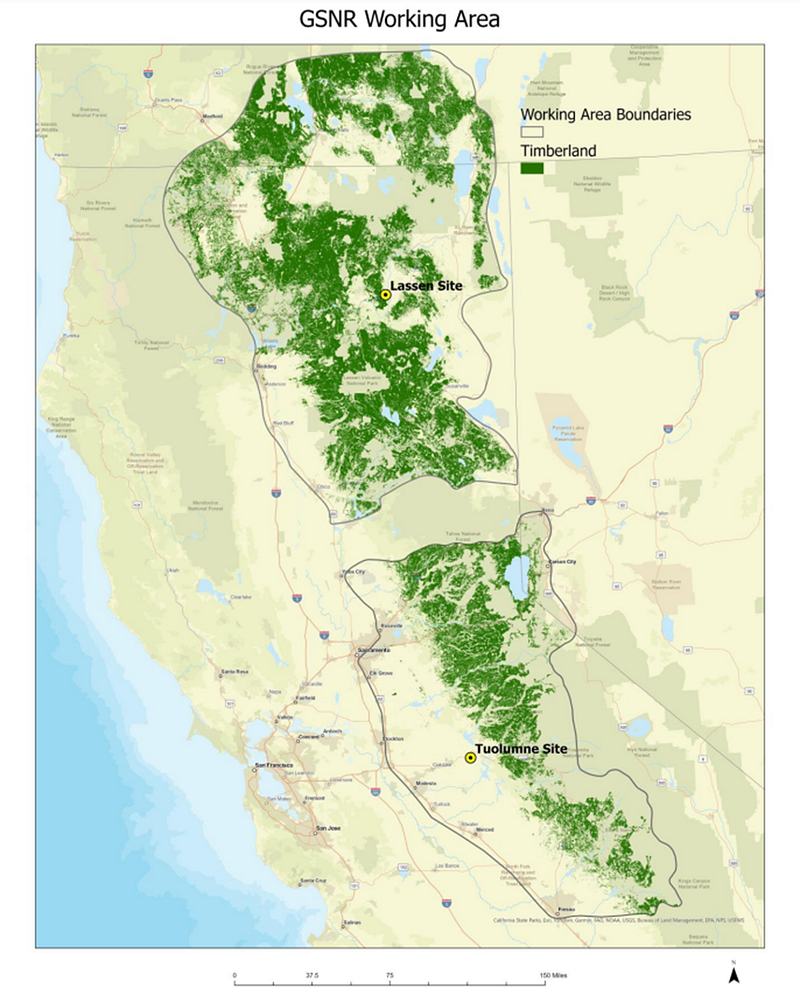
Initial plans indicate two processing facilities, or wood pellet factories, one in Tuolumne County, where Yosemite National Park is located (also Jamestown, a favorite of my childhood), and another in Lassen County, wonderfully rural and more sparsely populated. There is also a required storage facility that would be located at the Port of Stockton. They have however indicated their great desire for this to be only phase one; there is no telling what their long-term plans may be, especially in light of their recent Memorandum of Understanding announced with long-controversial Drax Biomass.

Yet once opened, there will be long-term financial incentives for keeping these facilities operating, requiring in turn long-term extraction and far more timber than would be necessary to protect our communities with home-out defensible space. Biomass pellets require dense woody fiber, i.e. healthy, mature trees. They are not made using the branches and shrubs that would typically be removed during home-hardening. Worse, these industrial-scale wood pellet plants would not only hack apart our carbon-storing forests, they would then use diesel trucks to transport the usable logs (leaving all “waste” behind, the very “ladder fuels” we are always hearing of) to these facilities to be ground into pulp, turned into wood pellets and then AGAIN be put on diesel trucks to be shipped to storage near ports where they pose a significant fire risk, not unlike the 2022 fire that destroyed the Ampine particle board factory in Amador County where my brother-in-law worked. The economic devastation to the small area was so great, that he and my sister moved two teenagers and two toddlers across the country for a fresh start. After this hazardous, sometimes extended storage, pellets would then be shipped overseas to be burned as energy, releasing….you get the point. Massive levels of greenhouse gasses are produced during every step of this complicated process, further warming our ailing globe.

Even here in the Lake Tahoe Basin, recognized globally and generally accepted as receiving stringent local and federal protections, we are witnessing first-hand the devastating real-time and intentional destruction of our beautiful watersheds and forests through “salvage logging”, “thinning”, and what agencies call “restoration” along with the negative effects this is already causing to water quality in the lake itself. These ecosystems are vital not only for what they are, but as an integral part of our tourism-based economy. Who would pay to visit this area were it home to murky waters and naked mountains?

But numerous agencies around Lake Tahoe have suggested various biomass options which would put further pressure on stressed land. Largely, the local conversation revolves around “small-scale” or “roaming” biomass. We already have our very own shiny-new sawmill, piled high with logs that were supposed to be primarily “burned trees from the Caldor scar”, but look to be hardly charred, likely because damaged trees don’t make great lumber. What is charred is remarkably over-seasoned for lumber use, and both its location and very existence have been maligned by community members. Placer, Washoe and Douglas counties have all been busy exploring biomass options, with El Dorado well on their way to two separate facilities, one in Grizzly Flat, already devastated by the Caldor Fire, and another suggested for Camino. South Lake Tahoe and Truckee both have plans for biomass facilities, the former considering several locations such as the South Tahoe Refuse Transfer Station, and Truckee Fire Protection District just this week received a biomass/bioenergy feasibility study, which will be presented by the consulting agency to Town Council on March 26th. Both are considering Biomass EV Chargers. The Tahoe Regional Planning Agency (TRPA) and California Tahoe Conservancy (CTC), supposed pillars of the environmental establishment, have both discussed mobile biomass facilities and biomass chargers with what amounted to glee.

Generally, I receive some version of “Well, this is just one small project” or “surely this is better than the alternative” when discussing either logging or biomass with local agencies, such as these quotes regarding biomass from a local sustainability department:

“It’s a worthy offset in my opinion because biogenic carbon is not causing climate change in the big picture.”

And

“You are commenting on a wider issue than we engage in. For our little part, we are just talking about green waste that comes off of residential properties that gets trucked away in the current model. To your point, I think anyone would agree that any given application of biomass energy technology is not a blanket solution everywhere. It’s all nuanced and site specific. In fairness, we are not the right jurisdiction/agency/entity to engage if you want to talk about those other issues.”

Most of the statements agencies have been making regarding biomass are misguided — failing to address social, equity and proliferation issues, like the quotes above. Others are outright factually misleading or incorrect.

Consider this: Were all these projects across local jurisdictions to be approved, how many separate biomass operations would exist within the Tahoe Basin? It seems rather irresponsible to approach these as singular projects, “just one small part”, in such an important, connected ecosystem. Each of these “small parts” will affect the whole basin. Once extracted from the ecosystem, how would this “material” be transported to these plants? Will this really reduce our VMT’s (Vehicle Miles Traveled) and emissions, or are more small loads traveling on basin roads actually a larger impact than large loads trucked out of the basin? Why not the somewhat planet-friendlier option of chipping and returning the material to replenish the soil and retain moisture? Biomass as carbon neutral has been widely debunked, and the social justice harms are immense, with plants built virtually on top of already marginalized communities across the Southern US, spreading ash and sawdust and pollution across neighborhoods. How will emissions and pollution from these “small-scale” plants be measured, tracked, reported and cross-referenced for accumulative effects across the basin if they are considered separate from one another? We also have two airports in the Tahoe Basin, one in Truckee and one in South Lake Tahoe, facilitating sometimes 100’s of private jet trips a day during the American Century Celebrity Golf Championship Tournament, hosted yearly on the South Shore of Lake Tahoe. Both were proposed biomass site options. Why not just cut emissions by disallowing private jet travel into the Basin? I’ve also noticed the conspicuous lack of rooftop solar at these airports.

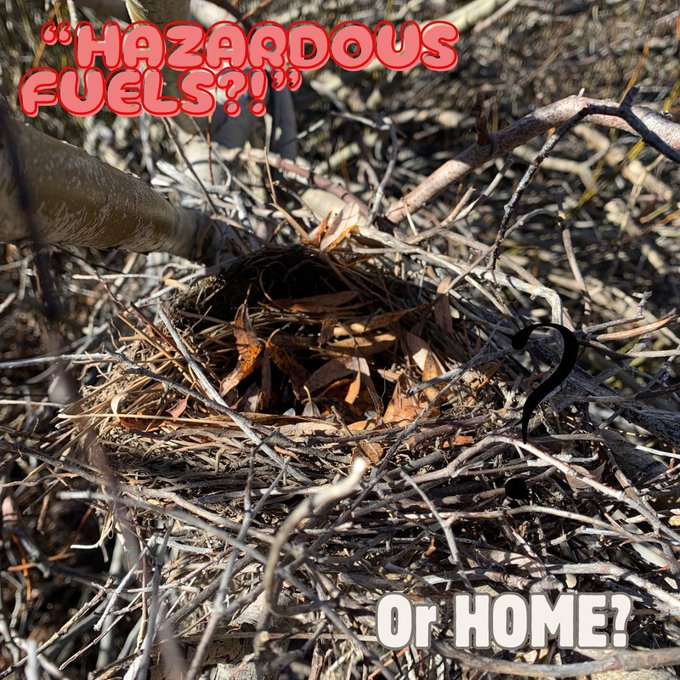
That is not even to address two of the most significant concerns. First, we must consider how approving these projects in an area so “environmentally conscious” as the Tahoe Basin is imagined to be will affect overall market confidence, contributing to acceptance and complacency surrounding biomass in much less protected areas, and also regarding GSNR’s industrial-scale plants. And what of removing all this “woody biomass” from the environment in general? What is being called “overgrowth” or “hazardous” or “ladder fuels” is actually serving many essential roles. Birds nest in shrubs, beneath downed branches and trees, and among leaf litter as well as in burned and snag trees, which are of particular importance to nesting woodpeckers which require hundreds of wood-boring beetles daily to support their nest. Coyotes often create their dens beneath dense Arroyo Willow along riverbanks. Ground debris and small vegetation help retain immense amounts of groundwater and moisture, actually often slowing fire, and serving a vital purpose during drought. Fungal colonies cannot thrive, or even survive without ground debris and decay. Erosion protection, lower ambient temperatures, etc. And of course their most essential role — the replenishment of nutrients to the soil as they break down upon death.
Another major point is that forests are meant to experience fire, and that grasslands are actually just as likely to experience fires with catastrophic loss of life and property, and grass fires can spread much more rapidly than forest fire. No amount of “thinning” or even outright clearcutting will slow or prevent wind and climate-driven fire. You cannot stop embers which travel miles, jumping every contingency line, and alighting spot-fires ahead and behind the fire lines, alighting on wood-shingle roofing and in leaf-filled gutters, flattening entire towns in mere minutes. Both Lahaina and just last month the Smokehouse Creek Fire, the largest in Texas history and it started in FEBRUARY, burned through grassland. Why would we want to turn our forests into grasslands?

Logging, fire suppression, overdevelopment, overconsumption, and all other forms of just plain old bad management and industry have brought us to this critical moment. The hubris involved in believing that we can continue to cut, suppress, “thin”, build and destroy our way out of current situations is frightening and driven by intense lobbying. Many in our communities have already experienced this intense lobby; have seen the abuse and harm with which these industries come. I grew up in Amador County, CA, former long-term home of a large Sierra-Pacific Industries facility, storing acre upon acre of once beautiful mature, healthy trees. When they finally closed the doors on that site, it decimated the local economy and unemployment skyrocketed for years. We cannot afford — financially, emotionally or sustainably — another round of industry boom and bust.

Until we begin to allow natural processes, fire regimes and ecosystems to recover from our abuse, we cannot expect any improvement to either ecosystem health or climate and fire conditions. Instead, we need to act in a completely different way. Nearly everyone will agree that our national infrastructure is in dire shape with little hope of withstanding the growing effects of a changing climate. Far beyond fire country, where I reside, these deficiencies must be addressed. Fire, flood, sea level rise, hurricane strength, tornado frequency, heat waves, drought, crop failure — ALL of these and more are issues of equal and growing concern. Yet billions of dollars were allocated just in California in 2023 for “forest management” and “fire suppression and prevention” alone. Coupled with the over $2 billion tax-payers are funding for one single lithium mine, how much infrastructure could have been improved with that amount? How many public transportation systems funded?

The discrepancy in funding between industry and infrastructure is astounding; it would be laughable if it wasn’t so important to our very survival. There are many who still want to debate the efficacy of “thinning” and “forest health”, grazing and biomass, EV’s and industrial solar and wind as “fixes” for the problems we face. Many of these debaters are from those agencies and industries which are likely imagining significant hits to their budgets. While I could talk about the science all day (and firmly believe that evolved ecosystems are far better off without human intervention) I really don’t even find that debate necessary.

With the information we already have regarding our failed infrastructure and the risks of climate change, combined with the knowledge that these ARE fire-adapted ecosystems, plus the clear statements by Cal-Fire, USFS and our insurance companies that we cannot fight extreme fire and that home and infrastructure hardening is the ONLY way to protect life and property, we know what we need to do. Bob Horton, Senior Director of Research and Policy at the Western Fire Chiefs Association said recently:

“Investing in home and community hardening is the best option state leaders have to lessen the pain of a chaotic insurance market and increasing wildfire risks with climate change.”

Why continue to funnel TRILLIONS into industrialized ecosystem and cultural site destruction, or “new” technologies that just involve paving over more habitat or burning new things as energy, rather than public transportation, infrastructure hardening and rooftop solar?

When one looks at the biggest picture — these thousands upon thousands of projects, millions upon millions of acres — it becomes clear that what we are doing is causing great harm while providing only short-term “solutions” that will never add up to long-term results in safety, sustainability or planet health. There is no chance of hardening our infrastructure or creating truly Firewise communities without a significant shift of funding into these programs, which requires the end of extractive industry handouts. While many still fear a loss of jobs and funding along with this shift, that is in no way the case. Current workforces can and should be redirected towards infrastructure hardening and our local economies would be stimulated in numerous ways — everything from trade schools to hemp production — offering much safer, higher-paying jobs closer to home. The long-term security (job security, life, fire, climate…) as well as cost savings and other benefits cannot be quantified.

On the other end, it cannot be overstated how little we understand the ways in which current policies will affect these ecosystems for the long-term, or how the (now certain) 2 degrees of warming is going to change them, no matter how they are “managed”. We are very confident now in saying that former logging, industrial mines, coal powered plants and other forms of land abuse were ill-advised, greed-driven mistakes. Why should we accept now that current approaches will somehow magically work if we simply label them “lithium batteries” or “forest health” or “solar farm” or “biomass”? Biomass is actually more polluting per unit of energy produced than coal. Perhaps that is because they are essentially the same thing — biogenic carbon. They both store carbon and release that carbon when burned. The difference being that “woody biomass” is much less energy dense than both coal and LNG, meaning that it requires much more combustion to produce the same amount of energy. To say that somehow because trees will “grow back” that biomass is “carbon neutral” is simply false. It takes a very long time for trees to “grow back”, if they ever do, meaning that while we are burning they aren’t storing as much, leaving us with an incredible carbon debt. Much like coal when left in the ground, if left to decay naturally, “biomass” would provide long-term carbon storage, only slowly releasing that carbon. Logging releases massive carbon and water stores into our atmosphere instantly, and then again when wood is burned. We would be laughing hysterically were someone to propose we begin opening coal powered plants again. Why would we think burning anything for power was the path to a “green future”?

Likewise for paving or bulldozing or digging up our deserts. Desert flora stores enormous amounts of carbon, within vast underground root systems, and in many cases these plants actually live far longer than our carbon-storing trees. We need to allow natural processes to govern these spaces as our planet continues to warm, whatever that new normal will be; at the very very minimum until we can determine how they are being affected already, and what “natural processes” will even be at 2 or 3 or even 5 degrees of warming. What does a “healthy” forest look like at 4 degrees Celsius above pre-industrial temperatures? How can we say what a “sustainable” timber harvest quota is today without knowing what our forests will look like in just a few decades? How will composition and dispersion naturally progress? How much natural die-off will occur?

Anything we do to our wild spaces today cannot be reversed without decades or centuries of time, if ever. In this rapidly changing climate we really have no clue what we can truly expect to happen completely outside of our control. We cannot compete with physics. Generations of our potential or real grandchildren could live without ever knowing what an untouched, unmarred landscape spreading to the horizon looks like, if they are even able to exist for that long. Never hear the chirp of frogs in the thousands, or watch the sky be darkened by endless flocks of migrating birds. Hear wind roaring high through massive, swaying redwoods. Stand in awe as unnamed colors explode across the desert to warm the cool morning earth beneath their bare toes. Feel the spray of an ocean where they can swim amongst neon coral, rather than towel off the stinky slick of oil or make room amongst trash for a spot to lie on the shore.

When has an industrial focus ever served our communities, the greater good, or the environment? They no longer even attempt to hide their “profit margins or bust” attitude or the feeling that they bear no responsibility for finding solutions that work. We can do better, and we must start yesterday. Tell those in power wherever you live that it is time to end the destruction, and to focus all of our efforts and resources on our most effective solutions. Infrastructure hardening against natural disasters of all types. Ensuring crop security and water supplies. Rooftop solar and wind. Mass public transportation. And what is likely the very most impactful thing we can do, yet also the most simple — the preservation as wilderness of ALL of our remaining undeveloped land and standing mature trees, already both far too uncommon and disappearing before our very eyes.

Links/References:

https://www.homelandsecuritynewswire.com/dr20240307-climate-change-poses-serious-national-security-threat

https://apnews.com/united-states-government-c119aa0ef87446108abd2aa637e91b7f

https://nevadacurrent.com/2024/03/21/solar-power-project-threatens-prime-desert-tortoise-habitat-conservationists-warn/

https://www.theguardian.com/us-news/2023/may/21/solar-farms-energy-power-california-mojave-desert

https://www.doi.gov/pressreleases/interior-department-proposes-second-offshore-wind-sale-gulf-mexico

https://www.nrdc.org/bio/amy-mall/5-key-reasons-stop-mountain-valley-pipeline

https://www.npr.org/2023/05/31/1179201992/mountain-valley-pipeline-west-virginia-debt-ceiling-deal

https://www.theguardian.com/us-news/2023/oct/13/native-americans-1865-massacre-lithium-mine-thacker-pass

https://www.protectthackerpass.org/the-history-of-thacker-pass/

https://www.thenation.com/article/activism/thacker-pass-mine-protest/

https://www.reuters.com/markets/commodities/lithium-americas-get-226-bln-us-doe-loan-nevada-mine-2024-03-14/

https://www.fs.usda.gov/news/releases/usda-announces-43-million-investment-advance-innovation-in-wood-products

https://www.usda.gov/media/press-releases/2024/03/14/usda-outlines-vision-strengthen-american-bioeconomy-through-more

https://www.reuters.com/world/us/us-unveils-solar-energy-plan-western-public-lands-2024-01-17/

https://www.doi.gov/pressreleases/fact-sheet-president-biden-take-action-uphold-commitment-restore-balance-public-lands

https://www.scientificamerican.com/article/grand-canyon-gains-new-million-acre-monument/

https://www.grandcanyontrust.org/blog/uranium-mine-starts-new-grand-canyon-monument

https://www.hcn.org/articles/south-politics-a-reality-check-on-bidens-30-by-30-conservation-plan/

https://www.savetheredwoods.org/

https://www.msn.com/en-us/news/us/the-shadowy-history-behind-the-fight-to-save-the-redwoods/ar-AA1ffFEM

https://grist.org/energy/logging-biomass-nature-conservancy/

https://www.thewildlifenews.com/2024/03/14/now-or-never-logging-video-timber-industry-propaganda/

https://wildfiretaskforce.org/

https://goldenstatenaturalresources.com/

https://www.rcrcnet.org/

https://www.visittuolumne.com/

https://www.lassencounty.org/visiting

https://www.desmog.com/2024/03/04/wood-pellet-giant-drax-targets-california-forests/

https://www.biofuelwatch.org.uk/2024/drax-pinewells-investigation/

https://dogwoodalliance.org/2022/01/fires-at-wood-pellet-facilities-what-you-need-to-know/

https://www.kcra.com/article/crews-battle-fire-at-a-lumber-mill-in-amador-county/40711097

https://nevadacurrent.com/2024/03/19/lake-tahoe-remains-murky-after-25-years-and-a-2-9-billion-investment/

https://www.rgj.com/story/news/2022/09/06/tahoe-forest-products-carson-city-nevada-lumber-sawmill-process-timber-salvaged-wildfires-new-jobs/7964646001/

https://carsonnow.org/story/08/23/2022/we-support-initiative-its-location-thats-challenge-sawmill-developers-host-forum-in

https://www.mtdemocrat.com/news/portable-biomass-facility-coming-to-county/article_040229ac-87f6-535c-b7b9-5962f974946e.html

https://southtahoerefuse.com/renewableenergy/

https://www.sierrasun.com/news/wildephor-consulting-unveils-biomass-bioenergy-study-findings-to-truckee-fire-protection-district/

https://www.theguardian.com/environment/2021/oct/04/biomass-plants-us-south-carbon-neutral

https://americancenturychampionship.com/

https://www.yahoo.com/news/plant-everywhere-fueling-growing-risk-080029246.html

https://www.hawaiinewsnow.com/2024/03/20/lahaina-disaster-highlights-lack-safety-equipment-fire-training-maui-officers/

https://en.wikipedia.org/wiki/Smokehouse_Creek_Fire

https://oregoncapitalchronicle.com/2024/02/26/oregon-homeowners-face-soaring-premiums-few-property-insurance-options-over-wildfires/

https://www.biologicaldiversity.org/campaigns/debunking_the_biomass_myth/pdfs/Forest-Bioenergy-Briefing-Book-March-2021.pdf

https://www.ecowatch.com/chatham-house-biomass-study-2288764699.html

https://www.bbc.com/news/business-59546278

https://www.hsph.harvard.edu/c-change/news/gas-biomass/

https://www.hsph.harvard.edu/news/hsph-in-the-news/natural-gas-biomass-surpassing-coal-as-biggest-pollutants-study-finds/

https://www.nrdc.org/bio/rita-frost/golden-state-natural-resources-biomass-boondoggle

https://www.sierrasun.com/news/golden-state-natural-resources-wood-pellet-project-and-the-debate-over-californias-forests/

Biomass
Climate Change
Green Energy
Collapse
Public Lands
Recommended from ReadMedium