
Billionaire Charlie Munger’s Secret to Becoming Smarter and More Creative
Don’t be “a man with a hammer”
From a very young age, we are made to believe that intelligence, smartness, and creativity are sort of mysterious qualities we are born with. For a long time now, there has been a lot of hype and focus around tests to measure these traits but not nearly as much towards developing them in people.
Besides the obvious problems with those tests, the whole system leads many of us into developing a fixed mindset. So, instead of obsessing over what nature has given to us, we need to learn to make the best use of it.
If you look at some of the most successful people in the world, they don’t just sit back and rely on their natural gifts to guide them through their lives. Instead, they work to improve themselves at understanding the world, making decisions, and generating revolutionary ideas.
They don’t see smartness as the ability to ace standardized tests. Rather, to them, it’s about being able to make sense of everything and to do the best with what you know and what you have. And they believe that’s something we can get better at.
Luckily for us, many of them share the secrets that help them boost their sharpness and creativity.
Munger’s Big Ideas
“He’s as smart and as high-grade a guy as I’ve ever run into.”
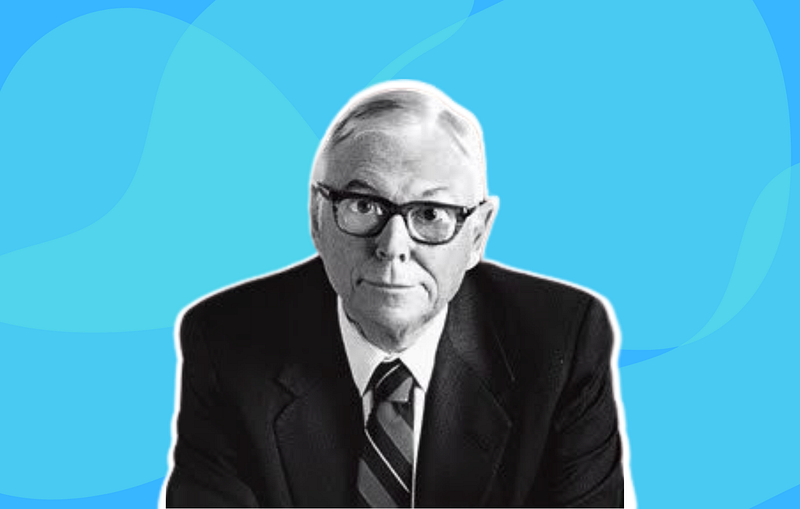
That’s what Warren Buffett says about his close friend and mastermind, Charlie Munger. Spanning over four decades, their partnership has been among the most enduring and profitable in business history. It has played a pivotal role in the success of Berkshire Hathaway, one of the ten most valuable companies in the world today.
Now people often ask Munger how they can learn to think better, and here’s something he has repeatedly mentioned in this context.
“I loved big ideas that had a lot of instructive power. And I liked them so well … I paid no attention to the territorial boundaries of academic disciplines and I just grabbed all the big ideas that I could. And then I used them in daily activity to solve problems and amuse myself and do self-education and so forth.”
He gives the example of Benjamin Franklin, whom he idolizes, saying, “he was a totally self-educated man that wandered over a vast amount of territory and was pretty competent over the full range.”
So Munger’s advice to people wanting to be smarter is — collect the big ideas from every field you reasonably can.
Now there’s one obvious benefit of this. As Elon Musk points out, to do anything big like building a company or organization, chances are you would need to know a lot of things, including how people, nature, and the economy work.
But there’s a lot more to it than that.
The Proverbial Man With a Hammer
“To a man with a hammer, everything looks like a nail.”― Mark Twain
When people possess little knowledge outside their narrow domains, they try to twist and fit everything into their tiny boxes of understanding. That means they are often forced to work with heavily distorted versions of reality. You don’t want it to be like that.
You want to be able to see things with exceptional clarity from different vantage points. That’s what sets the great thinkers, founders, and leaders apart from the rest. It enables them to see both problems and opportunities before anyone else and in ways that few others can.
Munger’s advice is aimed at helping you do that. And it connects very well to something Elon Musk once said about learning.
“One bit of advice: it is important to view knowledge as sort of a semantic tree — make sure you understand the fundamental principles, i.e. the trunk and big branches, before you get into the leaves/details or there is nothing for them to hang on to.”
Most of us try to hang all the different varieties of leaves we come across on to the same tree, the one we are familiar with. Munger tells you to familiarize yourself with the trunks and big branches of the different trees that exist out there.
That way, when you stumble upon a twig or a leaf, you would know which tree it belongs to. And so you will be better placed to work with it.
A Fresh Perspective
Every prominent field of study exists because there’s some aspect of the world it can explain better than any other. It offers a unique lens through which you can view the world.
Situations that seem inexplicable from one lens might be simple to understand or even obvious through the other. Moreover, it gives you different perspectives and interesting analogies.
Elon Musk’s quote from above is one example. By comparing the organization of knowledge to a tree’s structure, he makes his idea simpler to understand, easier to remember, and more powerful in effect.
Besides, by paying close attention to the repeating patterns in these analogies, you can discover deeper and more fundamental ideas at work. Like our analogy above highlights how structures require strong foundations or cores to grow without becoming unstable. It’s true for knowledge, ideas, trees, buildings, organizations, and pretty much everything else.
But that’s not all.
Looking at things through different lenses can help you take your mind away from trivialities and details for a moment and look at the larger picture. You might even find the whole map laid out in front of you in one of the analogies.
And as Steve Jobs says —
“A lot of [what it means to be smart] is the ability to zoom out, like you’re in a city and you could look at the whole thing from the 80th floor down at the city. And while other people are trying to figure out how to get from point A to point B reading these stupid little maps, you could just see it in front of you. You can see the whole thing.”
Innovation and Creativity
Originality, creativity, and innovation do not exist in a vacuum. They emerge from the synthesis of pre-existing ideas that might appear unrelated. People struggle to be creative when they fail to see this underlying concept.
So it boils down to your ability to make unique connections. But that requires you to have in your head things to connect in the first place. Hence Steve Jobs’s advice to those who want to be innovative —
“You have to not have the same bag of experiences as everyone else does, or else you’re gonna make the same connections and you won’t be innovative.
A fat collection of big ideas from various domains makes your bag of experiences, both rich and unique.
It also turns your brain into a kind of a multi-disciplinary team. And this article in the Harvard Business Review explains why that can help develop novel solutions to difficult problems. It says —
Bringing in ideas from analogous fields turns out to be a potential source of radical innovation…for two reasons: People versed in analogous fields can draw on different pools of knowledge, and they’re not mentally constrained by existing, “known” solutions to the problem in the target field.
And even if you don’t possess enough expertise in an area to craft a good solution, you at least know where to look for it.
How to Apply
Alright, now that we know one key ingredient to help level up our smartness and creativity, here’s what you can do to add it to your recipe.
Books and other media
This is the easiest, quickest, and most cost-effective way of learning anything. It’s no coincidence that the majority of highly successful people are avid readers.
Reading three (or so) good books giving a high-level explanation of a topic like psychology, marketing, or investing would be enough to develop a reasonable understanding of what that field of study is about, its core ideas, and common applications.
You can also use other forms of content such as documentaries, videos, blogs, or podcasts from trusted sources. But instead of consuming random stuff thrown at you by some algorithm, you might want to limit yourself to what’s relevant from the content library of a few of the most reputed sources.
But you must make it an active exercise. So take notes and ponder over what you learn and how it connects with everything else you know. Think about how you can apply it in your life.
Try new hobbies
Hobbies are great for exposing yourself to different ideas and skills. But all hobbies are not equal. When you are actually doing things (as opposed to passive enjoyment of others’ work), you gain a deeper and more synthesized understanding.
For example, if you get into photography, you may find yourself learning about stuff like —
- the physics governing the optics,
- the technology behind cameras and image-processing software,
- how angles and perspectives are used to bring out different emotions in a photo, and
- how to create optical illusions.
The best part is it never seems laborious.
Work on different small projects
If you look at some of the greatest business people — the likes of Elon Musk, Steve Jobs, Jeff Bezos, and Warren Buffet — in one capacity or the other, they have worked with many different ventures. That turns them into a powerhouse of ideas and experiences and enables them to do bigger things in the future.
So even if we cannot all be working on several multi-billion-dollar companies, we can find opportunities to work on projects that are different from one another in significant ways. You can do that by participating in different projects as an employee in a company, creating small products of your own, or helping/mentoring others in their endeavors.
Travel and meet people
As a kid, I wasn’t much into reading. And we didn’t have Google or YouTube back then either. Most of what I learned was from my habit of spending time with people who were smarter and sometimes several years older than me.
The thing is, most intelligent people are passionate about something and love to talk about it. So if you meet such people from diverse backgrounds and show genuine interest in what they have to say, you will find yourself some great teachers willing to teach you for free.
In a Nutshell
Smartness and creativity, two essentials for entrepreneurial success, are about looking beyond the obvious with clarity and interpreting what you see in ways that most people can’t. Munger’s advice of absorbing the main ideas from different domains can take you a long way towards doing that.
So, here are a few things you can do.
- Learn from books and other forms of content that are relevant and reliable.
- Try new hobbies.
- Work on a variety of projects, help others.
- Go out, meet people, and lend a curious ear to what they have to say.


