
Bill Gates Didn’t Think Gmail Users Would Need 2GB of Storage — Here’s What to Learn from His Error
On forward-thinking and long-term vision
In late 2004, Bill Gates visited journalist Steven Levy to talk about spam and the future of email. Google had just launched its e-mail service Gmail 6 months prior, and the topic came up during the conversation.
Levy explained that the IT department at Newsweek barely gave them enough storage to hold a few days’ worth of email, so they took the habit of forwarding everything to Gmail to avoid spending time deciding what to delete. They had only been doing this for a few months and already consumed half of Gmail’s 2GB free storage space. Gates couldn’t believe it.
“How do you need more than 1GB?” he asked. “What do you have in there? Movies? Powerpoint presentations? How many messages are there? Seriously, I’m trying to understand whether it’s the number of messages or the size of messages.”
It was almost as if Gates was offended by the act of giving users such a ginormous amount of storage for free, squandering precious gigabytes away. He not only had a hard time seeing a use for it, he also drew his reasoning from his entrepreneurial past. Gates comes from a time when storage space was a limited commodity you had to save up as much as possible. Giving users 2GB of free storage space, even 20 years after he had built the first version of his Windows OS, sounded ludicrous to him, because he didn’t take into consideration Moore’s Law and the forward-thinking it required to understand.
Moore’s law and the power of forward-thinking
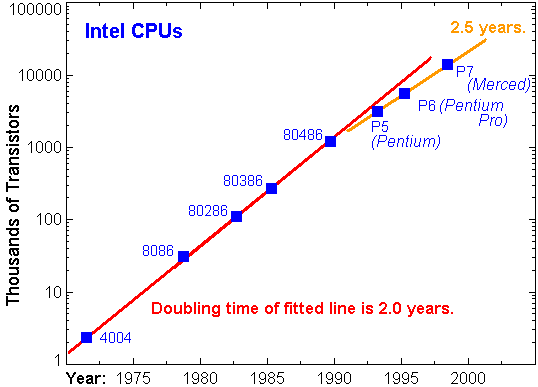
Moore’s law isn’t an exact mathematical formula but it has stayed true for over half a century. It stems from a simple observation by Gordon Moore in 1965: the number of transistors on a microchip (thus its speed and performance) doubled about every year. Over time, the details of the law were adjusted to better reflect the actual growth of transistor density. The doubling interval was first increased to two years and then decreased to about 18 months (source).
These days, the law is still delivering exponential returns, but at a slower pace. This doesn’t mean technology is slowing down (it’s moving faster than ever), but it means that the time it takes to double the performance of a CPU takes longer than it used to. It’s almost like progress can’t keep up with innovation, and that’s why many people get confused, including Gates.
The only reason Gates thought it was crazy to give away 2GB to millions of users was because even for him, it’s very hard to fathom the incredible rate of speed at which our world and technology are moving. There’s no way he doesn’t know about this, because he built Windows, reads 52 books a year, and is generally considered to be a very smart individual. But on that day in 2004, he let his rational instinct get the best of him. He didn’t trust the maths and the crazy future that was ahead.
How to see ahead
The most successful entrepreneurs in this world are the ones who see trends and patterns ahead of everyone else. This goes for technology but also services. Imagine how weird it would have been to explain the concept of audiobooks just 10 years ago. Who would have thought anyone would want to listen to books instead of reading them? Now it’s a $4.2 billion market. Imagine explaining the concept of Uber or Airbnb 10 or 20 years ago. Calling a car with the press of a button on your phone? Staying at a stranger’s place for one night? How would this be doable? Who needs this? These 2 companies now have a combined market cap of $128 billion.
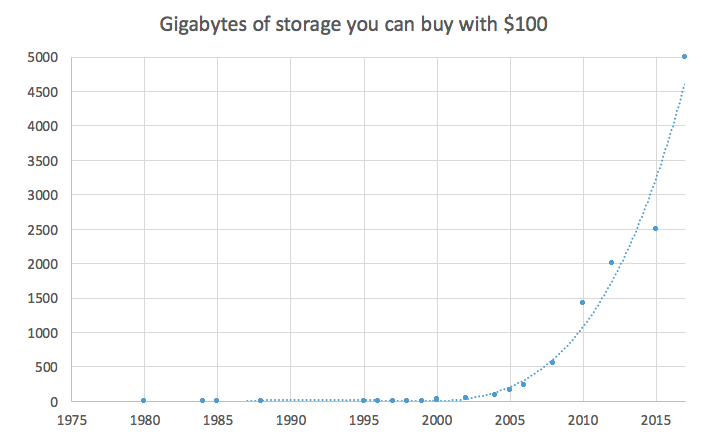
The first version of Windows only used 1MB of disk space and 256KB of RAM. When Gates built his OS, he couldn’t afford to squander even half of a megabyte on a useless piece of code. Every line of code, every character mattered, there was no room for noise, and efficiency was key. It was also about keeping costs low. A 340MB hard drive in 1989 cost $1,795 (more than $3,500 in 2022 dollars), so more storage meant more money spent on making the product. Nowadays, you can get a 2TB hard drive for $100.
20 years later, in 2004, Google knew that storage space costs were only going to drop, so they were not running a big risk by giving people 2GB of storage space for free. It was going to be worth virtually no server money only a few months down the line.
Make it big 20 years from now
One of the best ways to be successful as an entrepreneur is to ask yourself: “What will the world look like 5, 10, or 20 years down the line?”
This question is relevant in any industry:
- 20 years ago the median home price in the US was $179,331 (inflation-adjusted to 2020 dollars). Today it’s $336,900, and in 20 years it will probably be over $700,000.
- In 2004 Google’s market cap was $20 billion. Today it is $1.4 trillion, and it will probably double within the next decade.
- There were 2 billion cellphone users in 2005. In 2021 there were 5.3 billion.
If you think these numbers seem crazy now, imagine people’s reaction if you had shown them the same data 20 years ago. A lot of them would not have believed you. This type of forecasting seems insane, ludicrous, and completely improbable. Yet these things end p happening, and only those who open their mind to the possibility that it will be even crazier 20 years down the line, will hit it big with huge ideas.
Take my CEO for instance. He created his company around online employee engagement a decade ago. At the time, nobody really understood what he was doing, people didn’t see a need for the solution he had to offer. 7 years later, as the world became more and more connected, his company was making over $1 million in annual recurring revenue. When the pandemic happened and everyone switched to remote work, his product became more relevant than ever. Almost a decade after creating his company, he sold it for $30 million.
This is not to say global expansion, capitalism, and worldwide technology adoption are only positive. If you had told me 5 years ago something called TikTok would come around and turn kids into robots, I would not have believed you, yet it happened and we just have to wait 5 more years to see how these kids are gonna turn out. This is just one example of the negative parts of technology.
One last thing. In this article, I mentioned huge companies like Google, Microsoft, and billionaires like Bill Gates. I take these examples because they are common reference points that everyone knows, but it doesn’t mean you have to create a huge company and make billions to become successful. 3D printing, solar panels, and video imagery are great examples of fields that also exploded in the past 20 years, on a smaller scale. They made a lot of people more than enough money to live comfortably, and they will only gain in popularity over the next 2 decades.
No matter how big you make it, it’s never about the billions of dollars, the millions of users, or the market cap you reach. It’s about the power of forward-thinking, it’s about creating beautiful solutions for the problems and the needs of tomorrow, all the while learning from the mistakes of yesterday.
So think big, and shoot for the moon. Even if you miss, you’ll land on the stars.
Did you know I have a Youtube channel? Here!
Subscribe to DDIntel Here.
Join our network here: https://datadriveninvestor.com/collaborate