Bill and Melinda Gates Changed the World, but it Wasn’t Because of Their Wealth
Three things my parents taught me about being a global citizen
Having billions at your disposal to change the world doesn’t hurt, but believing wealth is imperative to alleviate suffering and inspire change, is a pervasive myth. Over the past twenty years, I’ve travelled to various countries and places within my own that are rich in culture and hospitality but often equally steeped in poverty and various injustice. These firsthand experiences showed me the necessary traits to create change and none of them include a high net worth. Being raised by parents who felt called from their small mid-western farm to be global citizens, later working at an international relief and development organization and now managing a family foundation, have taught me that those who ease the pain of a wounded world must be first be curious, be willing to make personal sacrifices, and live their life with intention. Bill and Melinda Gates encompass these traits. However, since the Gates are viewed as extraordinary and that often clouds our thoughts on what’s possible, allow me to share a story of the ordinary.
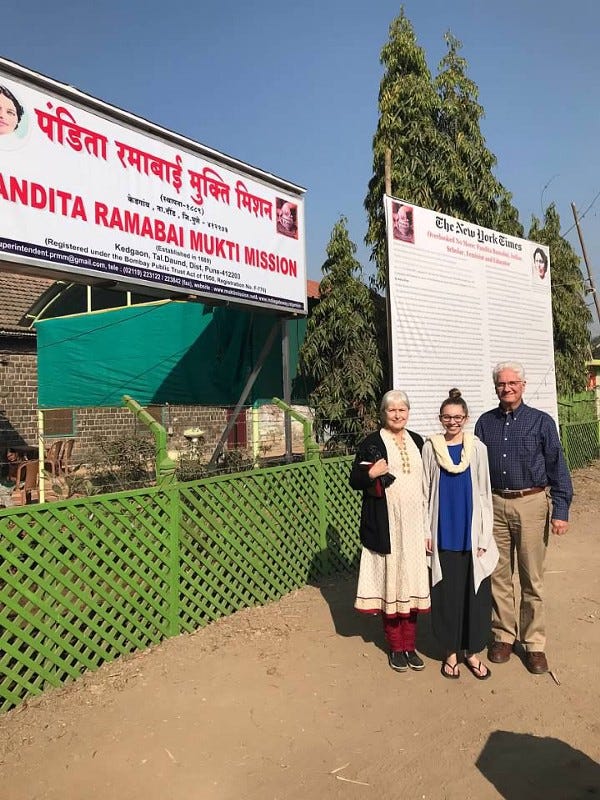
Pre-Covid, my teen daughter, Annabel and I sat in the cool shelter of the Maple House while the warm December weather continued its ascent in Pune, India. On metal bunkbeds lining the room in a home for adolescent girls, we listened to stories and dreams shared by young women at the Mukti Mission, a century old orphanage. Our trip to India was my daughter’s first international experience and I watched her close as she leaned forward, smiling and nodding to those talking even when the translation was shaky. Annabel wore a flowing, bright yellow tunic called a Kurti, a welcome gift from our Indian friend and host, Jayu. As I later talked with Jayu, a flash of yellow caught my eye as all the girls huddled in the middle of the tiled room. Giggling ensued and familiar music emerged. Popular dances in American teen culture were sought so Annabel shared songs from her phone and danced along. Between the laughing and picture taking, my mind traveled thirty-five years prior to my first international trip — a small orphanage in Port-Au-Prince, Haiti.
Be Curious
Being curious was crucial to my parent’s growth into global citizens. If not for their curiosity to learn more about the world outside of their own, we would’ve stayed cocooned in our hometown of Eaton, Ohio, a rural farming community. Our world was wide-open fields of rustling emerald cornstalks, tight rows of knee-high soybean, and grazing farm animals, dissected by single lane country roads that centered around a small city. With almost seven thousand residents, the city of Eaton bustled with mostly farmers and manufacturing employees. We were 99.3% white, church-going protestants with a handful of Catholics, and thanked the good Lord we were isolated from the rumored crime and chaos of larger cities. My childhood was filled with 4-H groups, the Preble County Fair with its carnival rides, lingering church services, and the Pork Festival with its county-wide parade, all you can eat buffet, and crowning of the pork king and queen (yes, that was an actual honor).
After my father graduated from college, served in the military, and learned he was expecting his second child, he accepted a sales job from his father-in-law at Bullen Ultrasonics, a family manufacturing business my grandfather had started in his garage. The job was temporary until my parents could figure out what to do with their lives, but my father with his Philosophy degree, discovered innovation and creating were his passion. In my parent’s mid-twenties, my dad received his first international order requiring travel to New Delhi, India. My mom, fascinated at the prospect of experiencing another country, went with him. New Delhi is quite possibly the complete opposite of a small farming community. My parents were both enlightened and overwhelmed. Little did they realize this business trip was a seed that germinated and later blossomed to awaken their souls to not only the beauty of other cultures but the myriad of needs in other areas of the world.
While my parents saw great beauty, they also saw people experiencing a depth of poverty unknown to them before this time. My mom and dad, who had always thought of themselves as poor, realized that in the context of the greater world they were in fact quite wealthy. In their belief that we are all deeply loved children of God, deserving a life of dignity and freedom, they became motivated by love and a deep sense of responsibility. Their guiding philosophy came from Luke 12:48, in the Bible, “To whom much is given, much is required”. At the time, they had little, but what they had, they wanted to share.
I failed to notice my parent’s inner journey, but I was quick to notice other changes in our household. We were planning our first vacation that wasn’t connected to one of my dad’s business trips. Our past vacations were fantastic. My father had to travel often out west to meet customers so each summer we would join him, by car, and drive to wherever he needed to go. In the process, we visited zoos, museums, drove along the coast in California, walked Fisherman’s Warf, saw the Grand Canyon, and visited a dude ranch in Colorado. But this vacation was different. Not only did it involve Florida and Walt Disney World, a place my father didn’t have business contacts, but we were even going to fly part of the journey — to an exotic location — a place their friends and family told them was crazy to visit. We drove from our Ohio home to Orlando Florida and spent two days visiting Walt Disney World. From there, we drove to Miami, Florida, boarded a plane, and flew to Port-au-Prince, Haiti. Today, my brother and I remember this vacation in vivid detail among all others. Well, part of it; we don’t remember a thing about Orlando Florida, but Haiti, THAT we remember.
We stepped off our plane in Port-au-Prince into the crippling July heat of a Caribbean island. A sea of faces much darker than our own, an unfamiliar language echoing around us, and armed military securing the crowded air conditionedless airport, brought us to a dazed stupor. We gripped the hands of our parents. Riding in the back of a pickup truck along a road with more holes than concrete, absorbed by horns, crowded streets of people, the smell of coal, sweat, and whatever product a vendor might be selling at our sides, my brother and I, jarred from our earlier shock, were now smiling. This far exceeded any ride at Walt Disney World.
My parents overarching purpose to this trip was to learn — they were and are today innately curious. They asked about various needs and what they could do to help. A few days into our trip one of our hosts shared a surprising message. He was familiar with where we were from because a lady from our town managed an orphanage in Port-Au-Prince. My parents laughed. The idea that a woman from our community was in Haiti operating an orphanage didn’t even resonate as startling. It was simply unbelievable. Well, after asking around, we found the tenacious woman, Becky, and she was indeed operating a small orphanage. Her mother, a quiet woman, lived in Eaton and even attended the same church as my family. Now my parents were stunned.
When we returned to Eaton, my parents looked up Becky’s mom and was able to share with her and their friends about the small orphanage which needed cabinets for storage, cooking items, and general repairs around the building. In the following decades, people from our church and community gave generously and traveled there to visit.
During my later teen years, I witnessed the curious nature of my parents who continually sought to better understand and serve. They became involved with projects in Dayton, Ohio as well as Jamaica and West Africa. Being curious may seem like a necessary step for a small town couple, but Bill and Melinda Gates, regardless of their advanced education, material wealth, and vast experiences, spent days sitting with people in various countries asking questions and learning about people’s challenges. Being curious is powerful; it accepts we don’t have all the answers and are willing to learn from the experiences of others. H.L. Menckin states, “For every complex problem there is an answer that is clear, simple, and wrong.” Oversimplifying people and issues which plague our world is the opposite of being curious. Changing the world requires the curiosity to appreciate the multi-faceted, complex lives and interconnected histories we live.
Personal Sacrifice
While curiosity is crucial, impacting those around us doesn’t happen without giving something of ourselves, or personal sacrifice. The interesting thing about sacrifice is that while you are giving of yourself, our spirit and connection to one another is receiving. The point of sacrifice isn’t to get something in return, but it happens. Small and large personal sacrifices are both meaningful to others. For example, maybe you are young and healthy but actively wear a mask when leaving your home. Your decision isn’t due to being at high risk of complications from Covid, but you’re protecting others who are vulnerable. You’re making a sacrifice on their behalf. If you’re purchasing coffee, chocolate, or apparel and one product is discounted while the other is the more expensive Fairtrade, maybe you choose the product sold by a company committed to treating their employees with dignity and the environment responsibly. You sacrificed out of respect and compassion for others.
Combine curiosity with personal sacrifice and you will venture far beyond your own purchasing power. Curiosity brings a passion to learn and explore and connects with your desire to sacrificially give of your abilities and resources for the benefit of others. The need for compassion and justice are prevalent and your unique resources can help transform the world.
For example, my father is a businessman with interests in nature, empowering others, and business that has led him to sustainable social enterprises like TAP Effect, providing piped water to rural communities in South East Asia and redemptive businesses — ventures which go beyond the just and moral, but willing to sacrifice corporate profit for the wholeness of their employees. The Aruna Project, is a redemptive business committed to more than Fairtrade athleisure products, they invest into the holistic health of the Indian women working for them. My mom is passionate about indigenous cultures and education. Her curiosity and sacrifice have taken her to help in schools and colleges in Sierra Leone, Jamaica, and India. Whether you are an engineer, writer, health professional, lawyer, or musician, the list is endless of what I’ve seen when people allow their curiosity merge with sacrifice.
Live with Intention
People who change the world also live with intention. Intentions are qualities to aim for, not an achievable goal with a detailed set of objectives and tasks. They reflect a value or trait we want to develop like simplicity or service. Living with intention is your life focused and with a mission — a purposeful shield from distraction and magnitude.
Two tricky things attempt to steal intentions. First, everyday life tends to trample and squeeze them dry. In the midst of social media buzz, traffic, a constant stream of notifications, deadlines, and let’s not forget the two P’s — politics and pandemics, the quiet affirmation of our soul’s desire is a Robin’s spring song next to a bull horn. Second, the vast need in our world will overwhelm the curious and those who sacrifice unless it’s combined with intentional living. Our world is filled with immeasurable pain and while these wounds can be tended, many will not experience full healing in our lifetime. Whether you’re Bill and Melinda Gates or my parents, when you talk to those experiencing loss, poverty, and injustice, you’ll become overwhelmed unless you are intentional.
Living with intention is a learned discipline that brings specificity and purpose to something important to you. I’ve been on countless trips with people who were curious, sacrificed their time and money to travel, and were emotionally moved by their experience to extend compassion. But they did not have intention. Many would share how they were going to go home, talk with others, and help in a way that they learned they could, but when they returned home to their everyday schedule, their life altering experience suddenly seemed otherworldly. Without a commitment to intention, maintaining their curiosity and sacrifice was no longer feasible.
When the curious are willing to sacrifice and live intentionally, the rippled course of their actions will carry far beyond the initial lives impacted. While I travel for work, I’m often approached by teachers, professors, doctors, academic deans, directors of nonprofits, pastors, and business leaders to introduce themselves and share how their lives were transformed by an ordinary farm-loving couple. Each of these people are now doing their own work to transform the world.
When Annabel and I finished our time (and her dancing) with the young women at the Maple House, we walked to dinner to meet up with her grandparents — my parents. Annabel recalled her story. We all sat together at the Mukti Mission and encouraged her dreams of empowering women and girls and her consideration of Social Work as a career. My parents were fully engaged as Annabel spoke, and I wondered what could be going through their minds. Changing the world isn’t only about helping those in need; your very life becomes an instrument of change, an open window for others to view life differently. Did my parents notice? That their curiosity, personal sacrifice, and intentional living led us all there at that moment?
While Bill and Melinda Gates are great examples of people impacting the world, you certainly do not need to be them or have their fortune to do the same.