
Big Problem – 52% Of Young Adults Now Live With Their Parents
Why are we burdening young adults with an economic recession they didn’t cause?

I don’t think there are too many young adults dreaming of putting their lives on hold by being forced into moving back home. And as much as parents love their adult children, I don’t think there are too many parents excited by the idea of unexpectedly having to house and financially support their adult children, in some cases, for years. Yet, that is exactly what Pew Research says is happening today.
In a recently released research article, Pew Research estimates the majority of young adults (between 18 and 30 years old) now live at home with mom and dad. According to Pew, we haven’t seen numbers this bad since the 1940s. In fact, the only other time in history more young adults have lived at home with their parents was during the Great Depression.
On the surface, it might not sound like such a big deal, but vast numbers of adult youth moving back home to live with mom and dad is much more than a temporary inconvenience. There are multiple examples from history that demonstrate large numbers of young adults moving back in with mom and dad can damage the save-spend psychology of that generation for years and even decades.
Forcing young adults to financially shoulder a large share of an economic recession they didn’t cause, isn’t just unfair — it can cause unintended, long-term damage to an economy. If hope is taken away from young people, they stop dreaming. If young people stop dreaming, they stop trying. If young people stop trying, they stop spending.
- Japan’s post-bubble economic recession
- The war generation, post the Great Depression
- Ideas to consider as the current economic recession grinds on
Japan’s post-bubble economic recession
Even after living over a decade in Japan I still occasionally have some version of the same conversation with a local;
What’s happened to the ambition of Japan’s youth?
Thirty-odd years ago, young Japanese people got married, bought houses, apartments, and cars, had two or three kids, and powered the Japanese economy to number 2 in the world. Those days are long gone. Since the bursting of the Bubble Economy and the subsequent economic recession, Japan has become the poster child of young adults living at home with mom and dad. Japan is also a tale of warning to other countries about what their futures might soon look like if economic-recession-burden is too heavily placed on the shoulders of the young.

For decades, young people in Japan have been getting married later and later, and these days, often not at all. Couples with more than one kid are getting rarer and rarer. Statistically, even dating and sex are in a steep downward trend — and now so is the population of the country. Sadly, these young adults, still living at home with parents are disparagingly referred to as parasite singles. Even more sadly, Japan’s economic recessions, weak recoveries, and decades of borderline deflation weren’t caused by the parasite singles of Japan — the economic damage was caused by the excess of previous generations.
Thirty years ago, the bursting of Japan’s Bubble Economy and the subsequent economic recession was very bad. I personally know families who faced economic ruin after assets suddenly and unexpectedly dropped in price. The recession was so shocking, there are many stories of Japanese businessmen traveling to a hot spring hotel somewhere nice to enjoy an evening of eating and drinking … before committing suicide alone in their hotel rooms.
Only 8 years after the bursting of the economic bubble, the economic recession that followed was so bad, by 1998 Japan reported the largest number of suicides ever recorded since record-keeping began in 1947. What was particularly shocking to people reporting the news at the time was the incredible rise of middle-aged and young salarymen committing suicide. Being gainfully employed during this economic recession did not guarantee survival.
Having a job, however, apparently does not confer much of a sense of relief, either. Many men who killed themselves in the last year were employed but fearful of losing their jobs or overwhelmed by increased workloads that were a result of colleagues losing their jobs, according to experts. — The New York Times — July, 1999
Job prospects for young adults were so poor, even graduating from the very best universities was no guarantee of employment. This would have been particularly stressful for young Japanese graduates. In Japan, there is a hiring season in the spring during which all companies hire new graduates. If a new graduate fails to find employment in this all-important hiring season, it often has life-long salary earning and job promotion implications (much like graduating in the middle of a recession has on the salary earning potential of youth in the West).
Unfortunately, the spike in deaths is at least partially due to corporate Japan’s response to the deep economic recession. Japanese companies started cutting headcount, out-sourcing jobs, and hiring contract rather than full-time employees. The consequence was a decade-long period of falling average salaries, nation-wide that didn’t start to rebound until after the 2008 Global Financial Crisis.
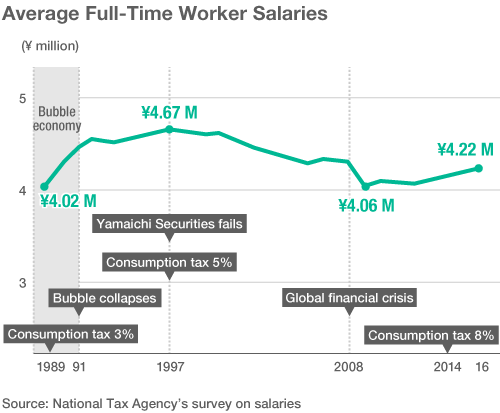
This was a particularly difficult change for a country used to life-long employment – the results were predictable. More and more young people were forced to stay living with parents for financial reasons, far longer than was culturally normal at the time. This lack of financial freedom for Japan’s adult youth caused an economic domino effect.
- By restricting graduate job opportunities and salaries, young people who were forced to live with their parents didn’t date as much. Why date seriously if there’s no money to get married?
- If you can’t afford to get married, why move out and buy a home?
- If you don’t have a girlfriend, why buy and maintain a car?
- If you don’t need to buy a house, you definitely don’t need to buy furniture or children's’ clothes or renovate a property.
By financially forcing young adults to stay home an extra 5 years, or 10 years, or more, Japan continues to artificially suspend the adult lives of young people. Young people should be getting married, leaving home, having babies, and spending money like crazy to establish new lives for themselves. However, for many young people, this still isn’t a realistic option and it likely won’t become a realistic option without significant changes to the economic system.
Unfortunately, the very high number of older people in Japan combined with high voting participation by older Japanese citizens has so far, effectively blocked young adults from being able to change a system that is financially rigged against them. And the very high savings rates of older Japanese citizens continues to be a terrible drag on the economy. Rather than being redeployed into the economy, cash is simply hoarded at negative interest rates, further limiting the work opportunities and salaries of employees entering the workforce for the first time.
Now Japan is in a horrible kind of ‘no-money-no-honey’ cycle that only exacerbates Japan’s birthrate problem and ongoing economic issues.

Men were more likely to have had intercourse if they had permanent, full-time employment and lived in cities with more than 1 million inhabitants. Compared to those with the highest incomes, men in the lowest income categories were 10 to 20 times more likely to have no heterosexual experience. — Tokyo University, 2020
The end result of this social experiment-gone-wrong has resulted in 30 years of deflationary pressure, a very low birth rate (adult diapers have outsold baby diapers for years in Japan), and now a falling population, not expected to return to growth until 2050 (if ever).
Placing too much financial burden on a country’s working youth in the middle and in the aftermath of an economic recession is economic malpractice.
The War Generation (aka — the Greatest Generation)
If you’re a Gen Xer like me, you’ll probably remember your grandparents as a little thrifty when compared to later generations. They didn’t use credit cards. In fact, they usually paid cash for everything and rarely took on debt unless absolutely necessary. They never lived beyond their means.
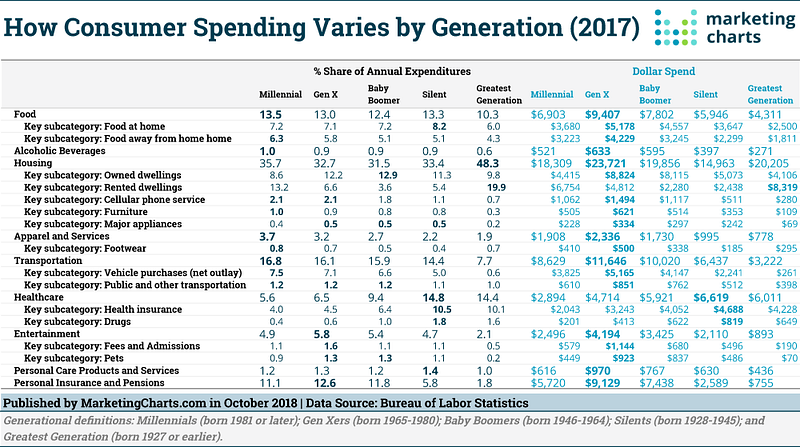
Everyone knows the conventional story about American spending habits. It begins with the Great Depression, which instilled a permanent thrift mentality. Scarred by deprivation, sobered by the scarcity of the war years, Americans in the middle of the 20th century were transformed en masse into tightfisted, financial neurotics, perpetually saving for the next rainy day. — The New York Times Magazine

Today we talk about how the pandemic and the internet is causing major (and perhaps lasting) changes to the way we work and the way we shop. The Great Depression also changed the buying and savings habits of people. For many people, this habit of thrift never completely went away.
As young adults, many people had no choice but to save. They had little choice but to grow gardens and put away money for a ‘rainy day’. In times of such uncertainty, waste was not an option. People often took whatever work was available at whatever salary they were offered. Naturally, the burden fell heavily on the working young of the time during the Great Depression, which in turn led to over half of working youth returning to their childhood homes. By the time the war was over and the economy bounced back, the psychological damage had been done.
Even when faced with better job prospects, plentiful food resources, and a rapidly improving financial situation, many people born in the War Generation never fully lost that saving mentality. Once altered spending patterns become a habit, it can be very difficult to change those habits, even when economic times turn good.
Placing too much financial burden on a country’s youth can have long-term unexpected consequences.
Ideas to consider
The US Federal Reserve claims they are trying to achieve 2+% inflation yet policymakers have no plan to achieve a positive wage-price spiral for young people. How can you achieve stable inflation if the working young you’re counting on for future growth, don’t have growing salaries to spend?
Sky-high student loan debt, sky-high real estate prices, record-low starting salaries, and now millions of entry-level jobs being eliminated due to the pandemic. It’s no wonder so many young people are moving home and gambling their government stimulus cheques in the stock market. I mean, why not, what have they got to lose?
If we are serious about stimulating the world economy back to life, how about not financially destroying our youngest generation of workers? I think it’s time to get much more radical in our thinking.
- First, governments around the world have to get serious and stop bailing out the stock market. Giant corporate bailouts only help the rich and turn otherwise sensible corporations into zombie companies that damage the economy over the long-term. The Bank of Japan has bought over 13% of the Nikkei in an attempt to stimulate the Japanese economy and support stock prices. This policy is a proven failure. Artificially propping up stock prices and piling up massive government debt is no help to future generations.
- Instead, governments need to focus on rent and mortgage protection, emergency unemployment funding, and anything else governments can think of to keep young people in the real economy — preferably working but at least with enough money to keep their independence.
- It’s time to talk seriously about student loan forgiveness. If not now, in the middle of a pandemic, when? Trillions were raised to bail out airlines and cruise line companies who are now turning around and threatening firings if their demands for more bailout money aren’t met. That money has been squandered – sunk cost – it’s gone. If policymakers can burn taxpayer money with no consequence on corporate bailouts, why not at least invest the money in our youth by writing off all student debt?
- We may as well make post-secondary education free too. If we are going to invest in young, hopefully rapidly growing, money spending future generations, let’s help get young people to participate in the real economy sooner. Let’s make education free to at least an undergraduate degree.
- As part of the mostly failed Abenomics economic policy, Prime Minister Abe asked Japanese companies to ‘pretty please’ raise the salaries of workers to help improve demand and achieve inflation in Japan (sound familiar America?). This was mostly met with laughter in corporate board rooms across the country. It’s time for governments to start raising salaries with legislation. I don’t care if it’s universal basic income, a significantly higher minimum wage, and/or strengthening unions. At this point, I’m open to any and all ideas. If you want a stable wage-price spiral to take hold, then it’s time for governments to at least discuss legislation to ensure fair salaries for all workers and a fair tax burden for all corporations.
If this article was helpful for you, please pass it on to someone you care about.